Here's Why Data Enrichment Services Are the Secret to Effective Hyper-Personalization in 2026
Are you certain your customer database tells the true story? Many businesses work with the belief that their customer records are accurate. In most cases, modern databases quickly become outdated. This leaves marketing and sales teams with incomplete or incorrect information. The gap makes it difficult to deliver the tailored interactions that today's buyers expect.
A data enrichment company solves this fundamental problem. By continuously updating and expanding records, these services transform basic contact details into deep customer intelligence. Outsourcing this work provides the foundation you need to build dynamic profiles based on actual buyer behavior and intent. This structured approach lets you treat customers as individuals and deliver relevant experiences that drive substantial growth.
This blog explains how B2B data enrichment creates competitive advantages through complete customer understanding. It also talks about implementation strategies and best practices that bring measurable business results.
Data Enrichment and Its Role in Personalization
Businesses collect large amounts of data. But raw numbers seldom tell the whole story. Organizations cannot deliver experiences that modern buyers expect if their customer database contains only names and email addresses. Data enrichment solves this issue. It converts basic contact lists into comprehensive customer profiles.
What Is Data Enrichment?
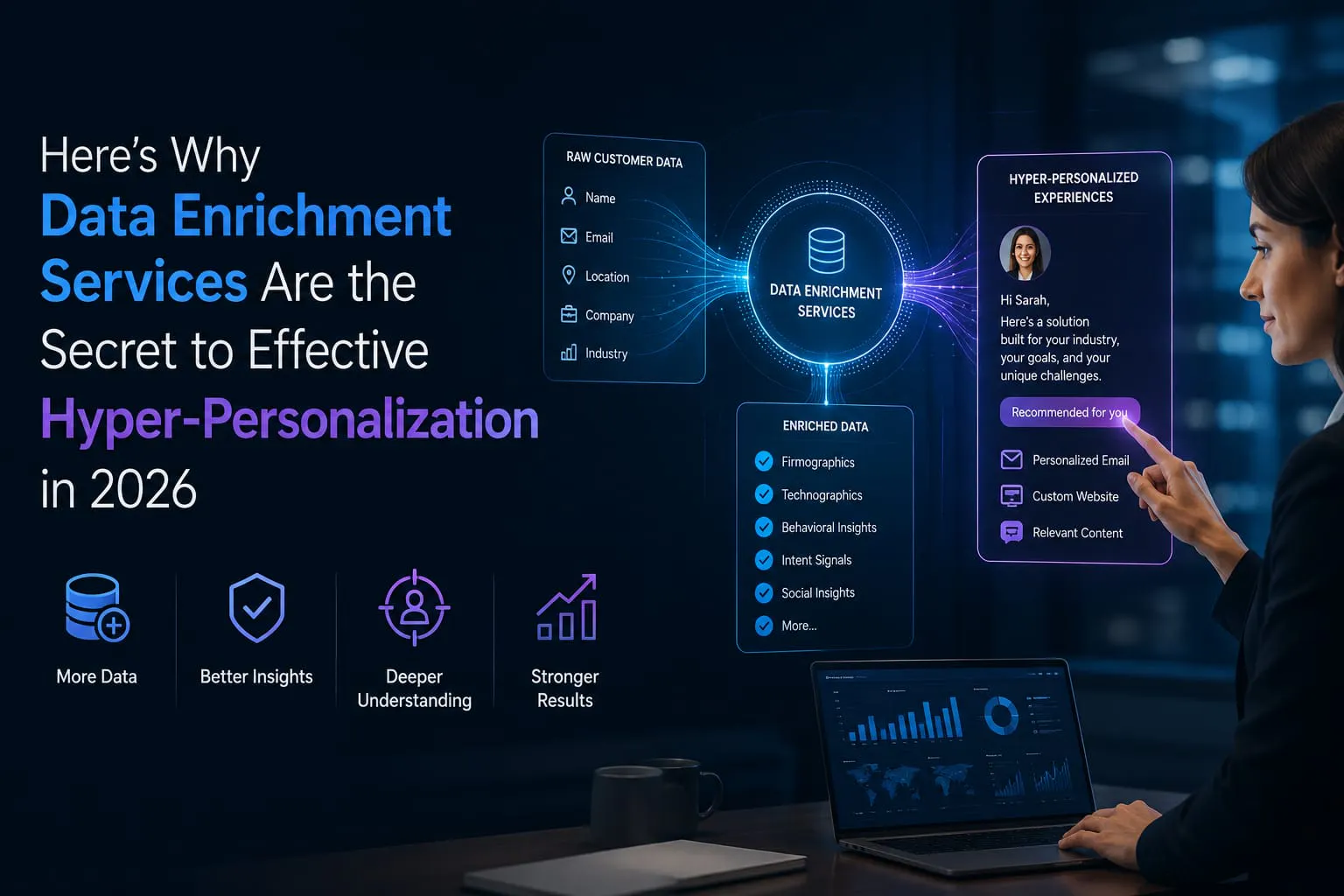
Data enrichment supplements existing datasets with additional information to make them complete and actionable. This process goes beyond simple data collection. It adds vital context and meaning to raw information. That way, a customer record with only a name and email address becomes a complete profile. It shows location, job history, and buying habits.
The process has three main components:
Verification to ensure data remains current and accurate
Supplementation to add missing details
Integration to combine information from various sources
Companies use different enrichment types depending on their needs. Behavioral data enrichment captures customer interactions across products and communication channels. Demographic enrichment adds characteristics such as age, gender, and income. Firmographic enrichment provides company data, including industry, size, and revenue. Geographic enrichment appends location details like physical addresses and coordinates.
Why Traditional Customer Data Falls Short
Traditional databases struggle with the complexity of modern business environments. Earlier, companies relied on structured information stored in databases. They analyzed it through static reports. This approach fails today when data comes from social media, IoT devices, and real-time customer interactions. Historical data and rigid methods cannot adapt fast enough. The world changes too rapidly for yesterday's information to predict tomorrow's reality with precision.
Then, customer data degrades quickly. Information becomes outdated, irrelevant, or factually incorrect easily. This bad data ruins personalization efforts. Businesses target customers with incorrect messages and create unsatisfactory experiences that drive shoppers away.
Many companies struggle with fragmented data scattered across various systems. Creating relevant experiences across all channels becomes impossible without a unified customer view. Speed adds another challenge. Decisions need to happen in seconds, not weeks, but static reports and manual analysis fail to keep up.
The Connection Between Enriched Data and Hyper-Personalization
Enriched data creates the foundation for hyper-personalization. It helps businesses understand the customer well. Their teams can supplement basic information with behavioral patterns and contextual details to build 360-degree customer views. These profiles reveal where customers stand and how to guide them forward.
Personalization delivers measurable results. Brands creating tailored experiences see revenue increases of around 6% to 10% 1. Data enrichment provides the depth needed to classify audiences with precision and create personalized campaigns. Detailed datasets allow precise targeting based on demographics and behavior patterns.
Organizations that outsource data enrichment services get access to continuously updated information. Their records stay accurate even if customers move, switch jobs, or change phone numbers.
Ways Data Enrichment Services Power Hyper-Personalization
Businesses need to deliver personalized experiences to meet a buyer's exact needs at the right time to stand out. Data enrichment makes this happen. It transforms simple and incomplete contact lists into valuable information.
1. Creating Complete Customer Profiles for Tailored Experiences
A data enrichment company turns simple contact records into multidimensional profiles that support advanced segmentation. It allows businesses to break down data silos and enrich customer profiles with hundreds of data points. The process appends contact information, demographic attributes such as age range and household composition, and behavioral signals like browsing patterns. It also adds firmographic details to B2B accounts.
These complete profiles reveal customer needs and interests. They uncover patterns that regular records generally miss.
2. Behavioral Data Enrichment for Accurate Recommendations
Behavioral enrichment captures the signals customers produce through their actions. It adds website visit history, content consumption patterns, email engagement metrics, product usage data, purchase history, and social media activity to their profiles.
Businesses can accurately predict which users are ready to buy based on this behavioral data. They can trigger automatic responses based on real actions. Their teams do not need to make assumptions about what a customer might want. They can offer recommendations using signals users leave behind every time they click, read, or browse.
3. Firmographic Enrichment for B2B Personalization
B2B data enrichment services add company-level attributes to business contact records. This firmographic data includes:
Company size measured by employee count
Annual revenue
Industry classification
Headquarters location
Number of locations
Founding date
Growth rate
Technology stack
This enrichment helps organizations understand the businesses they are selling to. Sales teams can tailor their messaging for each account and industry. This is the foundation of effective account-based marketing. They can adjust prices to match the company’s size. They can also focus on industries delivering the best return.
4. Geographic and Location-Based Personalization
Geographic enrichment adds physical context to customer records. It reinforces location data with precise latitude and longitude coordinates, census tract classifications, and urbanization level. Regional demographics add further detail.
Organizations use this information to determine customer locations using IP addresses and GPS. They can then create location-specific offers and content. They can also run campaigns in different languages.
5. Real-Time Personalization Through Continuous Enrichment
Customer data decays quickly. People switch jobs and move houses. Their email addresses and phone numbers also change. Continuous enrichment fixes this. It cleans and updates records as new information comes in. It adds missing attributes to existing data.
The process feeds up-to-date information into outreach campaigns. Sales teams thus get the latest facts and reach out to leads quickly. Organizations that outsource data enrichment services create workflows that spot gaps in data and trigger enrichment at optimal moments.
Implementing Data Enrichment Services in Your Business
Quality data forms the foundation of successful campaigns. But keeping information accurate becomes tough as your customer databases grow larger. Businesses can create automated enrichment workflows and link them with their existing tools to make data a powerful growth driver.
1. When to Consider Outsourced Data Enrichment
Bad data hurts businesses. It leads to loss of sales and valuable time. Old CRM records cause failed deliveries and bounced emails. Teams waste hours fixing errors instead of serving customers.
Companies should work with external partners when managing this information internally becomes costly and time-consuming. Outsourcing saves money on recruitment and training. It also reduces overhead on office space and utilities.
A data enrichment company uses advanced AI tools and machine learning algorithms to close gaps in business databases. These experts follow strict quality checks that are hard to maintain internally.
2. Building Automated Enrichment Workflows
Automation transforms data enrichment. Organizations can set up workflows to update their records automatically. They can use three approaches:
Real-Time Updates: The system enriches new customer records when they enter the database.
Scheduled Refreshes: The system updates current contacts at set intervals.
Manual Triggers: Teams can manually run an enrichment check on specific account segments when needed.
3. Integrating with Your CRM and Marketing Tools
Integration allows data enrichment to work smoothly. Organizations must connect enrichment platforms to CRM and marketing tools through careful field mapping and permission controls. They must use APIs to automate data transfer between these systems. That way, they can update CRM records and run highly personalized campaigns without manual input.
Here’s how this process works:
[Customer Fills a Short Form]
▼
[API Searches Trusted Databases]
▼
[Data is Validated and Verified]
▼
[CRM Fields Populate Instantly]
First, a user fills in a form to provide an email address. The enrichment platform matches this address against trusted databases. It verifies this information and then fills the right fields in the CRM. This process takes seconds and happens immediately as records arrive.
4. Measuring the Impact on Your Personalization Efforts
Organizations need to measure the success of their data enrichment investments and personalization efforts. They can do so by tracking improvements in conversion rates and average deal size.
An easy way to get the return on investment is through this formula:
ROI = {Financial Gains from Enrichment - Enrichment Costs} \ {Enrichment Costs} * 100
Businesses should also study the impact of enriched data on sales velocity. Speed is critical in sales. Teams acting on enriched data within the first hour of getting a buying signal generate much more revenue pipeline than those who wait 24 to 72 hours to hand off leads.
Best Practices for B2B Data Enrichment
Businesses need best practices to keep their information clean and up-to-date. Implementing structured validation processes and automated data refreshes makes their databases accurate and compliant.
1. Maintaining Data Quality and Accuracy
Enriched data loses value when its accuracy drops. Organizations must create processes with strong checks to keep poor-quality data out of their systems. Regular audits identify errors before they impact key business decisions.
Businesses that work with external vendors need to verify their data against reliable sources. They should ask how frequently they refresh their records and request sample datasets before signing a deal.
Also, data rules and formats need to be uniform across all files. Datasets should be regularly updated to keep them relevant.
2. Ensuring Regulatory Compliance
GDPR and CCPA protect customer privacy. Businesses should follow these laws when handling data. They must disclose how customer data gets used and keep all records on secure storage systems. This proves especially important in regulated industries like healthcare and finance.
Organizations remain responsible for compliance, even if they work with an outside vendor to enrich their records. For this reason, they should partner only with verified providers who show documented proof that they acquire data legally. They must also sign data processing agreements that clearly define responsibilities.
3. Balancing Automation with Human Validation
Automated enrichment makes work faster, but still needs people to oversee the results. Users should regularly review enriched fields and fix mistakes when required.
Businesses need policies for training users on interpreting enriched data and examining patterns where software usually fails. They should rely on human reviewers to make complex judgment calls, such as identifying cultural contexts. Creating systems where humans spot mistakes and then feed corrections into the software to improve its accuracy also helps.
Conclusion
Data enrichment services transform incomplete customer records into useful information that powers hyper-personalization. Organizations that supplement contact data with behavioral and firmographic details achieve revenue growth while reducing marketing expenses. Smart businesses start with pilot enrichment projects on smaller datasets and establish automated workflows. They partner with verified providers who understand compliance requirements well. These capabilities help them build the foundation for tailored experiences that customers expect today.

