Hershey's Candy Business Failed Multiple times to be NOW.🍫
Hershey's Candy Business Failed Multiple times to be NOW.🍫
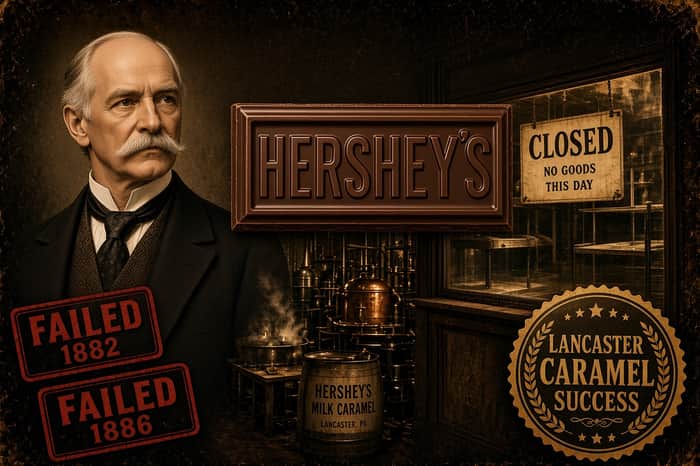
In 1876, Milton Hershey opened his first candy business in Philadelphia at nineteen years old, after spending four years learning the confectionery trade. His mother and aunt pitched in to help, but no amount of hard work generated enough cash flow. After six years of struggling, the business went bankrupt in 1882.
Hershey didn't stop. He headed to Denver, worked for another confectioner, and learned how to make caramels using fresh milk — a technique that would matter enormously later (small detail, huge payoff down the line lol). He tried again in New York, and that business showed some early promise before cash-flow problems caught up with it too, failing by 1886.
He returned to Lancaster with almost nothing. Even some relatives had stopped believing in him. He started again anyway, this time focused entirely on milk caramels, founding the Lancaster Caramel Company in 1886.
The early months stayed rough. Banks were reluctant to lend him money given his track record of failures. Then a British candy importer placed a large order, and a bank cashier personally backed the loan needed to buy ingredients. Hershey delivered, got paid, and the business finally took off. 🍬
Within a few years, Lancaster Caramel had grown into a major operation. Hershey saw another opportunity after watching chocolate-making machinery demonstrated at the 1893 World's Columbian Exposition, and in 1894 he established the Hershey Chocolate Company as a subsidiary. By 1900, he sold Lancaster Caramel for $1 million and kept the chocolate business — the decision that eventually became the foundation of Hershey as it's known today.
Three lessons worth pulling from this:
-
Failure can teach you the business
Hershey didn't just lose money. He learned about customers, suppliers, cash flow, products, and manufacturing through years of repeated failure. -
The breakthrough can come from something learned during failure
His experience making milk caramels in Denver became part of the foundation for everything that came after. -
Don't confuse a failed business with a failed entrepreneur
His first business failed. Then a second. His third major confectionery venture is the one that finally succeeded.
The takeaway:
Sometimes the first attempt is tuition. The second is experience. The third is where everything finally clicks. Every attempt doesn't need to work — it just needs to teach you something.
What's your version of Hershey's "Denver detour" — a stop along the way that taught you the one skill everything else was built on?
That's exactly what I amplify..
Solving real audio related problems in your business..
👉 santelmomusic.com
#entrepreneurship #businesslessons #miltonhershey #hershey #failure #innovation #audioproduction #startups #resilience

The detail that gets skipped when this story is told as persistence is what he was doing between the failures. He went to Denver and worked for another confectioner, and that is where he picked up the fresh milk caramel method the whole later business rests on. So the failures were not merely survived, each one was funded by working for somebody else and left him with a specific technique he did not have before. That is a different lesson than keep going. Plenty of people repeat the same attempt with the same skills and call it persistence. Worth separating the part that compounds from the part that is only endurance.