Hi IH — quick update. The MVP is live.
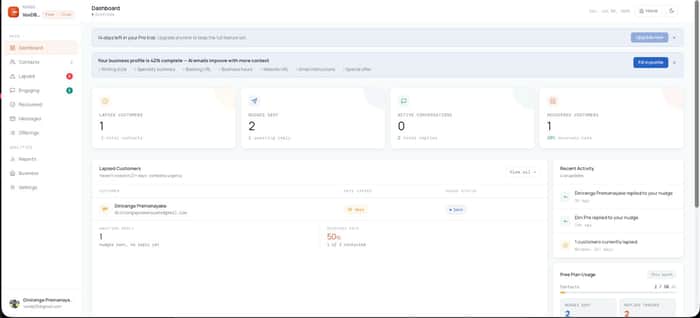
Back in March I said MVP in 60 days. It took closer to 95. Here's what actually shipped and what I learned.
What I built:
Nudge ( staging.usenudge.io ) watches your customer list, spots who hasn't been back in a while, and sends them a personalised re-engagement email automatically.
The AI knows their actual visit history, what services they got, your brand voice, and your pricing (if you opt in). It doesn't invent facts. If it can't ground a claim in your real data, it throws it out and retries.
No templates. No "Hi [Name], we miss you."
What's different from my March plan:
I underestimated the prompt engineering side. Getting the AI to write emails that sound like you - not like a chatbot - took real work. I ended up building a fact-grounding validator that rejects any generated email containing a price, service name, or staff member that doesn't match your actual data. That alone took 2 extra weeks.
Worth it.
Where things stand:
- MVP live at staging.usenudge.io
- Free tier, no credit card
What I need:
The first 10 service businesses to actually use it. Salons, barbershops, yoga studios, gyms — anyone with repeat customers they're not following up with. Free access, I just want real feedback.
If that's you, or you know someone -> drop a comment or reply here.
Still posting real numbers and honest mistakes as I go.

Diniranga, I think the bigger risk now is not the emails.
It's getting feedback from the wrong businesses.
A salon owner who logs in once and says "looks good" is very different from a salon owner who actually has dormant customers worth winning back.
For the first 10 users, I'd be less focused on service businesses broadly and more focused on businesses that already know repeat visits drive revenue but are not consistently following up.
The reason is that you'll learn much faster whether Nudge is solving a retention problem or just generating interesting emails.
The first-10-user acquisition path feels more important than the next product feature right now. Happy to put the tighter version in writing if useful.
That makes a lot of sense and I agree the risk isn’t the quality of the emails, it’s getting feedback from businesses that don’t actually feel a real retention problem.
I’ll narrow the first 10 users to businesses that already understand the value of repeat visits but aren’t consistently following up, so the feedback is tied to real dormant customers and real outcomes, not just surface level reactions.
I agree that who we onboard first will teach us far more than adding another feature right now.
Exactly.
The danger is that the first 10 users can make Nudge look validated even if they were never the right businesses to test retention in the first place.
I’d make the next step very narrow: define which businesses are most likely to have dormant customers, repeat-visit economics, and enough lost revenue to care now.
Drop your email and I’ll send over a tighter first-10-user path in writing instead of stretching it out in the thread.
The "false validation" risk is real - 10 happy businesses that never had a real retention problem would tell me nothing useful.
Would love the tighter path. Dropping my email: dinirangapremanayake@gmail.com
Sent you a note by email. Main thing is avoiding false validation from businesses that like Nudge but do not actually have a repeat-visit problem.
The fact-grounding validator is the part that stands out to me. A lot of AI email tools can sound polished while still getting small facts wrong — old prices, outdated services, or details that are no longer true. Putting a hard sanity check around real business data feels like a strong differentiator.
One thing I’d watch with the first few salon users: trust can break fast if the first automated email feels off. A “review before send” mode for the first couple of campaigns might help owners catch tone or data issues without disabling the whole thing.
Also curious how you’ll handle data freshness. Visit history is useful, but whether that history is still relevant after 90+ days feels like a harder product problem.
Nice progress — the 95-day timeline and validator both feel very real.
Huge congrats on hitting deploy! Spending 95 days in the trenches is no joke, but getting a version out that you are proud of is a massive milestone.I really resonated with diniranga's comment about drawing a line to avoid over-engineering. I’m currently at the end of Day 2 of building LinkCover xyz (a micro-SaaS to generate Open Graph images in 3 seconds so shared links don't look completely naked).My stats are exactly 0 users and $0 MRR, and I almost fell into the exact same trap today. I spent hours trying to make heavy layout libraries and WASM pipelines work on Cloudflare Workers before hitting a wall with environmental constraints. I had to force myself to stop, strip the code to the absolute bone, and pivot to a raw SVG template string generator. It has zero dependencies, but it's lightning-fast.
Breaking through the tech constraints to keep an MVP actually 'minimal' is the hardest part of the early phase. For your email validation system, did you build the fact-grounding engine from scratch, or did you lean on an external open-source framework?
Built from scratch. We looked at heavier NLP and entailment frameworks early on, but the failure modes that actually matter in production turned out to be pretty blunt - the kind of hallucinations that hurt users aren't subtle reasoning errors, they're concrete invented facts. A lightweight custom validator with zero extra dependencies handles those reliably and stays fast.
The bigger lesson was resisting the urge to build for the sophisticated failure mode when the simple one is what's actually breaking things. Sounds like you hit the same wall - the WASM pipeline was the impressive answer to a question your users weren't asking. The raw SVG generator is the right answer to the one they were.
That instinct to strip back and ship something that actually works is harder to maintain than it sounds, especially when the complex version is right there and almost working.
Congrats on getting the MVP out the door!
The fact grounding validator is a really interesting touch. Most AI-generated outreach falls apart when it starts inventing details, so solving that seems like a worthwhile investment.
Curious what was the biggest surprise after getting it in front of real users compared to what you expected while building?
Thanks! The grounding validator was a "must-have before we ship" call - early runs had the AI inventing services and prices that didn't exist, which would've killed trust fast.
Biggest surprise: data quality dominates everything. The best prompt still produces generic emails if the business hasn't logged visits or filled in their catalog. The real product challenge turned out to be owner onboarding, not the AI itself.
This comment was deleted 3 months ago
The fact-grounding validator is the right hill to die on, a re-engagement email that invents a price or service burns trust faster than silence. I've seen founders pair tools like Customer.io or Loops with a ScoresPulse style pulse first, just to learn which dormant users are quiet because they forgot vs because the service actually missed. imo the next unlock is asking reactivated customers what line got them to come back, that gives you a tighter wedge than open rates.
Agreed , a hallucinated price kills trust faster than silence, hence the validator being non-negotiable.
The pulse-first idea is interesting, we do use open/reply state to shape follow-up sequences but a softer "still interested?" touchpoint before the full flow is worth testing.
And yeah, direct attribution from reactivated customers beats open rates every time. That's going on the roadmap.
This comment was deleted 3 months ago
The "sounds like you, not a chatbot" part is the real battle with AI email tools. I went the other way, I don't have AI write my emails, I just got faster at writing them myself. I built DictaFlow for exactly that: hold a hotkey, speak, and it types. The email still sounds like me because, well, I actually said it. Less prompt engineering, more just talking. Respect for shipping Nudge though, 95 days is still ahead of most.
Totally valid approach , if you're writing your own emails, owning the voice entirely makes sense. Nudge is for any small business sending hundreds of reactivation emails a month who can't dictate each one. Different problem. Respect for shipping DictaFlow too.
Congrats on getting the MVP live.
What's your main goal for the next 30 days: feedback, users, or revenue?
users and feedback. But if I had to pick what matters most right now, it's feedback from real businesses. I want to get Nudge in front of actual salons, gyms, any other small businesses and hear what resonates, what's confusing, and what they'd actually pay for. Users without feedback is just vanity at this stage.
Shipped > perfect. 95 days with a grounded AI that doesn't hallucinate is worth more than 60 days with one that does. What's the first signal that told you it was actually working for a real customer?
Love that framing!
Still onboarding my first pilots, so no "real customer" signal yet. But the one I'm watching for: a business owner reads a Nudge-generated email and goes "wait, how did it know that?" - because it's pulling from their actual customer visit history, not templates.
That moment of surprise is what I'm building toward. 😄
Sounds great, mate! Good luck with it.
the target businesses, salons, barbershops, yoga studios, gyms, all share the same distribution problem. they don't read IH, they're not on Product Hunt, and the owner is cutting hair or teaching class not scrolling founder forums. curious how you're actually planning to reach them because the first ten users from this post will be easy but the path to the next hundred is a completely different sales motion than anything that works in this community
You're right , salons and gyms aren't on IH or Product Hunt. The owner is cutting hair, not reading founder forums. So the first 10 from this post are a gift, not a strategy.
The real distribution is offline - walking in, building trust face to face, showing the product on their own customer data. That's the motion that scales to the next hundred. Starting local is actually an advantage here, not a limitation.
the walk-in demo motion is right for validation but worth documenting what happens in each conversation even before you have paying users. which objections come up repeatedly, which features they ask about that you haven't built, how they currently handle re-engagement when it does happen. those patterns from the first twenty face to face conversations will shape the product more than anything you can learn from IH feedback and they're hard to reconstruct later if you don't capture them in the moment
This comment was deleted 3 months ago
95 days instead of 60 — sounds familiar.
Building takes longer than planned, always.
I'm Minchul, 57, former construction site manager from Korea.
Built Slash it — an Email Decision OS for busy executives.
Also looking for my first real users right now.
The fact-grounding validator sounds like solid engineering.
Good luck finding your first 10!
Love the story, Minchul, 57, former construction manager now building an Email Decision OS. That's the kind of founder journey IH was made for. Good luck with your first 10 too, hope we both land them soon! 💪
Thank you!
Same boat — let's both land them soon.
Following your journey too. 💪
The fact-grounding validator is the smartest part. Most AI email tools ship a hallucinated price and lose trust on the first bad send. Grounding every claim in real data is what makes auto-send safe.
Exactly this. One hallucinated price or wrong service in an email and the business owner never trusts it again , game over.
That's why grounding every claim in real visit data wasn't optional, it was the whole foundation. Trust is the product, the email is just the output. 😄
Congrats on shipping! What was the biggest thing you cut or changed from your original scope to actually get it out the door?
Thanks! The biggest thing I cut was SMS/WhatsApp as a follow-up channel. It was in the original spec - the idea being that if someone doesn't open the email sequence, a text could close the loop. I had the architecture sketched out.
I pulled it before building a single line.
The reasoning: I didn't actually know if email would convert yet, so I'd be adding maintenance overhead (carrier compliance, opt-outs, number provisioning) to a second channel before proving the first one. Single-channel also forces cleaner writing - you can't lean on "I'll just SMS them if they ignore it."
It's still on the list, but only if real owners ask for it after seeing email results. Classic "do less to learn faster."
Congrats! Ive recommended it to a friend of mine who runs the local café/restaurant. The best of luck!
That means a lot, genuinely. A café or restaurant is a perfect fit — regulars who drift away are usually just busy, not gone, and a well-timed nudge tends to bring them back. Hope your friend finds it useful, and feel free to have them reach out if they hit any questions getting set up!
Congrats on shipping.
A lot of people stay stuck in planning mode, so getting an MVP live is already a big win.
Looking forward to hearing what you learn from your first users.
Thanks! That's exactly the trap I was trying to avoid - I caught myself over engineering the AI prompt pipeline and billing system way past "good enough to test with real users." At some point I just had to draw a line and ship.
Hi, sir.
Profile: https://topstar-ai.github.io
I’d really appreciate the opportunity to connect and promise good benefit to you.
Looking forward to your thoughts.
Best regards.