Hiring is dying. Maybe building your own product isn't such a bad idea anymore?
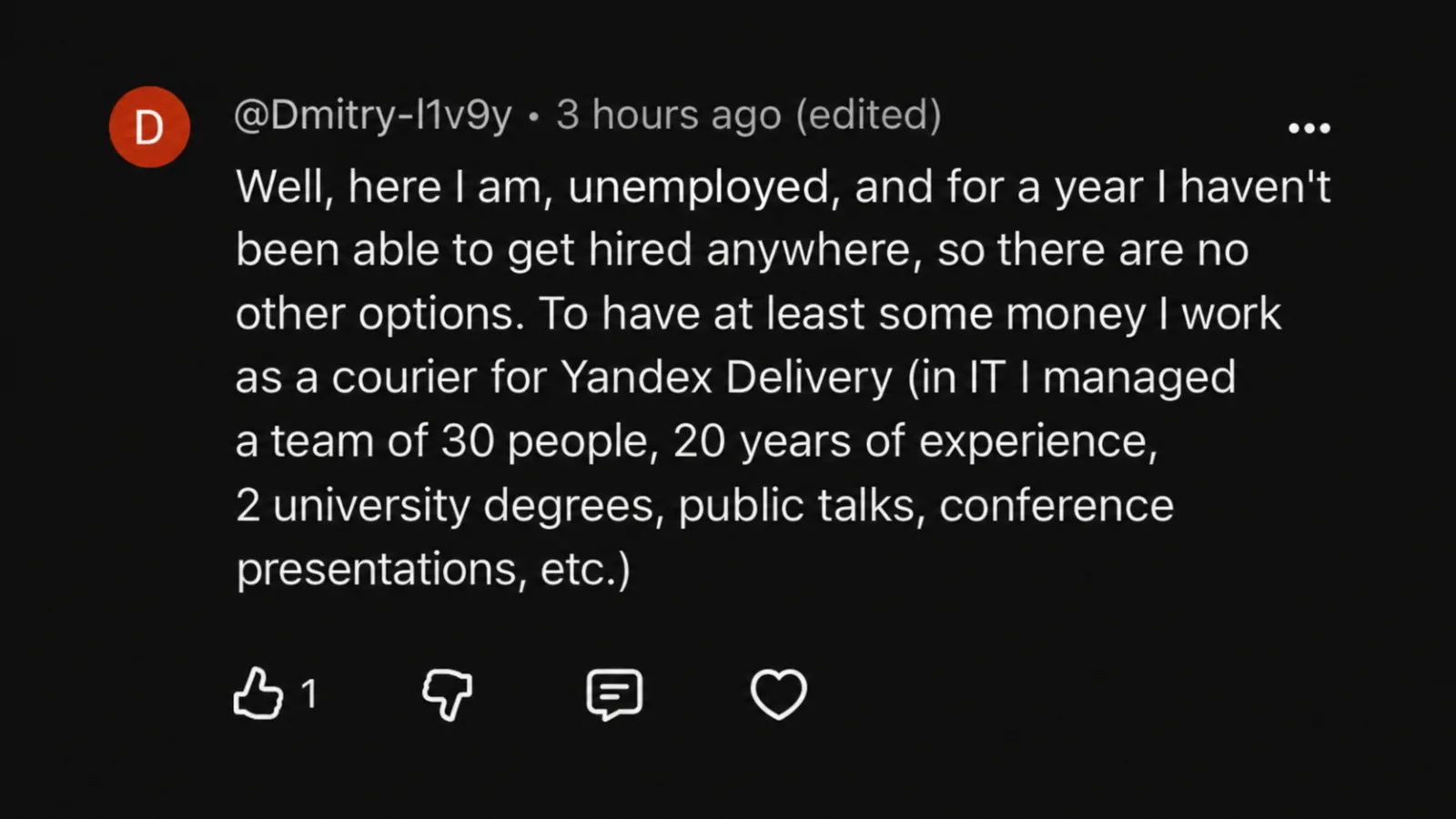
A comment under a video by a Russian tech YouTuber
For the cover of this post I picked a comment from a person who hasn't been able to find a job for a year. Obviously, that's one specific case, and you can't judge the whole market by it. But there are too many stories like this now to keep treating them as exceptions.
Disclaimer
I didn't study any hiring statistics before writing this. Everything below is happening either to me or to people in my immediate circle.
Lately I've been in a strange state. Something between tiredness and burnout. The old world of software development is literally slipping out from under our feet, and the new one hasn't been built yet. You can only guess what it will look like. It's unclear which skills will still be worth anything in a year, how to evaluate your own work now, and where to go next at all.
And the more I look at it, the more often I think: maybe, in the current reality, building your own product isn't as risky an idea as it used to seem.
The middle floor is disappearing
A couple of years ago it was obvious to everyone what a developer's path should look like. You could grow as an engineer, or you could move into management: become a team lead, a manager, the head of several teams. The second path looked like a pretty safe bet. You write less code, work more with people, processes and strategy, and your value to the company only grows.
Now that floor is starting to disappear.
People who moved into management a few years ago are writing code again. Team leads work side by side with regular developers, pick up new AI tools and dust off skills they haven't used in years. If such a manager didn't manage to climb high enough in time to land some juicy assignment, like being in charge of the company's AI transformation, they're in trouble. They'll be fixing bugs alongside the other ditch diggers. The bet on the manager position didn't pay off. Oh well.
But the problem isn't just managers. Programming is getting cheaper fast. So are testing, design, technical writing and editing.
If there's a good design system, a developer can already build ordinary interfaces directly in code.
The same thing is happening with testing. If QA takes the position of "I only test", their place in the company is automatically called into question. A developer is now expected to write the code themselves, check the frontend and the backend, add tests and make sure everything works for real customers. The division of labor is gradually collapsing into one common denominator: the product developer who takes a task in its entirety and drives it to a result.
I was always a frontend developer. Now I do everything: frontend, backend, testing, automation, infrastructure. The only way to stay useful is to not shy away from any kind of work and to not cling to the boundaries of your old role.
Two paths inside a company
If we look specifically at employment, I currently see two more or less clear paths.
First, you can become that universal product developer and try to win these hunger games. Take a task from start to finish, work across different stacks, use AI, quickly find your way around unfamiliar code and close what a small team used to do. Judging by everything, companies will need fewer and fewer of these people too.
The second path seems more promising to me. It's becoming the person who builds the entire AI pipeline inside the company. Introducing processes where a significant part of the work is done automatically. For example, building an automation where a bug gets filed, gets fixed, and at the very end there's just one approval left from that surviving product developer.
There are almost no established patterns here yet. Right now every company is reinventing its own wheel. But it was the same once with CI/CD, monitoring and release processes. Over time, standard approaches appeared. Most likely a separate role will appear too, some kind of AI Ops, who will be responsible for this whole system.
There's more work, but you feel less value in it
This whole transformation puts a lot of psychological pressure on you. On the one hand, with AI you do far more than before. On the other, there's a constant feeling that you're not doing enough.
Before, you could evaluate work more or less clearly: here's the task, here's the code, here are the few days or weeks it took to implement. Now you can generate a huge volume of changes in a day. Then you have to read all of it, check it, fix it, understand this AI-generated code, trace it through. And the feeling that something might break never leaves you. By the evening you're drained, even though it's hard to explain even to yourself what exactly you did all day.
The bar rises together with productivity. If AI lets you do twice as much, after a while that "twice as much" becomes the new normal. The company simply starts expecting more finished tasks from you.
And there's this constant fear that your current level is already not enough and that somewhere in the company there's a person who has set everything up better, works faster and is generally more profitable for the company.
The old contract between a developer and the market no longer looks reliable. It used to seem that if you can write code and you have enough experience, you'll always find a job for, say, 5–6 thousand dollars a month. Against that background, your own project looked like a risky gamble. You could spend several years building something and earn nothing, while right next to you there's clear, stable employment.
Except that stability in this comparison was an axiom. Now it isn't one anymore.
The risks of a job and of your own product are converging
If an experienced specialist can spend a year looking for a job, then your own project no longer looks like such a crazy alternative. In that same year, without serious investment, you can try to reach at least some basic income.
Yes, most likely at first that income will be laughable compared to a developer's salary. But a year of job hunting doesn't guarantee any income at all either.
I started building my own app about a year ago, without leaving my job. Over the last month I made $600 from it. That's not the kind of money you can quit a job for yet, but the number of paying subscribers grows every day, and with it I worry a tiny bit less about my future. Some kind of hope is showing up.
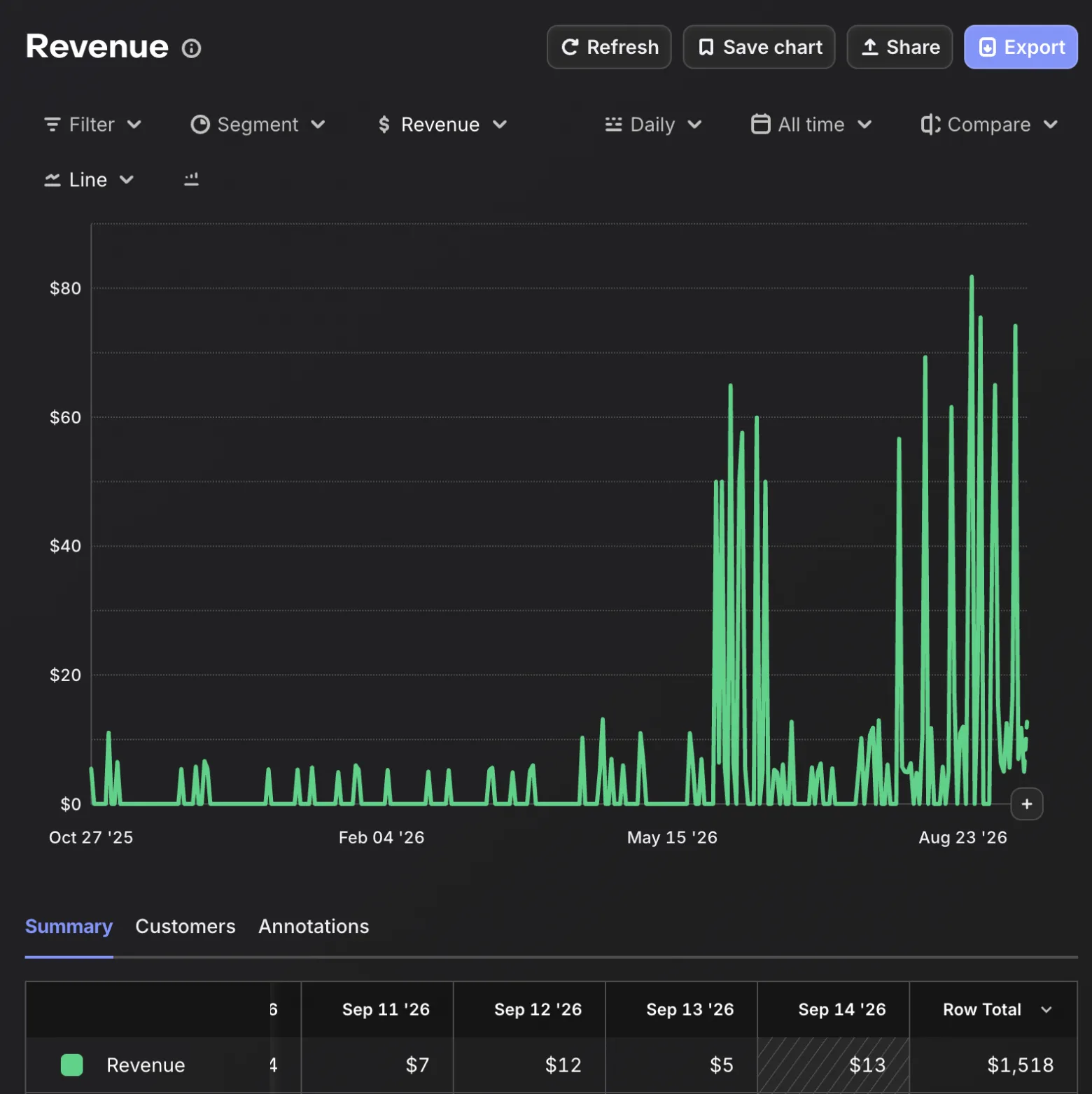
Revenue over the app's entire lifetime
This is important. The chart shows that more or less noticeable money started coming in only this summer. That is, for the first 8 months I was building the app with zero results. I spent all my free time on it, fixed bugs, promoted it. And the first subscriptions were either mine or pity subscriptions from friends who wanted to support me.
This is probably the hardest stage. You've already spent a lot of time, but you still have no proof that the idea will ever bring in money. It's very easy to give up at moments like these.
I don't know how far I'll get with this app. $600 could turn into $6k or more, it's a matter of time. The main thing is that now there's at least a measurable result and some working promotion channels that can simply be amplified and repeated.
In your own project, hours stop equaling money
What I like most isn't even the current income, but the change in the way of thinking itself.
In a job the connection is fairly direct: you give the company a certain amount of time and get a fixed sum. You can get stronger, get promoted or move to another company, but quickly doubling your income is almost impossible. Most of the time you have to go through a long career cycle again.
In your own product the result can be non-linear. Sometimes you spend several days on a new feature and it affects almost nothing. Then you post one short video or change one screen, and the number of subscriptions doubles. That doesn't mean every video will bring in money. Rather, you gradually learn to look for the actions that give a disproportionately large result.
Over the last year I've grown, it seems, more than in several previous years of employment. And not so much in programming. I had to figure out analytics, marketing, monetization, SEO, how the app stores work, talking to users, writing copy and creating content. I haven't felt this kind of growth at work in a long time.
When you build a product yourself, you can't say "another department should handle this". There is no other department. If nobody buys the app, it's not enough to write good code and consider your part of the job done. You have to figure out why people don't get to the payment, what they don't understand, where they drop off, and how to tell them about the product in the first place.
In a sense, it's the same universal product developer, except you're working for your own business rather than someone else's.
You'll have to learn to look stupid for a long time
Your own project has an unpleasant feature: the people around you constantly explain why nobody needs it.
I've lost count of how many times I've heard the question: "Why are you building this app if [insert any similar one] already exists?" I was told it's a copy of one product, then a copy of a second, then a copy of a third. People wrote that the idea is banal, the market is oversaturated, and the feature I built is useless.
Sometimes criticism is useful. Users can point precisely at a problem you don't notice yourself. But most of these comments don't help improve the product. People simply compare your early version with a company that has existed for ten years and conclude that there was no point in starting.
If you take every comment like that as an objective assessment of the idea, you'll give up very quickly. In the first months you yourself aren't sure you're doing something sensible. Any random person can plant doubt in you with literally one comment.
So here you'll have to break yourself a little. Keep working when the numbers barely grow. Publish content nobody reads. Ship features that don't work out. Admit mistakes, change direction and try again. At the same time you shouldn't ignore feedback, but you also can't let every commenter decide the fate of the project.
This is probably one of the main entrepreneurial skills: looking, for long enough, like a person who's busy with some nonsense.
So is your own product still riskier than a job, or not anymore?
I don't want to conclude that all developers need to quit urgently and launch a startup. I myself don't yet have a product that could feed me instead of a salary. I keep working my job and I understand how hard it is to get your own project even to its first stable money.
But the risk ratio itself has changed.
Before, we compared an almost guaranteed salary with a small probability of success for your own project. Now, on one side there's a market where entire roles are disappearing, requirements are growing, teams are shrinking and the rules of the game keep changing. On the other side there's still a risky product, but modern tools let one person do what used to require a team.
In a job you can try to become the last universal developer who can do everything and withstand the growing load. You can take the place of the person who automates everyone else's work and builds AI processes inside the company. Both paths look reasonable, and I myself keep moving in that direction (just in case).
But there's a third option: use the same tools to build something of your own. Not wait for yet another company to decide how much it needs you, but go find users yourself and build a product for them. Or grow your own audience and become the person people follow because he's showing a working path through all this chaos.
The probability of success here is still low. But the probability of calmly working the next ten years in one familiar role doesn't look high anymore either.
And if before my own product looked to me like giving up stability for a potentially big payoff, now I see it differently. Maybe there's no stability left in any of the options. It's just that in your own project you at least keep a chance to build something that belongs to you, grows with your effort and one day lets you earn not five thousand dollars a month, but significantly more.
That's no guarantee, of course. You could even say it's just risk diversification, if you do everything in parallel.
The app I'm talking about is VibeLing, a vocabulary app for learning foreign words and phrases. If you're curious how it's going, I'm happy to answer questions in the comments.
