Hitting $1M ARR in two years and working four hours per day
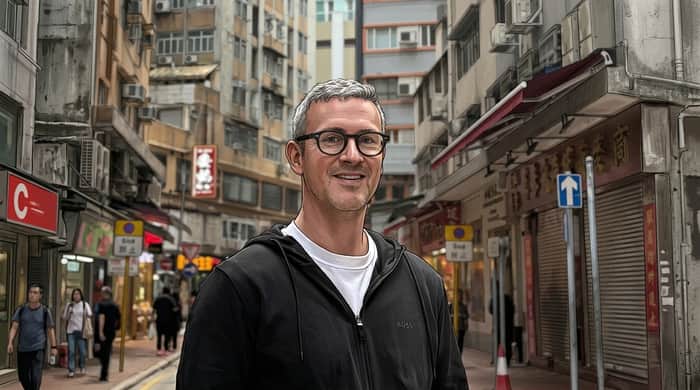
Aurélien Amacker runs a business with 3 million users and a team of 90 — and he only works four hours a day. He's never taken a dollar in funding for systeme.io, so he builds it on his own terms. And, as he says, "Growth is a means, not an objective."
Here's Aurélien on how he does it. 👇
A backwards path
I'm Aurélien Amacker, founder of systeme.io. I'm French, based in Lisbon. My path into software was backwards — I never set out to build a SaaS company.
In my twenties, I quit a corporate job, started a blog, and made a living selling online courses about building an online business. That's where I ran into the real problem: running even a simple online business required duct-taping together a landing page builder, an email tool, a membership platform, an affiliate tool, and a checkout. Five subscriptions, five logins, and many things quietly breaking in between. I eventually paid a developer to build a small internal tool for my business. It worked so well that I decided to turn it into a product.
systeme.io is an all-in-one platform for online entrepreneurs: sales funnels, email marketing, online courses, affiliate programs, e-commerce, and automations, all in a single account. We launched in April 2018. In October 2019, I did the math and realized we reached $70k MRR; by the end of our second year, we crossed $1M in ARR. And we currently have over 3 million accounts.
We achieved this bootstrapped, with no outside funding, no paid acquisition, a tiny distributed team, and a founder who couldn't code. Today, we are around 90 people.
Viewing SaaS as an investment
The courses that I was selling provided me with something most first-time SaaS founders lack: cash. I viewed it as an investment decision. Everyone around me invested in real estate, but I had no edge in that market. I was just another buyer with no particular insight, competing against full-time professionals. In software, I had an edge: I knew this exact market because I was the market, understood the flaws in existing tools, and had an audience to whom I could sell. Investing my money where I had domain expertise seemed obviously better than investing it where I had none.
It cost more than I expected. My first contractors proved a dead end, resulting in roughly a year lost with nothing usable. They could not deliver, and I took twelve months to fully accept it. I lost about $30k and, much worse, a year of my life with nothing usable. At one point they even took my email list and promoted a course to my own subscribers without asking me. I still paid them what I owed. As a parting gift, the agency's founder told me my idea was worthless and would never work.
So after a year, I had no product, no usable code, and no idea what to do next. I was close to giving up. Instead, I went to Upwork and started testing freelance developers one at a time. Most were like the agency: lots of confidence, very little delivery. Then, I found one developer who was different. When he told me something, he did it. That sounds like a low bar, but after a year of the opposite, it was everything. I also noticed something telling: other developers were slightly afraid of him and made excuses around him. He actually knew what he was doing.
I decided to trust him, and that decision is why systeme.io exists. He helped me hire a second and then a third developer. That team of three built the initial product in about a year. The timeline was the same as the agency's, with a fraction of the drama, and this time we had something real.
In total, I spent around $200k of my own money to bring systeme.io to break even. No investors, no loans. If it hadn't worked, the money would have been lost.
Its survivability stemmed from not validating in the dark. I already had an audience of people building online businesses, knew what they paid for and complained about, and could present the product to them the day it existed. This differs from market research. It's closer to building a tool for yourself and discovering thousands of others share the same problem.
Symfony talking to Java
We started with PHP and Symfony. That was the pragmatic choice at the time: my first developer knew it well, it was easy to hire for, and it let three people build a lot of product quickly. Most of the original platform — the funnel builder, email sending, courses, checkout — still runs on that foundation today.
As we grew, we moved to Java for the newer modules. The reason wasn't fashion. Some parts of an all-in-one platform are much heavier than others, particularly anything that processes large volumes in the background, and we wanted something built for that kind of load. So the architecture progressively split: the older core in Symfony, newer services in Java, talking to each other rather than one monolith doing everything.
A business model that bets against the market
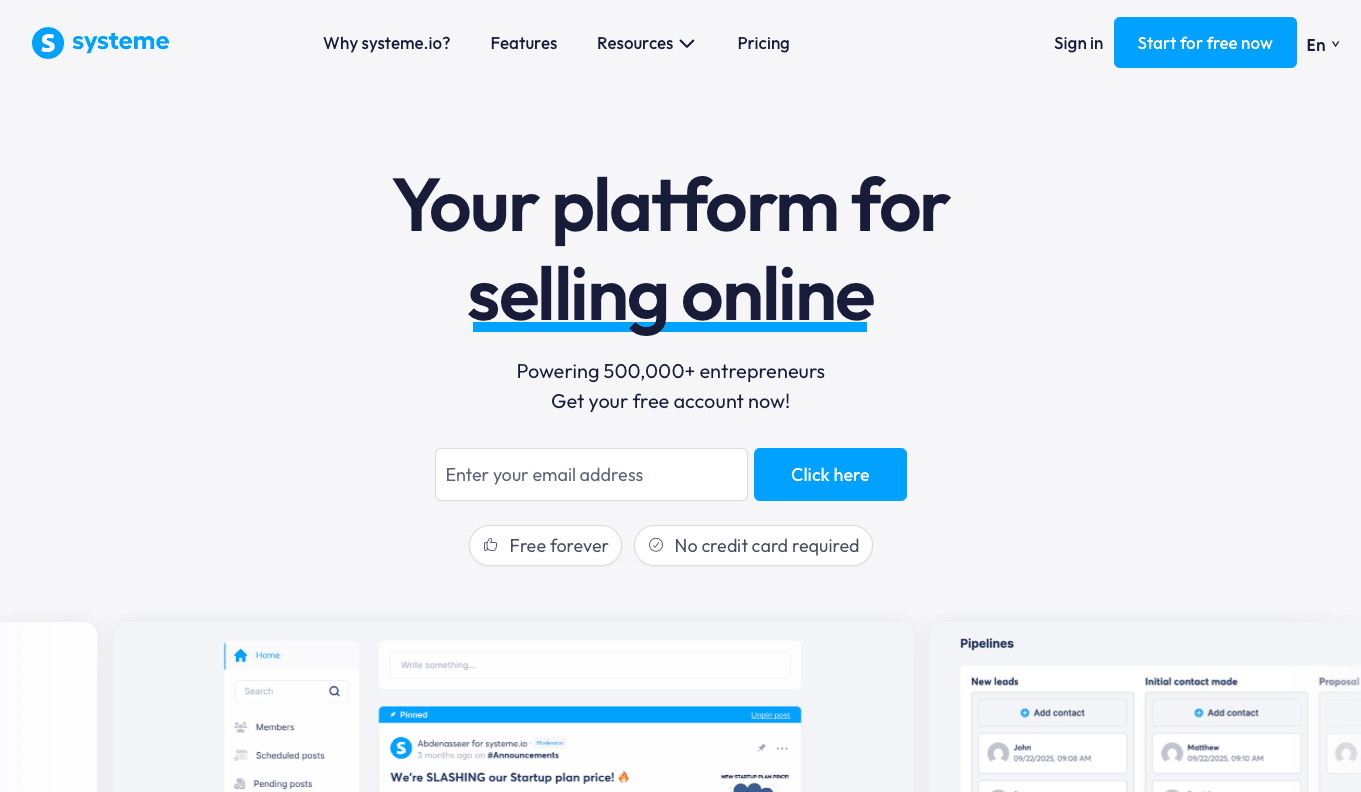
We bet against the market. Instead of selling to agencies and marketing teams for $300/month, we targeted beginners — those launching their first offer — with a genuinely free plan and paid plans starting at $17. That constraint shaped everything: no add-ons, no upsells to unlock basic features, no pricing that punishes list growth. It also meant we needed to be radically simpler than the competition because our users weren't marketing operators; they were people selling their first ebook.
The free plan is not a trial with a countdown; it's a real product for running a small business. While expensive to support, it's also our best acquisition channel because people who start free and succeed tend to tell others.
Last year, we surprised people by cutting the price of our entry paid plan from $27 to $17 per month. This directly impacts short-term revenue, and no competitive pressure forced us to do it. We did it because our core mission is to enable as many people as possible to launch an online business, and $10 per month is a real barrier before you make your first sale. Being bootstrapped makes such a decision possible. Nobody needed to approve a temporary dip in revenue in exchange for a larger top of funnel and a mission we truly believe in.
Revenue expansion stems almost entirely from customer success rather than from extracting more per account. Plans are tiered by usage, mainly by contact count; customers whose businesses grow move up on their own. Nobody at systeme.io sells them anything. This aligns us with our users: we make more money when they do, and if they stagnate, we don't. Annual plans are the other lever; they cost customers less per month and provide us with upfront cash.
On the cost side, being bootstrapped shaped every decision. We employ around 90 people, are fully remote, hire talent wherever it is rather than in expensive cities, and have never had a sales team. Margins on a subscription product with no field sales and no paid acquisition are very good, and we have been profitable for years. That profitability allowed us to spend a year of engineering time on the white-label offer, where any customer can resell the entire platform under their own brand and keep 100% of the revenue, included free in their subscription. That decision cost us short-term growth, and no board asked me to justify it.
Word of mouth and affiliates
As far as growth, I'd spent years building an audience of people trying to start online businesses, selling them courses, and answering their questions. When the product was finally ready in April 2018, I launched to that list and got around 400 paying customers. That's a very unfair advantage. I solved the hardest part of a SaaS launch — finding the first few hundred people who trust you enough to give you their credit card — before I wrote a line of code. Not because I planned it, but because I'd spent five years in the same market.
After that, word of mouth and our affiliate program generated almost everything. These two are hard to separate because the affiliate program is simply word of mouth that we pay for. We started at 40% commission, raised it to 50%, and today we pay 60% recurring for the lifetime of the customer.
That last number represents our entire strategy, and it's worth explaining why we keep increasing it rather than decreasing it. Most companies treat affiliate commission as a cost to optimize. We treat it as our entire acquisition budget. We don't run ads. We don't have a sales team. So, instead of paying Facebook to interrupt strangers, we pay our own users generously, forever, for bringing us customers who already trust them. A 60% lifetime commission sounds insane until you compare it to a paid acquisition cost that buys a customer with no recommendation attached. And it's self-reinforcing in a way ads never are: our users build online businesses, our product includes an affiliate tool, so we ask them to do what we teach them to do. Some of them make a full-time income promoting us.
Content and SEO in multiple languages serve as our other quiet channel. We sell worldwide, and we invested early in translating the product and content. This made us the obvious all-in-one platform in several markets where nobody competed in the local language.
This worked so well, for so long, that we barely built anything else. When one channel gives you 30 to 50% growth every year without much effort, there's no forcing function to learn paid acquisition or build a real marketing team. Then growth slows, and you discover you have one muscle, and it's the only one. I'm fixing that now by building actual in-house marketing capability. If I could go back, I'd have started that three years earlier, while the affiliate flywheel was still masking the problem.
My advice, however, is the opposite of "diversify early." Find the one channel that fits your product structurally and push it much further than feels reasonable. For us, that meant raising commissions three times instead of protecting margin. Most people spread themselves across five channels, doing all of them badly. Go all-in on the one where you have an unfair advantage, then build the second channel before you need it.
Be suspicious of the consensus
This might be contrarian, but not being plugged in has helped me most. I know almost no other SaaS founders. I have one entrepreneur friend who built his own SaaS over the years and is very successful now, and that's it. A few years ago, in Lisbon, I met the CEO of a company that competes with us, and she asked me if I had entrepreneurs to introduce her to. I thought for a moment and realized I couldn't name anyone. I didn't have a network.
I don't think that held us back, and I now see it as an advantage. Instead, I consume a lot: podcasts, books, biographies of entrepreneurs. Not tactics for this quarter, more like general culture about how businesses get built and how people who built them think. Andrew Warner's Mixergy first put SaaS in my head, years before I acted on it. Long-form content from people who built something teaches you more than a conference conversation, and it doesn't cost you a week.
A network's downside is inheriting its consensus. When you spend your time around other founders, you chase the same things at the same time, because everyone is anxious about the same things. Being in my cave means our roadmap comes from our users and what frustrates me as an operator, not from what everyone in a group chat has decided matters this year.
The clearest example is AI. We were late, and part of that was a trade-off; we spent a year of engineering on the white-label offer instead. But part of it was deliberate: I wanted to see whether the tools were good before rebuilding our product around them. The early ones weren't. Enormous noise surrounded capabilities that didn't survive contact with real users, and many companies shipped AI features that were essentially marketing. Waiting cost us some ground, and I'm catching up now, but we're building on tools that work rather than on a demo.
I recommend protecting your attention. Read widely, follow your customers closely, and be suspicious of anything everyone in your industry agrees about simultaneously.
The combo he'd run if he were starting over today
I had two advantages most people don't: an audience and a problem I lived with daily. That created the opportunity. But if I were starting from zero today, here's what I'd do, and it's not what people want to hear.
Talk to potential customers. Get on calls. Try to sell. That's it, and almost nobody does it because it's uncomfortable, unlike building. Writing code or setting up a landing page feels like progress, and nobody rejects you while you're doing it. A sales call can end with someone telling you your idea is pointless. So people avoid the only activity that provides real information.
Push it as far as taking money. Try to presell. If you can't deliver, refund them; that's not the end of the world, and it's a far cheaper way to discover you were wrong than six months of building. Payment is the only meaningful validation. Compliments are free. If you can't get money yet, the next best signal is several different people independently describing the same pain and showing interest in the same solution. Not one enthusiastic person, but several who don't know each other.
Then use AI to build a prototype.
That's the combo I'd run today: real conversations with real people, ideally from those who have paid, plus a working prototype in front of them as fast as possible. Today's tools make prototyping accessible to non-coders, which was simply not true when I started.
From there, you have two paths. Either keep scaling it yourself, or find a technical cofounder who can build the product properly, still using AI, but with an architecture that supports thousands of users. The prototype gets you to validation. It doesn't get you to a business.
Building your product quietly in a corner and then trying to sell it doesn't work. That's the default failure mode, and it's too risky.
Growth is a means, not an objective
In the short term, my goal is AI. We're shipping our MCP server and an AI chat inside the product so users can run their funnels, emails, and courses by prompting instead of clicking. What I'm most excited about is the internal side: using these tools to make our team dramatically more productive. We can now build things that were not possible eighteen months ago, and after a year of catching up, I'm enjoying that part a lot.
Beyond that, my goals are not what people expect from a founder answering this question. I work about four hours a day. I have a balanced life. I train every day, and I cook dinner for my family almost every evening, which is a genuine hobby rather than a chore. I live in Lisbon with my kids. That's not a phase I'm passing through on the way to something more intense. It's the point.
I have no interest in building an enormous company that goes public. I have no interest in dealing with investors, board meetings, or having to justify a decision like cutting our entry plan price or giving away white label for free. Those are exactly the decisions that made systeme.io what it is, and they only happened because nobody could stop me.
So the goal is boring, and I'm fine with that: a profitable company that keeps creating real value for our customers, run by a team of people I like working with, that lets all of us have a life outside of it. If I can keep adding value and keep enjoying the work, that's the whole ambition. Growth is a means, not the objective.
Follow along
You can create a free account at systeme.io, no credit card, and the free plan is a real product rather than a countdown timer.
Otherwise, I'm on X. Happy to answer questions there, and I'll keep an eye on the comments here too.

Leave a Comment