Hitting $40k+ MRR with bottom-of-funnel content until AI search forced her to change tactics

Cecilia Razak built a tool to facilitate remote work at her previous business. She then launched it as Slides With Friends and grew it to $40k+ MRR via word of mouth and bottom-of-funnel content. But now, AI search is affecting her traffic, and she's recalibrating with new tactics.
Here's Cecilia on how she's doing it. 👇
$40k+ MRR and two young kids
I started in academia, then worked at branding and marketing agencies, but I've been running my own tech startups for about a decade now. In that time, I've brought companies from an initial idea to about $60k MRR a few times.
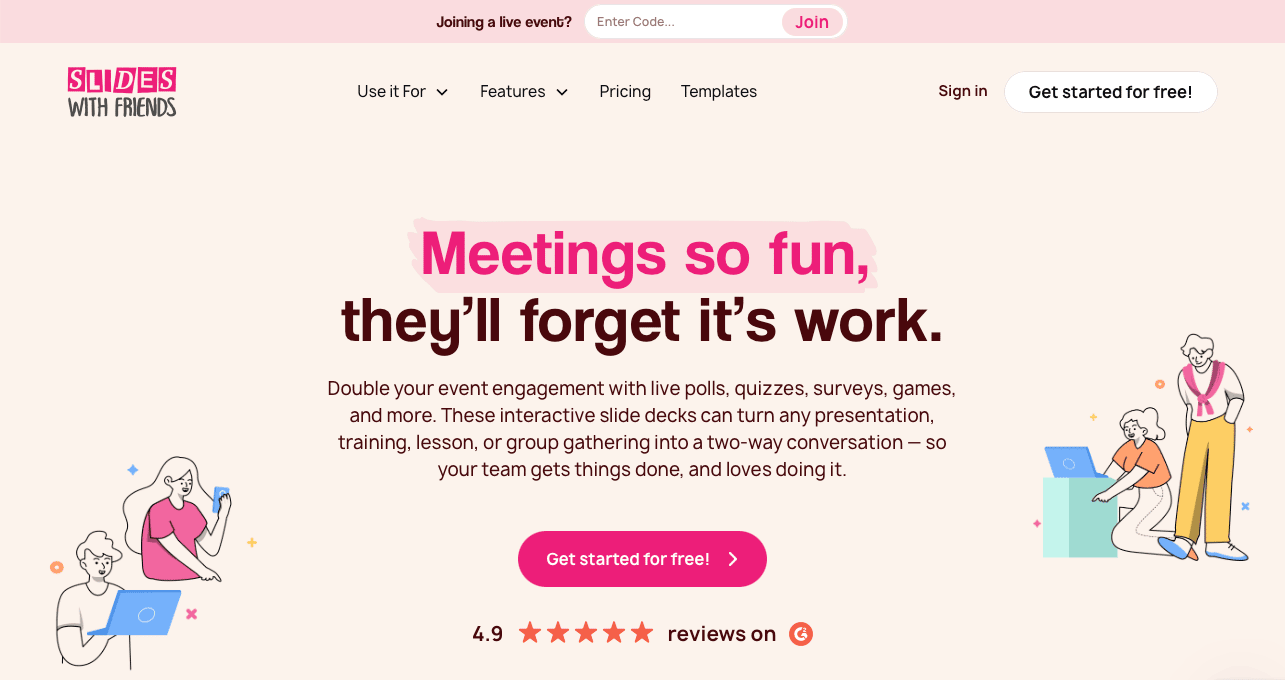
My cofounder and I work on Slides With Friends. It's an interactive presentation tool, launched in 2020. I don't share revenue publicly anymore, but we crossed $40k MRR in 2024.
I'm also recently postpartum and raising two young kids. Life is busy and full for me these days!
Building for her other business
Slides With Friends launched during the pandemic, a time of profound disconnection.
Like most useful tools, it arose from a need our own business had at the time: to facilitate connective teamwork like meetings, reviewing material, assessing, and playing.
We needed a tool that made gathering and engaging large groups easy, fun, and accessible for everyone — regardless of location. And we needed a way to onboard and train new team members.
So, Slides With Friends grew out of a different business's experience during quarantine.
Needs, experience, and time
Building an initial product that led to paying users was possible and quicker for us, with the help of three key elements:
A clearly defined need that we could fulfill not only for ourselves, but also for other users and businesses: running meetings with employee feedback and assessment.
SaaS business experience: We both previously ran companies and built software.
Time: With the pandemic, we could focus on this build because our other business slowed considerably.
My cofounder and I spent long hours talking about what would perfect the experience, what people wanted, why they wanted it, and how to make it all salable.
A product that lends itself to freemium
We're a subscription model, and we price by the seat. Most of our users are self-serve individuals, and we secure larger ACV contracts with orgs and enterprises through higher-touch sales. Our margins are typical-SaaS-excellent; the main costs are payroll and servers.
We started charging when we had an MVP and a sales website. The first paying user that we didn't know — always a very exciting moment — gave us $48 for unlimited annual access. This occurred after the tool had been live for a couple of months, with friends and users we had reached out to already using and paying us. At that point, we also had a few strong blog posts up.
We have a product that lends itself well to freemium: it's an interactive presentation tool. Users market it to their group when they use it, because their whole group experiences that "aha moment" during their live event. We therefore offer a robust freemium tier that lets people host unlimited live events. The more events, the more marketing they do for us.
Iterating on growth
We did a lot of wheel-spinning before we honed in on effective growth strategies. For example, we tried Product Hunt launches. But it didn't take off until we did two things.
First, we had to understand our Ideal Customer Profile (ICP) in extreme detail: What problems did we solve, and who was willing to pay for that solution?
Then, we had to target our ICP with:
Bottom-of-the-funnel, buying-intent blog content
Word of mouth, which worked well because our tool is a group event platform
In the beginning, organic search was our strongest channel and, also being one of our bailiwicks, yielded fast growth. Now, we still get enough traffic for good leads, but the recent shifts in the AI search landscape caused revenue to fall.
We are moving the needle back up again by focusing on higher LTV sales to inbound, qualified ICPs. AI sorts these leads to determine their potential value based on parameters like email address, onboarding details provided, product-qualifying activities, etc.
We iterate and adapt as we go.
Time and churn
One of the aspects of our particular industry is that it's novelty-biased, meaning we get some churn after annual subscriptions expire. As a result, we expanded into more business use cases, which offer longer staying power.
If I were to start over, I might position us this way from the start — less toy, more tool.
Time is my other challenge. It's the real golden value, and I have so little of it right now that I am hypervigilant about where I spend it. I think it would have been a good idea to pause more fully while having babies — trying to do both has been hard.
Unfair advantages
I would not be here today without all the help, luck, and perseverance I've been blessed with. First, my cofounder, who is also my husband, drives ideas and possesses true business and technical talent. His dedication to learning, adapting, and finding paths forward is our special sauce.
Past funding launched us to where we are now — I couldn't do this as I am without those angels.
I also have childcare and family help. I couldn't do this without help, especially with young kids at this stage of my life — if you can, I am impressed by you and hope you are doing okay!
In terms of books, I like the Buddhists, the Stoics, and systems thinkers. The last good book I read was A Swim in a Pond in a Lake.
My main quality is a drive to just keep going. You can just do things, you know.
Do your own thinking
Here's my advice.
Think about others before yourself. This helps you understand a need well enough to create a custom solution and sell it. If you start from "I want to be an entrepreneur," you lack direction. If you start from "Here's a problem I understand that others also have — what do they need, how can I help them?" — you gain business direction.
Oh, and don't use AI to give you ideas or strategy — it makes things muddy, and can only recycle from its training data, which is not a good recipe for "new" or sparks of genius. Use it for research and task completion; this is where it shines. It's like having a very dedicated, but not big-picture-understanding, first-time intern. Do your own thinking.
What's next?
From here, I want to grow to around $1M ARR, then sell, start something new, and spend more time with my kids. I'll do that by increasing ACV contract sales. And by hiring a salesperson once we solidify that process.
I don't have any socials anymore. They eat time and mindshare — and you have to tend and cultivate what gets your mindshare. But you can check out slideswith.com.

Leave a Comment
Awesome case study! The built-in viral loop of interactive presentations—where every live event doubles as a product demo for attendees—is product-led growth at its finest. Wishing you the best as you scale toward $1M ARR!
Huge respect for sharing the reality of postpartum founder life alongside building a $40k+ MRR business. Moving away from low-ACV, high-churn self-serve use cases toward enterprise/org-level contracts is the absolute right play.
Also, love your take on AI: treated as a task-oriented intern rather than a source for strategy. Congrats on the consistent growth
Huge respect for sharing the reality of postpartum founder life alongside building a $40k+ MRR business. Moving away from low-ACV, high-churn self-serve use cases toward enterprise/org-level contracts is the absolute right play.
Also, love your take on AI: treated as a task-oriented intern rather than a source for strategy. Congrats on the consistent growth
The shift from "toy to tool" is such an underrated piece of advice here. When you build something highly interactive or event-based, it’s easy to get caught up in the engagement metrics and miss the actual enterprise utility. Transitioning that positioning to focus heavily on long-term business use cases is exactly how you beat the novelty-bias churn. Really appreciated the candid takeaway on ICP alignment.
This is incredibly valuable. Seeing the $40K+ MRR journey laid out like this is inspiring.
The "toy vs tool" shift really resonates. Building my API product (ModelBridge), I've been going through the same realization — starting as a side project that made multi-model access easier, but the real retention comes from being "production-grade infrastructure."
Also, the AI search traffic change hits close to home. AI makes information more accessible, but it also makes "just blogging" harder to reach users. Are you seeing a strategic shift from PLG toward SLG with the higher-ACV enterprise focus?
thrrh
gd