Hitting a $5M+ ARR and selling for
$35M

Noah Tucker worked in e-commerce until he built the solution to his biggest pain point. Now, Social Snowball is bringing in a high-seven-figure ARR.
Here's Noah on how he did it. 👇
Finding the problem
I worked in e-commerce and used plenty of influencer and affiliate tools. Most were very outdated, and none had the functionality I was looking for. After years of frustration, I decided to build my own.
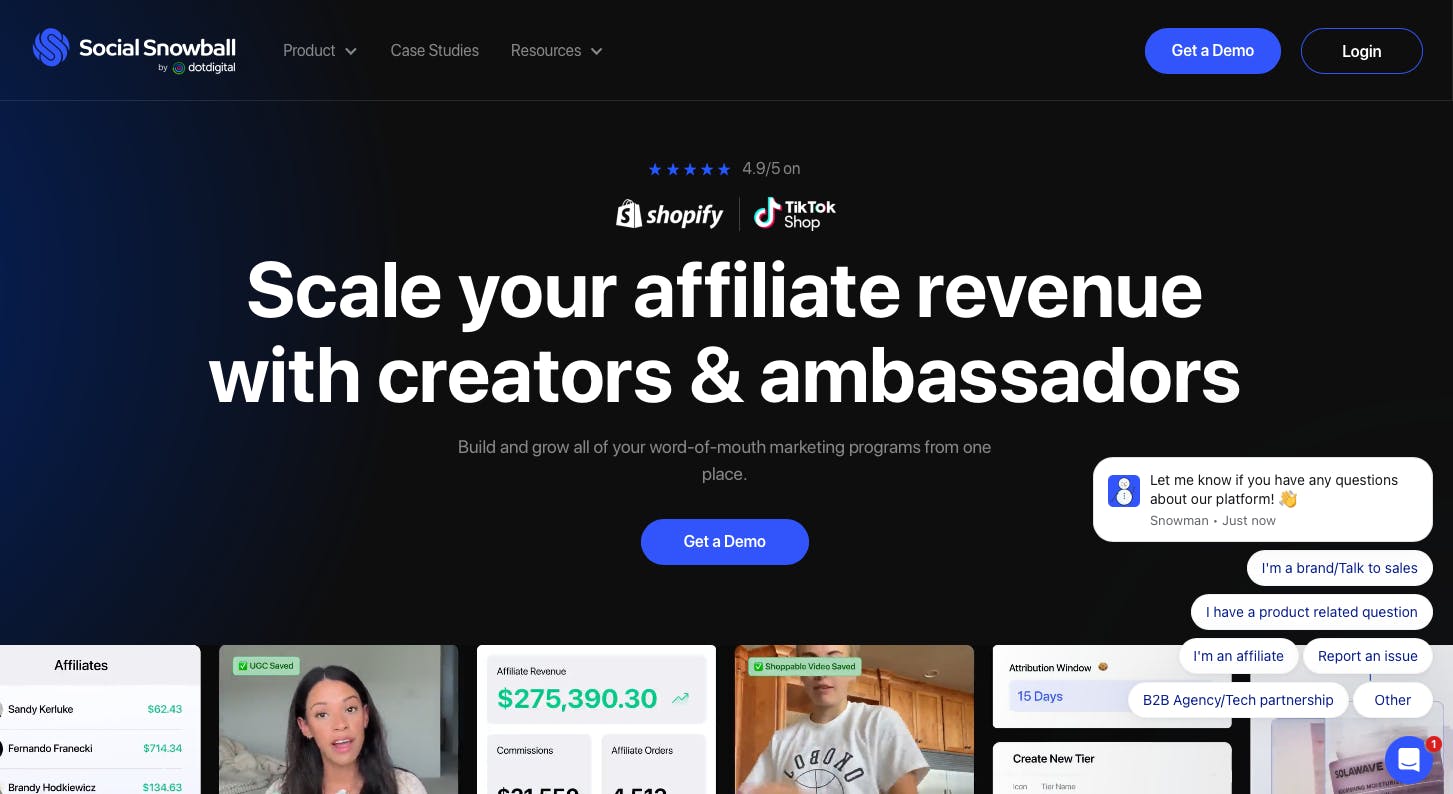
And that became Social Snowball, a B2B SaaS platform that helps e-commerce brands manage and grow their creator and affiliate partnerships.
We are currently between $5M and $10M ARR, and Dotdigital Group acquired us over the summer for $35M.
Contracting the right engineer
I am non-technical, so I worked with a dev agency for v1.0. That proved disastrous. I wasted a ton of time.
They kept making timeline promises they couldn't keep. What was supposed to be a 3-month project turned into 15 months — and at the end of it, I was left with a broken app.
After that, I hired engineers from Upwork until I found a freelancer good enough to get an MVP off the ground.
Even though, we eventually built it, I'd say that not having a technical cofounder was my biggest setback. I wasted multiple years trying to find the right engineering leadership. We'd likely be way further ahead today if I'd had that from the beginning.
Hiring on LinkedIn
Speaking of hiring, I've have had a ton of success hiring from LinkedIn. I look for people who have already worked in the exact role I'm hiring for at a similar — but larger — company. And I reach out to them.
That's where I make most of my hires these days.
A three-pronged approach to growth
We've grown revenue by increasing pricing as the product has matured and by growing our user base. Our biggest channels for the latter have been:
Content marketing: Educational content around influencer marketing in the form of ebooks, webinars, video courses, newsletter, podcast, etc
In-person events: Everything from small dinners and happy hours to major conferences where we get a booth and speak on stage
Agency partnerships: We have a program and dedicated team for our agency partners. We incentivize them to refer their clients to Social Snowball and we refer brands to them as well.
Keep customer feedback top of mind
Here's my advice: Launch with the simplest MVP possible. Then, obsess over feedback from your initial paying customers.
This feedback should guide your roadmap and help you build a product with strong product-market fit.
The product you think you will build vs what you actually build from user feedback is often quite different. Don't lose sight of your big vision, but keep customer feedback top of mind for all product decisions.
What's next?
Since we've already been acquired, my goal is to keep growing the business and one day start another.
You can follow along on LinkedIn. And check out Social Snowball.

Leave a Comment
Love how honest this is — especially the dev agency lesson. 15 months for a broken v1 is brutal, but pushing through that says a lot.
Big takeaway: obsessing over customer feedback and hiring people who’ve already done the job at a bigger company. Simple, but powerful.
Congrats on building to $5–10M ARR and the $35M exit — seriously impressive 👏🚀
100%. Learning fast is a real superpower in this space
The $35M number is interesting when you look at it from Dotdigital's side rather than Noah's.
Dotdigital is a marketing automation platform serving mid-market e-commerce brands. Social Snowball's customers are almost exactly their ICP — same buyer, same stack, complementary problem. The acquisition isn't really about the affiliate software. It's about acquiring a qualified pipeline of accounts that are one upsell conversation away from expanding into Dotdigital's core product.
That's why the multiple holds up even if 3-7x sounds steep for a point solution. The calculation isn't just "buy the ARR" — it's "buy the customer base and the distribution channel into e-commerce brands we want anyway."
This is the pattern in most B2B martech acquisitions: the acquirer is paying for the ICP overlap as much as the product itself. The ARR is collateral.
The $35M exit at $5-10M ARR implies roughly a 5-7x ARR multiple — strong for bootstrapped B2B SaaS, but the multiple makes more sense when you look at the acquirer: Dotdigital is an email/marketing automation platform that needed a creator and affiliate layer to stay competitive against Klaviyo and Attentive. Social Snowball wasn't just a revenue acquisition — it was a capability acquisition that plugs directly into Dotdigital's existing e-commerce customer base. That strategic fit is what compresses a typical earnout negotiation.
The origin story is textbook scratch-your-own-itch but with the key ingredient that gets skipped over: Noah worked in e-commerce long enough to know the buyer, the workflow, and why the existing tools were wrong. That's not just an insight — it's a sales and product moat. You can build the right features without customer discovery calls because you are the customer.
The dev agency lesson (15 months for a broken v1) is one every non-technical founder eventually learns. The fix is usually "hire one senior engineer instead of an agency" but Upwork works too if you have the ability to spec tightly.
Creator/affiliate as a core commerce channel is only growing — TikTok Shop, the collapse of Meta ROAS, Shopify's ecosystem push toward social commerce. The market timing here was as important as the product. Congrats on the outcome, Noah.
Hey!
I noticed your checkout flow doesn't have a 'Save' logic. I'm building a tool that automates this for an 11% performance fee. Want to be our first Beta tester?
The biggest advantage of choosing the right team. The importance of working with the right people in every job.
Is there anyone who need help with laravel ?
Massive congrats, Noah—$35M exit from solving your own e-comm pain point is the dream! Love the honesty on the dev agency nightmare and going Upwork for MVP. Inspiring for non-tech founders like me grinding a niche SaaS right now. What's one growth lever (content, events, agencies) you'd double down on hardest if restarting today? 🚀
How long did it take you to feel confident about your startup’s positioning, and would you pay for a tool that helped you get there in under an hour?
The dev agency lesson hits hard. Everyone who's built something non-technical has a version of this story , 3 months becoming 15 months with nothing to show. The real insight here is that the problem found Noah, not the other way around. Built from genuine frustration, not a market opportunity spreadsheet. That's usually where the best products come from. Congrats on the exit! 🚀
The dev agency disaster is the most honest part of this post, and probably the most useful. 15 months for a broken v1 is brutal, but what makes it instructive is that it's not a rare edge case. Agencies optimize for signing contracts, not for shipping. Non-technical founders are the easiest targets because they can't audit the work in progress.
The real lesson isn't "don't use agencies." It's that without someone technical who's accountable to the outcome, not just the invoice, you're flying blind on the most critical part of the business.
The three growth channels are also worth studying because they're unsexy in the best way. Content, in-person events, agency partnerships. No growth hacks, no viral loops. Just repeatable channels that compound over time.
Impressive scale. When you were between $0–$5k MRR, what actually moved the needle most — distribution or product improvements?
How long did it take you to feel confident about your startup’s positioning, and would you pay for a tool that helped you get there in under an hour?
Fantastic idea in building a product to solve your own pain points. There are probably many other people in the market who have similar problems looking for a solution. Great job!!
How long did it take you to feel confident about your startup’s positioning, and would you pay for a tool that helped you get there in under an hour?
This is such a useful breakdown — seeing the transition from $5M ARR to a $35M exit gives real perspective on what actually moves growth levers. 🙌
One pattern I keep noticing with SaaS that stalls between early traction and scaled exit is not a product problem — it’s a messaging & clarity problem.
Most visitors don’t intend to bounce — they just never quite understand the value in the first few seconds and quietly click away. It’s subtle, but it’s revenue leaking one visitor at a time.
I do async funnel clarity audits for SaaS founders — I map out where messaging confuses buyers, where conversion blocks happen, and what tweaks actually move needle — all for $150 in easy‑to‑read notes + visuals (no calls).
If any fellow founders want a second set of eyes on their landing pages, happy to point out 3 quick wins I often see missed.
Thanks for sharing this — exit insights like this are 🔥
Great read. This is what strong founder execution looks like: solve a problem you’ve lived, ship a simple MVP, listen obsessively to customers, and scale through repeatable channels. Also appreciate the honest lesson on engineering hiring, it probably saved a lot of founders' years. 👏
good point about hiring from linkedin. looks like that's the best place for everything related to professional work.
Preach! Inspiring story of what I'm sure most of us would dream to achieve. I like the idea of keeping focus on the customer and the real feedback driving the development. I am guilty of growing attached to things I've made and having a hard time rethinking it without tearing down and building new. Making things happen this year! Thanks for the post
As businesses adopt digital payments for flexibility and global reach, the number of businesses accepting cryptocurrency has grown. Cryptocurrency is becoming increasingly accepted as a legitimate payment option.
Clipping Solution Asia is a well-known photo editing services company. Having with the big team, we can control our virtual clients. The company is consisted of 150 plus highly experienced graphics designers. We support our clients them from long ago. So why aren’t you?
Was the $35M outcome driven more by growth rate or strategic fit with the buyer?
This is impressive. Congrats.
Held Bitcoin since 2014. Thought I was careful. I wasn’t.
Met someone online → trust built → introduced to a “platform” offering 10% weekly ROI.
Looked legit. Proofs, screenshots, testimonials.
I invested part of my BTC.
When withdrawing, I was hit with:
processing fees
withdrawal fees
verification fees
Paid them all.
Then got blocked.
Textbook scam structure.
I was mentally wrecked.
Through my cousin, I contacted Hackwest (hackwest at writem dot com). No upfront payment — I did some tasks instead.
Recovered my Bitcoin.
Still unreal.
Posting for awareness, not sympathy:
ROI guarantees = scam
Platforms that charge fees before withdrawal = scam
Romance + crypto = scam
“Proof” screenshots = fake
Trust no one with your keys or investments
Learn from my mistake.
Bitcoin rewards discipline — and punishes trust.
Hitting $5M+ ARR and selling for $35M is a strong milestone that reflects scalable growth, product-market fit, and investor confidence. It shows the business has consistent revenue, a loyal customer base, and sustainable margins. Achieving this level typically requires a clear niche, strong branding, efficient operations, and recurring demand. A successful exit at this valuation highlights strategic positioning, market demand, and long-term value creation built through innovation, leadership, and disciplined execution.
Hi everyone! I help startups improve their websites so they convert more visitors into customers.
If anyone wants feedback on their landing page or user experience, I’m happy to share suggestions. Just send me a message.
$5M ARR and a $35M exit — huge congrats! The part about contracting the wrong dev agency hit close to home. I'm non-technical too (just a designer), and finding the right people to build with is genuinely harder than building itself sometimes.
I'm currently working on FontPreview — a free font testing tool I built mostly myself by learning enough HTML/CSS to be dangerous. But as I think about adding more features, I'm starting to wonder if I need to bring someone else in.
Your LinkedIn hiring approach is interesting. When you reach out to people who've worked at similar companies, what's your message template like? Would love to learn how you approach that conversation without it feeling like a cold pitch.
Congrats again on the exit. Well earned!
WOW! Thanks for sharing. Very relatable!
I especially like how simple and grounded your playbook actually is: ship the simplest MVP you can, obsess over feedback from the first paying customers, and then double down on a few scalable growth channels (content, in‑person events, and agency partnerships) instead of chasing every possible tactic. It’s a great reminder that strong product‑market fit and focused distribution can compound into serious outcomes.
Really relatable story, especially the part about struggling to find the right engineers - that’s something many founders go through. The reminder to launch simple and listen closely to customer feedback is so true. It’s cool to see how consistent execution and partnerships can turn frustration into a real business.
The dev agency disaster (15 months vs 3 promised) is painfully relatable. Non-technical founders get burned by this constantly - agencies overpromise because they're optimizing for signing contracts, not delivering. Finding one good freelancer who actually ships beats a team that can't.
Thanks for amazing story, is this your first startup? Did you use any more complicated systems like a/b testing to achieve better market fit? Again great article 👍
Interesting...
вов оце так мозок зробити дохід в 5 мільйонів та потім продати вот такі люди з розумною головою класні отожби поспілкуватися в живу булоб класно
like the way you word it, effectively, getting feedback is certainly the best way to not lose yourself, trying to over-engineer things, and stay consistent with the main idea and core functionality. Those feedbacks are precious assets and can help build a longer term roadmap, hence bringing steps activable along the way for future releases/features. Congratulations
Interesting with your growth and success through those three approaches.
Greate Decision bro 👏
Really insightful story.
It’s a great reminder that getting to $5M ARR is one thing, but knowing when to sell is a completely different skill.
Hi, i downloaded "FMG_VM64_HV-v7.6.6.M-build3654-FORTINET.out.hyperv", create a new VM in Hyper, create a Disk Drive and bind the extracted "fmg.vhd". Then i started the VM, open Browser and set my Login Details from FortiCloud Account. It looks "licensed" but the VM is noch listed in my Assets? can anybody tell me why?
The biggest takeaway here is the cost of not having technical leadership early.
15 months for v1 + broken delivery is brutal but also common.
Curious in hindsight: would you optimize for a technical cofounder with equity from day 0, or hire a strong founding engineer + fractional CTO earlier?
hmm, intresting
Really appreciate the honesty about the dev agency experience. That part hit.
As a solo founder, I’ve learned that engineering execution risk is massively underestimated — especially when you’re non-technical. Timelines slip quietly, and by the time you realize something’s wrong, you’ve already burned months.
Respect for pushing through that and still getting to $5–10M ARR. That’s serious resilience.
The “simplest MVP possible + obsess over early paying customers” advice is gold. I’m building a small budgeting app right now, and I’ve already noticed the version in my head vs the version shaped by feedback are two different things. The real product is always narrower and clearer.
Also interesting point about hiring from slightly larger companies in the same role — that’s a smart way to shortcut learning.
Out of curiosity, looking back, what’s one early feature you thought would matter that ended up being irrelevant once real customers started using the product?
That’s an incredible milestone, hitting $5M+ ARR and achieving a $35M exit shows strong product-market fit, smart scaling strategy, and excellent execution. Stories like this are great motivation for founders building long-term value. As businesses scale, having reliable tools and systems also becomes critical. For anyone working heavily with tech infrastructure, checking can help avoid performance issues and keep operations running smoothly.
Congrats on the exit, Noah! It should be like a fucking dream, no? The "obsess over feedback" part hits home. I worked with a founder who sold his first SaaS after 18 months of bootstrapping, and what made the difference was systematically collecting feedback from day 1. I've shipped a tool designed for this (Saasfeedback.ai) that can automate that loop (video feedback, surveys, in-app prompts), but the key is making it a habit not an afterthought. Curious: did you have a specific cadence for collecting feedback, or was it more "time to time"?
Stories like this are really motivating. It’s interesting how many successful products start from solving a simple personal problem first...
Can you help me validate this: How long did it take you to feel confident about your startup’s positioning, and would you pay for a tool that helped you get there in under an hour?
Hitting $5M+ ARR and selling for $35M is a strong and realistic exit outcome if your business shows consistent growth, profitability potential, and scalable operations. Buyers typically look for recurring revenue, low churn, strong customer retention, and a clear market position. A 5–8x ARR multiple is common for SaaS and subscription models with solid metrics. Clean financials, proven systems, and a defensible brand significantly increase valuation and attract serious investors or acquirers.
Loved the transparency in sharing both the struggles and the wins. The lesson about hiring the right engineer early really hit — technical leadership from day one makes a huge difference. Thanks for sharing the real journey behind the ARR growth 👏
I am currently working on improving signup security for a SaaS product.
Has anyone here tested SMS OTP verification to reduce fake signups?
Would love to know if it improved user quality.
Really insightful journey. The part about wasting time with the wrong dev agency hits hard — so many founders underestimate how critical the right technical partner is early on. Also love the focus on feedback-driven growth instead of building in isolation. Congrats on the acquisition, and respect for sharing the real lessons behind it, not just the success headline.
Awesome
Noah Tucker built Social Snowball after facing problems with outdated influencer marketing tools and grew it through smart hiring, marketing, and customer feedback.
Thanks for sharing the insight man, nice to see your perception coming from someone following the same path.
The feedback loop is real and valuable. Solve a problem, launch quickly, adapt with feedback. This loop is where the real companies are built and sold.
Incredible journey. It’s rare to see someone be so transparent about the setbacks (like the 15-month dev delay) while still hitting an eight-figure exit. Thanks for sharing the roadmap.
This is incredibly insightful, especially the part about launching simple and letting customer feedback shape the product.
I’m an indie iOS developer, and my most useful lessons came after shipping — not before. I built a sunlight planning app initially for photographers, but early users included architects and homeowners. That completely changed how I thought about positioning and features.
What stood out to me in your story is how critical the right engineering foundation is. As a solo builder, speed of iteration became my biggest advantage — being able to ship, adjust, and improve without coordination overhead.
Looking back, was there a specific moment when customer feedback clearly showed you had real product-market fit?
Man, this hits hard. Years of using outdated tools, then I built your own
5M+ ARR and exit.
I'm 7 months into a similar loop with my Python system monitor
same frustation, same question.
How long did it take you to feel confident about your startup’s positioning, and would you pay for a tool that helped you get there in under an hour?
Thanks for sharing. This is insightful for some of us taking the same path. Congrats
Thanks for sharing this, Noah. The part about contracting the wrong dev agency hit home. I went through the exact same thing building FontPreview – what was supposed to be 3 months turned into 9, and I ended up rebuilding most of it myself. Hearing stories like yours makes me feel less alone in the struggle. Congrats on the acquisition! Afsar
Congrats on the sale. Curious to your approach to growth. Did you trial many methods and just pick three that had the highest return? Was there any other methods you tried that just didn't work at all etc?
This was a great read — really honest and concrete about the journey.
Hitting strong unit economics early seems to make a huge difference in valuation discussions later on.
I’m curious how you balanced focusing on core revenue-driving users versus experimentation during the scaling phases. Did you intentionally limit feature expansion to protect metrics, or were there moments where you pivoted based on customer feedback?
Faisal Movers is one of Pakistan’s leading bus service providers, known for its reliable, safe, and comfortable intercity travel. Founded with the goal of offering high-quality transportation across major cities and remote areas, Faisal Movers has built a strong reputation for punctuality, professional staff, and modern buses equipped with amenities like air conditioning, Wi-Fi, and entertainment systems. The company operates a wide network of routes connecting cities such as Lahore, Islamabad, Karachi, Peshawar, and northern tourist destinations like Naran and Gilgit. Over the years, Faisal Movers has become a preferred choice for travelers seeking convenience, safety, and affordable travel options in Pakistan.
The dev agency disaster is painfully relatable. 3 months turning into 15 months with a broken app — that's the reality nobody talks about when they say "just hire a dev." The hiring strategy from LinkedIn is gold though — finding people who did the exact role at a similar but bigger company. Simple but most founders overcomplicate hiring. And the feedback about launching with the simplest MVP possible is the advice I keep hearing from every founder who actually made it.