Holographic Display Tech Is Changing the Game — Here's What You Need to Know
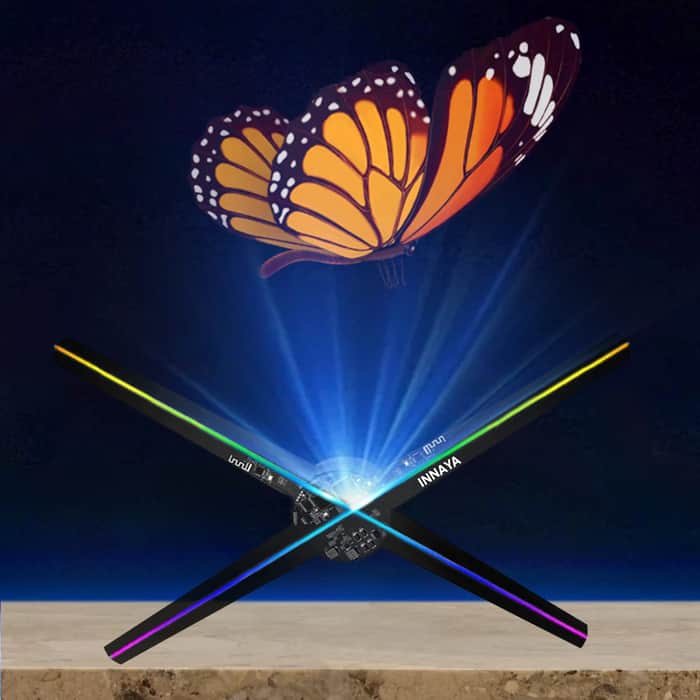
Walk into any high-traffic retail store or packed trade show floor right now and you'll notice something: the booths pulling the biggest crowds are not the ones with the flashiest banners or the loudest music. They're the ones running floating, mid-air visuals that make people stop dead in their tracks and reach for their phones to record. That's the power of modern holographic projection technology — and in 2026, it has never been more accessible or more affordable for independent business owners and brands at every level.
Whether you run a boutique clothing shop on a busy corner or manage marketing for a mid-size company heading into conference season, the two technologies reshaping visual advertising right now are 3D hologram fans fans and precision logo projectors. Both are compact, relatively easy to set up, and produce an outsized visual impact compared to their cost. This piece breaks down how each works, who benefits most, and why pairing them together creates a brand presence your competitors simply can't match with a banner and a folding table.
What Exactly Is a 3D Hologram Fan?
The term "hologram" gets tossed around loosely these days, but the technology inside a modern 3D hologram fan is genuinely impressive. At its core, the device uses a spinning blade fitted with a dense strip of LED lights. When those blades spin at high speed — typically between 700 and 900 RPM — the persistence-of-vision effect tricks the human eye into perceiving a solid, three-dimensional image floating in open air. Load up a rotating product render, an animated logo, or a looping promotional clip, and what people see isn't a screen — it's an object hanging in space.
INNAYA's current lineup covers five distinct form factors, each designed for a specific use case. The H16" model is the entry point: a compact 16-inch unit priced at $107.90 after the current 50% launch discount, built for counter displays, reception desks, or tight retail shelves where you want maximum eye contact without eating into floor space. Step up to the H23" at $359.76 and you get a substantially brighter, larger display suited for storefront windows or mid-size booth builds.
For showrooms and immersive brand activations, the H39" model at $719.40 produces a display arc that reads clearly from fifteen or twenty feet away — the kind of presence that anchors an entire trade show booth. At the top of the range, the H-PRO Lifesize rig at $1,559.64 is designed for multi-fan synchronization, allowing brands to build genuine life-size holographic installations that stop entire event hallways. Rounding out the lineup is the LS Mini desk unit at $155.76, a favorite with content creators and popup vendors who need portability without sacrificing visual punch.
Every model in the INNAYA range ships with WiFi app control, free worldwide shipping, a one-year warranty, and that same 50% launch discount — which makes this an unusually low-risk entry point for businesses testing holographic display for the first time.
The Real-World Business Case for Holographic Display
It is easy to be skeptical of any technology marketed as a game-changer. The honest answer is that 3D hologram fans are not magic — they will not rescue a bad product or replace a coherent marketing strategy. What they do extremely well is solve a specific problem that every physical-location business faces: getting people to slow down.
Foot traffic conversion depends almost entirely on attention. Someone has to notice you before they can decide to engage with you. Static signage has an average glance time measured in fractions of a second. A floating, animated product display draws eyeballs for five, ten, sometimes thirty seconds — enough time for a staff member to initiate a conversation or for a QR code on a nearby stand to get scanned. Retailers who have deployed these units consistently report meaningful lifts in foot traffic and dwell time, and because the WiFi app control lets you swap content without touching the hardware, you can rotate promotions, seasonal offers, and different product showcases on the fly.
Enter the Gobo Projector: A Different Kind of Visual Impact
While a hologram fan creates impact at close to mid range, a quality gobo projector extends your brand's visual reach across distances that no LED display can match. The INNAYA G10 is purpose-built for exactly this role. Priced at $236.31 after the 50% discount, this plug-and-play unit projects your custom logo or graphic in high definition onto floors, walls, sidewalks, and building facades — anywhere within its throw range.
The practical applications are broader than most business owners initially realize. Restaurants use the G10 to cast their logo or a daily special onto the sidewalk outside, turning foot traffic passing twenty or thirty feet away into an audience for their brand. Bars project onto dance floors to reinforce atmosphere. Event production teams use multiple units to brand entire venue spaces without running cable for traditional signage. Retail storefronts project onto the pavement outside their entrance, creating a branded path that literally guides people toward the door.
What sets the G10 apart from cheaper gobo alternatives is the combination of HD lens quality, weatherproof construction, and flexible power configurations — 60W for indoor and close-range outdoor, 110W for longer throws and direct outdoor exposure. The plug-and-play setup means no specialist installation is required, and the unit is designed to run for extended periods without performance degradation. INNAYA backs it with a 12-month warranty and their standard free global shipping.
Pairing Both Technologies: Why the Combination Works
Used independently, both the hologram fan and the gobo projector are strong tools. Used together, they create something more powerful: a layered brand environment that engages potential customers at every stage of their approach. The G10 projector catches attention from a distance — someone crossing the street or walking along a busy block sees your logo illuminated on the pavement or wall and registers your location. As they get closer, the hologram fan in your window or at your booth entrance deepens that engagement, holding their attention long enough to convert curiosity into a conversation or a purchase decision.
This kind of layered visual strategy is exactly what larger retail chains have been deploying for years using expensive custom installations. The difference in 2026 is that INNAYA has made both technologies available at price points that work for independent businesses — a combined investment under $400 can give a small retail operator or event vendor a display presence that reads as genuinely premium.
Getting the Most Out of Your Setup
A few practical considerations will help you maximize results regardless of which technology you deploy. For hologram fans, content quality matters enormously — a poorly rendered animation will undercut the visual impact of even the best hardware. INNAYA recommends working with files specifically optimized for holographic display, with clean black backgrounds and high-contrast animated subjects. Their team can assist with content guidance, and the WiFi app makes uploading and managing content straightforward once you have the files ready.
For gobo projectors, placement angle and distance are the key variables. The G10 manual and INNAYA's support team can walk you through calculating throw distance for your specific environment, and experimenting with floor versus wall projection during your initial setup will quickly reveal which creates more engagement for your particular venue or event layout.
Both products benefit from being refreshed regularly. Rotating hologram content keeps the display novel for repeat customers, and updating your gobo graphic to reflect seasonal promotions or current offers ensures your outdoor projection stays relevant rather than becoming visual wallpaper over time.
The Bigger Picture: Why Visual Innovation Matters in 2026
Advertising budgets are under pressure across the board. Digital ad costs have climbed steeply over the past several years while organic reach on social platforms continues to shrink. For businesses that rely on physical presence — whether that's a permanent retail location, a regular market stall, or a packed calendar of trade shows and events — investment in high-impact physical display technology is increasingly one of the smartest places to put marketing dollars.
The attention economy is real, and in physical spaces the businesses winning are the ones that have figured out how to stop people in their tracks without relying on volume or excess. Holographic fans and precision gobo projection do exactly that. They create moments of genuine visual surprise that override the autopilot most people walk around on in busy commercial environments — and that surprise translates directly into engagement, conversation, and sales.
INNAYA's current launch pricing makes this the right moment to evaluate whether either technology fits your 2026 marketing setup. Given that both units ship free worldwide and carry solid warranty coverage, the barrier to experimentation is lower than it has ever been. The brands that build familiarity with this hardware now will be the ones running it confidently by the time it becomes the expected standard rather than the exception.
