How a Live Ranking Checker Changed My International SEO Strategy
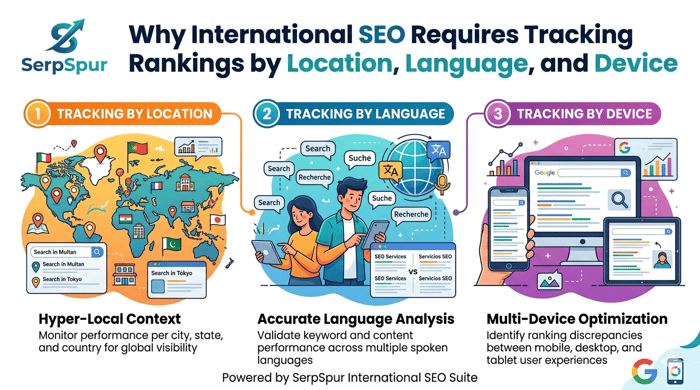
I've spent years working with SEO tools, and one thing always frustrated me: rank tracking never felt truly accurate.
Most tools show you keyword positions from a single perspective. They don't always reflect how users in different countries, languages, or devices actually experience search results. As a result, I often found myself making SEO decisions based on incomplete data.
Recently, I started using a live ranking checker built into SERPSpur, and it completely changed how I approach international SEO.
The Problem with Traditional Rank Tracking
For a long time, I assumed my rankings looked roughly the same everywhere.
I would check a keyword from my location, see where my page ranked, and use that information to guide content updates and optimization efforts.
The reality was very different.
Search engines personalize results based on multiple factors, including:
Geographic location
Device type
Language settings
Search engine variations
Local competition
That means a keyword ranking #8 in one country might rank #3 in another and #15 somewhere else.
Without seeing those differences, you're essentially flying blind.
A Surprising Discovery
While testing rankings across multiple locations, I found something unexpected.
My website's mobile rankings in France were significantly better than desktop rankings.
At first, I assumed it was a reporting error.
After running multiple checks, the pattern remained consistent.
French mobile users were seeing my content higher in search results than desktop users.
That insight immediately changed my strategy.
Instead of focusing entirely on desktop optimization, I started prioritizing:
Mobile user experience
Mobile page speed
Mobile content formatting
Mobile-specific search intent
The result was better engagement and improved performance in a market I hadn't been paying enough attention to.
Why International SEO Requires Better Data
If your audience is spread across different countries, local ranking data becomes essential.
A keyword position in your home country doesn't necessarily reflect how users see your website internationally.
For example:
A page ranking well in the United States may struggle in France.
Mobile rankings may outperform desktop rankings.
Local competitors may dominate specific regions.
Search intent can vary dramatically by language and location.
Understanding these differences allows you to create more targeted SEO strategies.
Features That Actually Matter
The live ranking checker I use tracks rankings across:
Multiple search engines
Different countries
Language variations
Desktop and mobile devices
Real-time search positions
This gives a much clearer picture of actual search visibility compared to traditional rank tracking methods.
Instead of relying on assumptions, I can see exactly where opportunities exist.
What I Learned
The biggest lesson was simple:
SEO data is only useful if it reflects reality.
Checking rankings from your own location isn't enough when your audience is global.
If you're targeting international traffic, you need visibility into how search results appear across different regions and devices.
Small differences in ranking positions can reveal major opportunities for content optimization, localization, and growth.
Final Thoughts
International SEO is becoming more competitive every year.
The websites that win are often the ones with the best data, not necessarily the biggest budgets.
Using a live ranking checker helped me uncover insights I would have otherwise missed, including the surprising discovery that my mobile rankings in France were outperforming desktop results.
If you're managing multilingual websites, targeting global audiences, or expanding into new markets, I strongly recommend tracking rankings by country, language, and device.
The free ranking checker inside SERPSpur has become one of the most useful tools in my SEO workflow, and it's helped me make smarter decisions based on real search visibility rather than assumptions.

Location-based ranking checks are a game-changer for international SEO. I once optimized a site for the US and later found it was ranking #1 in Australia by accident—completely changed my approach. What's been the most impactful insight from your French mobile data?