How a simple alarm clock app makes $50K/month
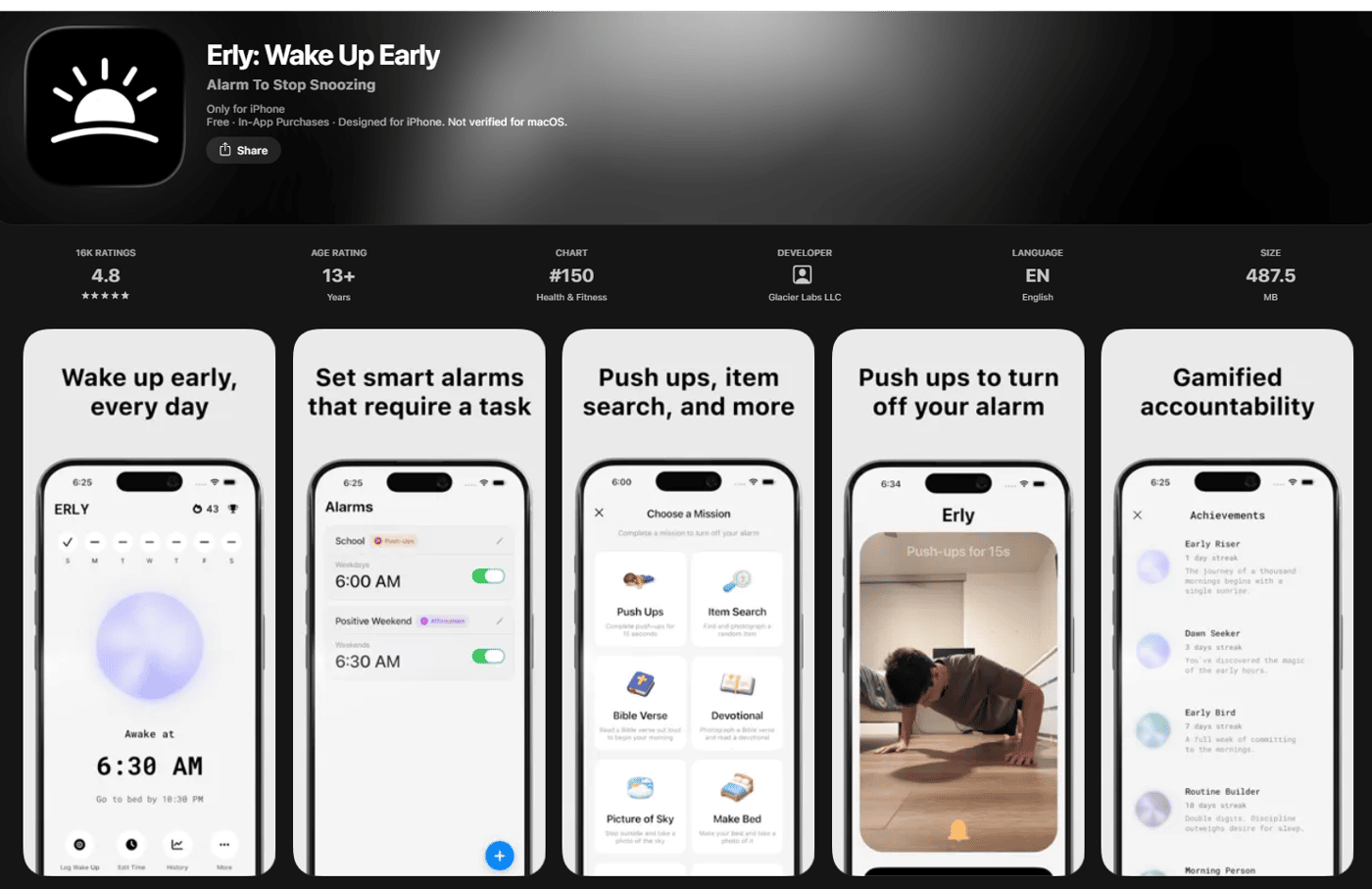
I came across Erly, an alarm clock app that won't turn off until you do push-ups.
Maker: Jake Glacer
Revenue: $50K/month
Marketing Strategy: Instead of relying on ads, Jake focuses on TikTok and Instagram influencers who create "day in the life" and lifestyle content where the app fits naturally. He also prioritizes influencer deals that come with a view guarantee.
The lesson?
You don't need a complex app to build a successful business. A simple idea, combined with the right marketing strategy, can generate serious revenue.
Most developers spend months building features. The best founders spend just as much time thinking about distribution.
If you're looking for validated mobile app ideas with their estimated MRR and a breakdown of their marketing strategies, I put together a list you can check out here:


One thing I notice with apps like this is that the product itself creates content. Watching someone do push-ups to turn off an alarm is naturally shareable, which makes influencer marketing feel authentic instead of forced. That's a very different challenge from building a B2B SaaS.
exactly. that's why B2C apps heavily focusing on instagram and tiktok.
curious what the retention looks like — alarm apps get deleted fast in my experience. is the $50k mostly new installs or subscribers sticking?
Great question I will tell you the answer once I find it out
The interesting part is that the product is simple, but the behavior is very visual.An alarm that forces you to do push-ups is basically built for TikTok. You don’t need a long explanation, and the “before/after” moment is obvious in a few seconds.Feels like the real takeaway is not “build simple apps”, but “build something where distribution can happen naturally through the product behavior.”
I like that perspective. Products that naturally create moments people want to share have a huge distribution advantage. When the product itself tells the story in a few seconds, marketing starts to feel like a byproduct of usage rather than something you have to force.
Yeah. Exactly.
This was a great reminder that distribution deserves just as much attention as product development.
One thing I'm curious about: if you were launching the same app today with zero audience and zero budget, would you still start with TikTok and Instagram influencers, or do you think there's a better acquisition channel in 2026?
Would love to hear your thoughts.
That's the channels I also use for a new app.
Thanks for sharing. That makes sense. Have you found influencer marketing still gives the best ROI compared to content marketing or SEO over the long term? I'm building a marketplace for digital businesses, so I'm trying to learn which acquisition channels compound over time versus those that mainly provide an initial boost.
hmm intersting
Thanks.
I agree with this
Thanks varun.
you are right , more easy app is more convenient for people to use
Yeah many easier apps make huge money because people understand the app easily.
I can relate to this comment.
Most developers spend months building features. The best founders spend just as much time thinking about distribution.
This was the issue I had with getting into business with co-workers or friends. To much thought process will slow down any creation.
Timely thread — I'm building WakeWin (a gamified alarm you dismiss by solving a puzzle, then either physically moving via pedometer or photo-verifying an object), so I've stared hard at this exact space. My read: the alarm-app market is huge because the core job ("actually get me vertical") is genuinely unsolved for chronic snoozers, not because the tech is novel. The mechanic itself is easy to clone (as this post basically proves). The real moat is retention — streaks, a difficulty curve that scales with the user, and not being so annoying that people uninstall on day 3. Happy to compare notes with anyone else building in this space.
I am collecting my ideas to make this a type of security app that triggers unusual events and set an alarm or red alert for business
great!
The interesting part is not the alarm feature, it’s the content loop.
A product that creates its own marketing is a huge advantage for solo makers.
true!
I may be interested in this app and follow its to do the push up, but honestly, less than 5 day later, I will give up , close the feature, turn to bed, goodbye my app, have a nice sleep
totally understandable. what is better than a good nap!
$50K/month from an alarm clock app that forces push-ups is such a good reminder that simple mechanics can carry a whole business.
Prioritizing influencer deals with a view guarantee over ads is a smart distribution move most indie devs skip entirely.
it's a smart move.
It's pretty amazing but I think the money he spent on marketing the app gotta be pretty insane
I also think so.
amazing how a simple concept is still profitable ! the creator is a genius ! I tried and find it nice!
Yeah. It's not a new app but the concept is cool.
indeed ,sometimes reinventing and modernizing worth it
Interesting approach with the alarm clock + push-up combo! The forced physical action to dismiss alarms is a clever hook for habit-building apps. I wonder if this concept could extend to productivity tools — imagine an MCP server that refuses to return AI results until you complete a quick task. Gamification mechanics seem to work well in niche utilities.
That's a very good idea.
Thanks! Appreciate the kind words. Gamification + utility combos seem to be an underrated pattern for indie apps.
People with distribution skills are really lucky!
Distribution is the most difficult part.
Facing it myself, seems almost impossible lol as with no prior experience on social media.
Great find. proves yet again distribution is everything!
Exactly, distribution is everything.
Great reminder. As a solo founder building Daycipline, this really resonates. It's easy to get caught up adding features, but users only come when you consistently focus on distribution. Building is optional. Distribution is mandatory. 🚀
Distribution is the hardest part. One should figure out distribution first before even building anything.
insanely simple idea.
yeah the idea is really simple but they executed it professionalyl.
keep sharing more resources like this. really helpful!
thanks. i will
thanks for the information. really informative.
I am glad that you found it informative.
The idea is really simple. I love how they executed it.
yeah the execution was extraodinary.
That's a very good idea.
the idea is simple but their execution was brilliant!
good
thanks.
I think this advice is based on a fluke; I've seen aggressive marketing campaigns that don't retain users because the app is simple.
The detail worth stealing here is the view guarantee, because it converts influencer spend from a lottery ticket into media buying with a floor price. Most founders negotiate on price per post when they should negotiate on guaranteed reach, then let the creative vary. I tell my portfolio founders the same thing about any channel: cap the downside first and the experiments get cheap enough to run weekly.
Ok
I think the marketing strategy is the real product here. "Do push-ups to turn off your alarm" is memorable enough that creators naturally want to make videos about it. Distribution becomes much easier when the product itself creates shareable moments.
The push up part made it easier to create content on social media.
Great example of distribution > features. I'm building VoxCut, a simple app that removes silences from audio/video files — one feature, does it well. The hardest part isn't building, it's getting people to discover it. Jake's influencer strategy with view guarantees is smart — you're basically buying guaranteed distribution instead of hoping for organic reach. Curious how he finds the right influencers though — trial and error or some tool/process?
I think trial and error is the only way yo find it out.
Playbook scaling is underrated—most founders treat their path as bespoke when really the repeatable patterns (audience segmentation, pricing tiers, feature prioritization) are where the real insight lives. If you've done this across multiple apps, I'm curious: which of the 6 steps compressed the most from your first app to the most recent? That's usually where the learning compounds.
really cool idea.
Yeah it's really cool!
Love this angle. The revenue numbers are what make it actually useful versus the usual app-idea lists that run on vibes. How are you sourcing and verifying the MRR figures? A few of these (Cal AI at $1.14M/mo, WeWard at $615K) are semi-public, but plenty of indie apps stay quiet about real numbers. Self-reported, pulled from Sensor Tower / Appfigures type data, or a mix?
This is a good reminder that distribution can matter more than product complexity.
The interesting part is that the app has a very simple core promise: “it forces you to wake up.” That makes it easy to explain, easy to demo on TikTok, and easy for influencers to create content around.
A lot of founders, especially technical ones, try to win by adding more features. But here the advantage seems to be clarity + a strong distribution channel.
Curious how you would evaluate whether an idea is “influencer-friendly” before building it.
what do you think about influencer-friendly idea?
This comment was deleted 2 months ago