How Agentic AI is Transforming Agricultural Automation
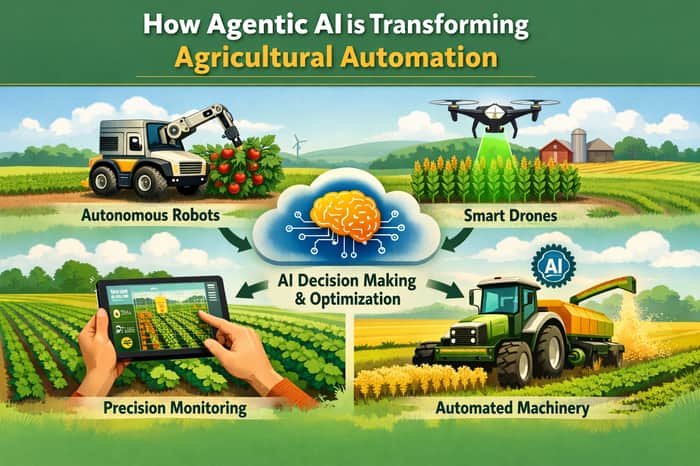
Agriculture has always been at the heart of human survival, but in today’s rapidly evolving world, traditional farming methods are no longer enough to meet growing demands. Rising population, climate change, labor shortages, and resource constraints are pushing the agricultural sector to innovate faster than ever. This shift is strongly supported by industry insights from MarketsandMarkets, which highlight the rapid growth of AI in agriculture. Forecasts suggest that the precision farming segment alone could reach USD 1.43 billion by 2028, while the overall market is expected to exceed USD 10 billion by 2032, growing at a CAGR of 20.5% to 25.5%. Additionally, software dominates the market with a 45.2% share, followed by hardware (24.5%), services (18.0%), and AI-as-a-Service (12.3%), emphasizing the increasing importance of intelligent digital platforms in farming. While automation has already transformed agricultural practices, a new wave of technology, agentic AI, is now taking agricultural automation to an entirely new level.
What is Agentic AI?
Agentic AI refers to advanced artificial intelligence systems that can act independently, make decisions, and adapt to changing conditions without constant human intervention. Unlike traditional AI, which typically follows predefined rules or requires continuous input, Agentic AI behaves more like an intelligent agent. It observes its environment, analyzes data, makes decisions, and takes actions in real time.
In agriculture, this means moving beyond simple automation (like scheduled irrigation or GPS-guided tractors) toward systems that can think, learn, and act autonomously, just like an experienced farmer would.
The Evolution from Automation to Intelligence
Agricultural automation began with mechanization, tractors, harvesters, and irrigation systems. Over time, digital tools like sensors, drones, and farm management software have improved efficiency. However, these systems often operate in silos and depend heavily on human oversight.
Agentic AI changes this by connecting data sources and enabling higher-level decision-making. Instead of just collecting and displaying information, AI agents can:
-
Analyze soil health and weather conditions
-
Predict crop diseases before they spread
-
Adjust irrigation and fertilization automatically
-
Optimize harvesting schedules based on market demand
This shift from reactive to proactive farming is what truly defines the next generation of agricultural automation.
Key Applications of Agentic AI in Agriculture
1. Autonomous Farm Management
One of the most impactful uses of Agentic AI is in fully autonomous farm management systems. These AI agents can oversee entire farming operations by integrating data from sensors, satellites, and machinery.
For example, an AI agent can monitor soil moisture levels, weather forecasts, and crop growth stages simultaneously. Based on this data, it can decide when to irrigate, how much water to use, and which areas need more attention—without requiring manual input.
This level of autonomy not only improves efficiency but also reduces human error.
2. Precision Farming at Scale
Precision farming has been around for a while, but Agentic AI takes it to the next level by making it dynamic and adaptive.
Instead of applying water, fertilizers, or pesticides uniformly across a field, AI agents can:
-
Identify specific areas that need treatment
-
Adjust inputs in real time
-
Minimize waste and environmental impact
This leads to better crop yields while conserving resources—an essential balance in modern agriculture.
3. Smart Pest and Disease Control
Pests and diseases are among the biggest threats to crop production. Traditional methods often rely on reactive measures, which can be too late and costly.
Agentic AI enables predictive and preventive approaches by:
-
Analyzing historical and real-time data
-
Detecting early signs of disease through image recognition
-
Recommending or executing targeted interventions
In some cases, AI-powered drones or robots can be deployed automatically to treat affected areas, reducing the need for widespread chemical usage.
4. Autonomous Machinery and Robotics
While self-driving tractors and robotic harvesters already exist, Agentic AI enhances their capabilities significantly.
Instead of following fixed routes or instructions, AI-powered machines can:
-
Adapt to field conditions in real time
-
Avoid obstacles and optimize paths
-
Coordinate with other machines for efficient operations
For instance, during harvesting, multiple AI-driven machines can work together, adjusting their roles based on crop density, weather changes, and equipment availability.
5. Supply Chain Optimization
Agentic AI doesn’t stop at the farm; it extends across the entire agricultural supply chain.
AI agents can:
-
Predict market demand and price fluctuations
-
Optimize storage and transportation
-
Reduce post-harvest losses
In this broader ecosystem, integrating financial intelligence becomes equally important. This is where an agri-finance software solution plays a crucial role, helping farmers and agribusinesses align operational decisions with financial planning, manage credit cycles, track investments, and ensure better profitability alongside AI-driven automation.
Benefits of Agentic AI in Agriculture
Increased Productivity
By automating complex decision-making processes, Agentic AI allows farmers to focus on strategic planning rather than day-to-day operations. This leads to higher productivity and better use of time and resources.
Resource Efficiency
Water, fertilizers, and energy are critical inputs in agriculture. Agentic AI optimally utilizes these resources, minimizing costs and environmental impact.
Reduced Labor Dependency
Labor shortages are a growing concern in many regions. Autonomous systems powered by Agentic AI can perform tasks that would otherwise require manual labor, ensuring continuity in operations.
Improved Sustainability
Sustainable farming practices are no longer optional; they are essential. Agentic AI supports sustainability by minimizing waste, reducing chemical usage, and promoting eco-friendly practices.
Better Risk Management
Farming is inherently risky due to unpredictable weather and market conditions. Agentic AI helps mitigate these risks by providing accurate predictions and adaptive strategies.
Challenges and Considerations
Despite its potential, the adoption of Agentic AI in agriculture comes with challenges.
High Initial Investment
Implementing AI-driven systems requires significant upfront investment in technology, infrastructure, and training. Such costs can be a barrier, especially for small and medium-sized farmers.
Data Dependency
Agentic AI relies heavily on data. Poor data quality or a lack of data integration can limit its effectiveness. Ensuring accurate and consistent data collection is crucial.
Technical Complexity
Managing and maintaining AI systems requires technical expertise, which may not be readily available in rural areas. Bridging this skill gap is essential for widespread adoption.
Ethical and Security Concerns
As AI systems become more autonomous, concerns around data privacy, security, and decision-making transparency become more important. We need clear guidelines and regulations to address these issues.
The Future of Agriculture with Agentic AI
The future of agriculture lies in intelligent, connected, and autonomous systems. Agentic AI is not just an incremental improvement; it represents a fundamental shift in how farming is done.
In the coming years, we can expect:
-
Fully autonomous farms with minimal human intervention
-
AI-driven ecosystems where machines, sensors, and software work seamlessly together
-
Increased use of real-time data for decision-making
-
Greater accessibility of AI tools for small-scale farmers
As technology continues to evolve, the gap between traditional farming and smart agriculture will widen. Farmers who embrace agentic AI will be better positioned to face challenges and seize new opportunities.
Conclusion
Agentic AI is redefining the boundaries of agricultural automation. By combining intelligence, autonomy, and adaptability, it empowers farmers to make better decisions, optimize resources, and improve productivity.
While challenges remain, the potential benefits far outweigh the obstacles. As adoption grows and technology becomes more accessible, Agentic AI will have an important bearing on the future of agriculture, making it more efficient, sustainable, and resilient.
For farmers, agribusinesses, and technology providers alike, the message is clear: the next level of agricultural automation is not just about machines; it’s about intelligent systems that can think, act, and evolve on their own.
