How AI Smart Mobile Security Reveals A Bigger Opportunity For Founders
Most industries do not change overnight. They evolve gradually until a point where the old way of doing things starts to feel inefficient.
Security is one of those industries.
For decades, the model remained the same:
- Install cameras
- Hire guards
- Monitor feeds
- Respond to incidents
It worked, but efficiency becomes a problem as scale and complexity increase.
What makes AI smart mobile security interesting is not just the technology. It represents a shift in how problems are solved and where new opportunities exist for builders.
The Real Problem Is Inefficiency
Traditional security systems are not necessarily broken. They are inefficient.
Consider the patterns:
- Cameras are widespread, yet blind spots remain
- Guards patrol regularly, yet incidents still occur
- Data is collected continuously, yet insights arrive too late
This is a strong signal for founders.
When you see:
- High cost
- Manual processes
- Delayed outcomes
There is usually an opportunity for innovation.
What Makes This Different From A Builder Perspective
At first glance, this looks like a hardware-driven solution.
- Vehicles
- Cameras
- Sensors
But the real product is not the hardware. It is the system.
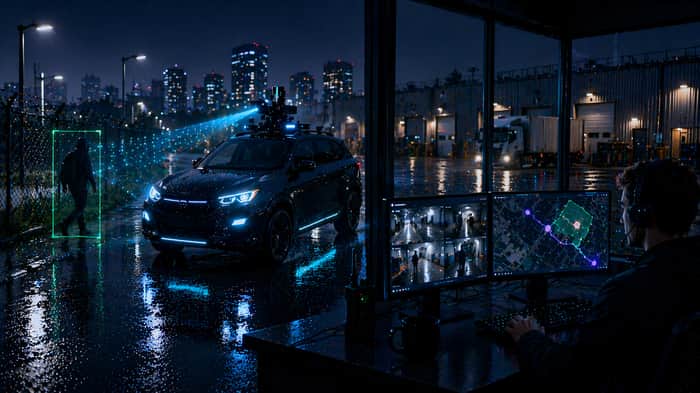
A mobile AI surveillance unit functions as:
- A moving data collector
- A real-time decision engine
- A continuous feedback loop
This transforms security into a continuous intelligence system.
From Static Infrastructure To Dynamic Systems
Traditional systems are static.
- Installed in fixed locations
- Expanded by adding more hardware
This leads to linear scaling:
- More coverage equals more cost
Dynamic systems operate differently.
A smart mobile security system:
- Moves across environments
- Adapts to changing conditions
- Allocates resources efficiently
This represents a shift from:
- Infrastructure → Intelligence
Mobility As A Core Advantage
Mobility changes how surveillance works.
Traditional Systems
Static Cameras
- Continuous monitoring
- Limited to fixed locations
Human Patrols
- Can move
- Cannot monitor continuously
AI Mobile Systems
A combined model:
- Moves across zones
- Monitors continuously
- Analyzes in real time
This is the foundation of AI patrol vehicle security.
Key Insight For Founders
Combine two limited systems to create a more capable hybrid.
The Shift From Data To Insight
Traditional systems generate large volumes of data:
- Video feeds
- Logs
- Reports
But data alone is not useful without action.
With real-time threat detection AI, systems:
- Identify relevant events
- Filter unnecessary noise
- Surface critical insights
With behavioral analytics security AI, they go further:
- Recognize patterns
- Detect anomalies
- Anticipate risks
This follows a clear evolution:
- Data → Analytics → Insights → Action
Why This Matters Beyond Security
This model applies to more than just security.
It is relevant in industries with:
- Large physical environments
- Constant movement
- Delayed decision-making
Examples include:
- Logistics
- Smart cities
- Agriculture
- Construction
- Retail analytics
This is not just a security product. It is a real-time intelligence system for physical environments.
Real-World Use Cases And Insights
1. Campuses
A campus security patrol solution handles:
- Unpredictable movement
- Large areas
- Continuous activity
Insight: High variability environments benefit from adaptive systems.
2. Warehouses
A warehouse security monitoring system involves:
- Open spaces
- Repetitive operations
- High-value inventory
Insight: Efficiency and visibility drive measurable returns.
3. Industrial Sites
Industrial site mobile security requires:
- Risk monitoring
- Zone enforcement
- Continuous awareness
Insight: High-risk environments justify advanced systems.
4. Retail Spaces
A mall security patrol AI system focuses on:
- Crowd behavior
- Pattern recognition
- Anomaly detection
Insight: Behavioral data is more valuable than raw activity data.
5. Events
An event security surveillance system needs:
- Rapid deployment
- Flexibility
- Scalability
Insight: Temporary environments benefit from modular solutions.
The Business Perspective
Organizations invest in outcomes, not technology.
Key outcomes include:
- Better coverage
- Faster response
- Lower long-term costs
Many aim to reduce security costs with AI patrol systems while improving performance.
Cost As A Replacement Strategy
A common assumption is that AI systems are expensive.
However, cost is often offset by:
- Reduced staffing needs
- Fewer incidents
- Lower infrastructure expansion
This reframes the equation:
- Not added cost
- But cost replacement
The Broader Trend: Autonomy
Security is moving toward autonomous systems.
- Autonomous patrol vehicles
- Self-adjusting monitoring
- Data-driven decision systems
Autonomous Security Patrol Vehicle Benefits
- Continuous operation
- Consistent performance
- Scalable deployment
This reflects a broader shift toward intelligent, self-operating systems.
Challenges And Opportunities
Every emerging space presents challenges.
1. Real-Time Processing
- Requires efficient AI pipelines
Opportunity: Tools for easier edge AI deployment
2. Accuracy And Noise
- False alerts reduce system trust
Opportunity: Context-aware filtering systems
3. Integration
- Legacy systems can be difficult to connect
Opportunity: Middleware and API solutions
4. Privacy
- Data collection raises regulatory concerns
Opportunity: Privacy-focused AI frameworks
Where To Start As A Builder
You do not need to build an entire system.
You can focus on specific components:
- Alert optimization tools
- Behavioral analytics models
- Dashboard user interfaces
- Real-time data pipelines
Start small and solve one problem effectively.
The Core Pattern
The real value lies in the pattern behind the system:
- Combine mobility with intelligence
- Transform data into actionable insights
- Replace static systems with adaptive ones
This pattern will continue to appear across industries.
Conclusion
Security is entering a new phase.
The shift is clear:
- From watching to understanding
- From reacting to anticipating
- From static systems to dynamic systems
For founders, this represents a significant opportunity.
Those who recognize and apply this pattern early will be positioned to build the next generation of intelligent systems.
For a real-world example of this approach, explore:
https://avveniretech.com/aismartmobile/
