How Are You Actually Monetizing AI in Your SaaS?
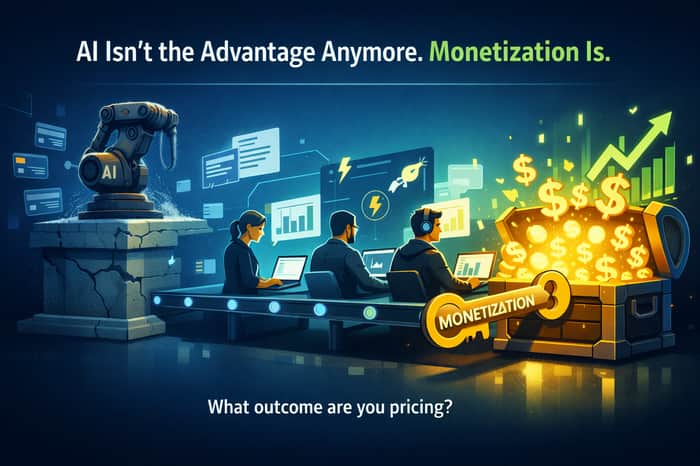
AI isn’t the advantage anymore.
Monetization is.
Most SaaS founders I talk to already have AI in the product.
The real question now is: how are you charging for it without breaking trust or margins?
After watching dozens of AI-first and AI-added products this year, a few patterns are clear.
First: AI gets adopted faster than it gets paid for.
Founders ship AI to stay competitive, then hesitate to charge because users “expect it now.” That gap kills leverage.
Second: successful AI monetization isn’t about pricing models.
It’s about where AI sits in the workflow.
The products that monetize well usually do one of three things:
AI replaces a painful manual step
If AI removes real human effort (analysis, cleanup, decision-making), users accept usage-based or credit pricing easily.
AI creates a visible output, not background magic
Reports, summaries, recommendations, forecasts. If users can point to what AI produced, they’ll pay.
AI gates speed, not access
Base experience is available to everyone. AI accelerates outcomes. Faster answers, faster insights, fewer steps.
That’s where willingness to pay shows up.
Third: most AI features cluster around the same jobs.
Across SaaS, AI is mainly being used for:
Text generation and rewriting
Data analysis and summarization
Recommendations and prioritization
Automation of repetitive workflows
Support and internal assistance
Nothing exotic. The differentiation isn’t the model — it’s the job it’s hired for.
The founders doing well with AI pricing aren’t asking
“Should this be an add-on or usage-based?”
They’re asking:
“What outcome becomes obviously more valuable with AI turned on?”
That answer usually tells you how to price it.
Curious how other indie founders here are charging for AI — bundling it, upselling it, or keeping it invisible for now?

A key trend that I am seeing is outcome based pricing. More clients want vendors to put skin in the game. For example, if your product is designed to help your clients save money, then an outcome based pricing could be around charging X percentage of the money you have saved them.
This way of pricing is challenging to scale and not every client will be up for it. However, with everyone coming with similar products and pricing, this is a key way to differentiate, and build trust.
Great point. Outcome-based pricing really does align incentives and build trust even if it’s harder to scale, it’s a strong differentiator in crowded AI markets.
We’ve been exploring a few ways to monetize AI in our SaaS.
Premium Features: Offering AI-powered tools (like automated content generation, analytics, or recommendations) as part of a paid plan.
Usage-Based Pricing: Charging based on API calls or number of AI outputs generated.
Value-Added Services: Providing insights, reports, or optimization suggestions powered by AI to help users save time and make better decisions.
On our own platform (BlockBlastMods), we’re experimenting with AI-driven tools for our community, which helps us both engage users and test monetization models without being intrusive.
Nice breakdown. I like the focus on testing monetization through real user engagement without being intrusive that’s a smart way to learn what actually delivers value.
good
When I started building my LLM-powered CRM tool, I had the same question.
My problem: per-client costs varied wildly based on database size and cleanup complexity. Seat-based pricing made no sense when one client's 100 records cost pennies and another's 10K records cost real money.
And yeah, the moment I realized I needed usage-based pricing, I stopped building the actual product and started building billing infrastructure. Postgres schemas, metering logic, Stripe webhooks. Two weeks in, I wasn't close to done.
That "stop focusing on my product" moment was brutal. Even though it was the most important thing, I couldn't ship without a way to charge for it.
I ended up using an gateway and billing infrastructure that provides both. Same data powers both. Got back to building the CRM instead of building custom billing infrastructure.
In my experience, the best pricing model for AI features is the one that tracks your actual costs. If LLM usage varies by customer, usage-based pricing is honest. If it's predictable, bundle it.
The key is making sure you choose an infrastructure that can actually enforce limits and track usage in real-time.
If anyone else is stuck on this, happy to share what worked for me.
This is a great insight. That “billing before product” trap is very real with AI, and your takeaway on aligning pricing with actual costs is spot on. Appreciate you sharing the lesson learned.
This comment was deleted 7 months ago