How Data Driven Thinking Is Redefining the Way Entrepreneurs Discover Profitable Online Businesses
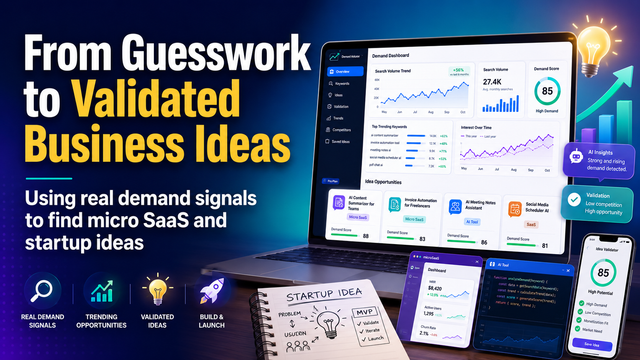
The Shift From Guesswork to Real Market Understanding
The way people build online businesses has changed significantly in recent years. In the past, most founders relied on intuition, personal interest, or trending topics when selecting what to build. While that approach occasionally worked, it was largely inconsistent because it lacked any real proof that users actually needed the product.
Today, a more structured approach is emerging. Founders are increasingly looking for signals that show real demand before investing time or money. These signals include search behavior, online discussions, complaint patterns, and repeated feature requests across communities.
This shift is especially important in competitive digital markets where almost every niche already has existing solutions. Whether someone is exploring micro saas ideas, saas ideas, or broader startup ideas, the key question is no longer “what sounds interesting,” but instead “what problem is already being expressed by real users.”
The difference between success and failure often comes down to this single shift in thinking: building based on evidence rather than assumption.
Why Traditional Idea Generation Falls Short
Traditional brainstorming methods often encourage creativity without grounding ideas in real-world demand. While creativity is valuable, it becomes ineffective when disconnected from actual user behavior.
Many founders still rely on vague assumptions such as “this tool might be useful” or “people probably need this.” The issue is that “probably” is not a reliable foundation for building anything sustainable.
Common problems with assumption-based building include:
• Products launched with no existing search demand
• Solutions entering markets that are already oversaturated
• Tools solving low-priority problems
• Misalignment between user expectations and product features
• Difficulty in acquiring users without clear positioning
Even strong technical execution cannot fix a product that no one is actively looking for. This is why many well-built apps fail to gain traction despite significant effort.
A more reliable approach focuses on identifying validated business ideas before development begins. This reduces uncertainty and ensures that time is invested in solving real problems.
The Rise of Demand Driven Entrepreneurship
A major shift in modern entrepreneurship is the move toward demand driven decision making. Instead of asking what could be built, founders are now asking what people are already trying to solve.
This is where real-world data sources become extremely valuable. Platforms like Reddit, App Store reviews, and keyword search tools reveal consistent patterns of frustration and unmet needs.
For example, repeated discussions often highlight opportunities such as:
• Tools that automate repetitive administrative tasks
• Simple SaaS platforms for niche industries
• AI tools that improve writing, research, or organization
• Lightweight apps solving a single focused workflow problem
• Subscription tools tailored to specific professional groups
These opportunities are not invented. They already exist in fragmented form across online conversations. The opportunity lies in recognizing them early and turning them into structured products.
This is where the concept of micro-SaaS ideas with real search demand becomes powerful. Instead of guessing, founders can build around topics people are actively searching for and discussing.
Understanding the Modern SaaS and AI Opportunity Landscape
The software market is expanding rapidly, especially with the rise of AI-powered tools. However, increased opportunity also means increased competition. Simply building an AI product is no longer enough to guarantee success.
Instead, founders need to focus on alignment between product and user behavior. Successful saas business ideas usually share a few key traits:
• They solve a narrow and clearly defined problem
• They serve a specific and identifiable audience
• They deliver immediate value without complexity
• They are easy to adopt without long onboarding
• They address problems users already talk about publicly
AI saas ideas are particularly interesting in this context. However, they only work when they enhance existing workflows rather than attempting to replace entire systems. For example, an AI tool that summarizes documents or automates reporting is far more practical than a broad, undefined “AI platform.”
Validation becomes essential here because it ensures that the idea is not just technically possible but also commercially relevant.
How Business Ideas DB Helps Founders Find Real Opportunities
One of the biggest challenges for founders is filtering through endless ideas and identifying which ones are actually worth building. This is where data driven platforms play a major role.
A strong example of this approach is Business Ideas DB, a platform designed for indie hackers and founders who want to discover opportunities backed by real demand signals.
Instead of relying on guesswork, it uses structured analysis across multiple sources:
• Reddit discussions to identify recurring pain points
• App Store data to uncover gaps in existing products
• Keyword research to measure actual search interest
• AI based scoring to prioritize high potential opportunities
This combination creates a more reliable foundation for decision making. Each idea is backed by evidence rather than speculation, making it easier to decide what to build next.
For anyone exploring saas ideas, app ideas, or early stage startup ideas, this type of validation significantly reduces risk and increases clarity.
From Idea Exploration to Structured Opportunity Discovery
Beyond individual idea evaluation, structured collections of opportunities help founders see patterns across entire markets. Instead of focusing on one idea at a time, they can explore clusters of related problems.
A useful example is the curated collection of validated micro-SaaS ideas with real search demand, which organizes opportunities based on actual user interest signals.
This kind of structured discovery helps founders:
• Identify underserved niches faster
• Compare multiple opportunity areas at once
• Understand monetization potential earlier
• Spot recurring demand patterns across industries
Within these collections, common categories often include productivity tools, AI assisted workflows, niche CRMs, automation systems, and lightweight analytics platforms.
Each category is rooted in real user behavior rather than abstract brainstorming, which makes it significantly easier to move from idea selection to execution.
Turning Validated Ideas Into Working Products
Once a strong idea is identified, execution becomes the next challenge. However, even execution benefits from a validation first mindset.
Founders working with validated business ideas typically follow a more focused process:
• Build a minimal version of the product first
• Focus on solving one core problem extremely well
• Avoid adding unnecessary features early on
• Launch quickly to test real user feedback
• Iterate based on actual usage patterns
This approach works especially well for micro SaaS products, where simplicity often leads to faster adoption and clearer product-market alignment.
Monetization also becomes easier when demand is already confirmed. Users are more willing to pay for solutions that clearly solve problems they already recognize.
Why Evidence Based Building Outperforms Intuition
The most successful founders are not necessarily the most creative. They are the ones who consistently identify real demand signals and act on them quickly.
As tools for analyzing market behavior improve, the process of discovering profitable SaaS ideas is becoming more structured and accessible. This does not reduce creativity. Instead, it ensures creativity is directed toward meaningful problems.
Platforms like Business Ideas DB represent this shift by helping founders focus on what already has proof of demand instead of what simply sounds interesting.
This is why modern entrepreneurship is becoming less about guessing the right idea and more about interpreting real user behavior correctly.
Building Around What People Already Want
The strongest business opportunities are rarely hidden in complex theories. They are visible in everyday conversations, repeated frustrations, and consistent search patterns across the internet.
When founders learn to interpret these signals properly, they gain a significant advantage in identifying opportunities early.
Whether exploring micro saas ideas, evaluating ai saas ideas, or testing new app ideas, the core principle remains the same: build based on real demand, not assumptions.
By focusing on validated business ideas and using platforms that surface real user interest, entrepreneurs can reduce uncertainty and significantly improve their chances of building something people actually want.
