How do you process recurring payments for your SaaS?
Hi!
I want to start a discussion about your solutions for SaaS recurring payments (subscriptions).
- What payment gateway are you using?
- Do you include taxes (VAT) on the pricing page? (tax exclusive vs tax inclusive)
- Do your users choose monthly payments over annual plans?
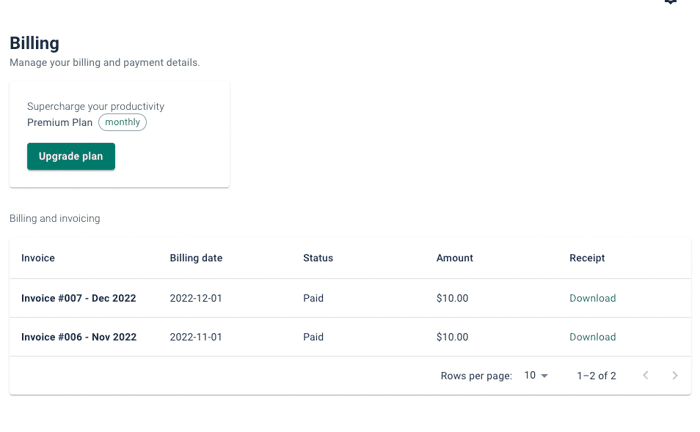
And of course, you can attach how your Billing page looks in your app!

I write at Zero To Founder about various things one need around building profitable products.
Below are a few platforms you can use to accept SaaS payments.
Stripe: The most popular SaaS payment/billing platform. Stripe is fully integrated with most third-party applications as well. For example, many newsletters, community applications, NoCode tools, etc., have direct integration with Stripe. Stripe is not fully available in a few countries. Make sure to check Stripe availability in your country. If Stripe is not available in your country and you still prefer to use Stripe, you can register your company using Stripe Atlas(or any other similar service) to register a company in the US and get a Stripe account to operate. Note that, with Stripe you need to handle all the taxes by yourself. Stripe can be used for most cases like SaaS subscriptions, Service/Freelancer/Support work-based payments, Info product payments, Marketplace payments, etc.
Paddle: Paddle is also a pretty advanced system for SaaS subscription/billing/payments etc. But the main difference between Stripe and Paddle is - While Stripe only handles the payments for you, Paddle actually acts as a reseller for your product/software. So, technically the users are buying SaaS (or other products) from Paddle while Paddle buys from you. While this sounds a little bit confusing, this actually makes tax processing/filing much easier for individuals/bootstrappers as the primary tax handling across the world (wherever your product is sold) is taken care of by Paddle while you have to file your normal taxes for your payments from Paddle.
While these are the top two popular players, you can also use PayPal, Gumroad, etc. too, to accept payments, but they don’t perfectly fit this use case.
I can start the discussion:
What payment gateway are you using?
I've started implementing the Paddle, due to being a merchant of records - I'm free of taxes, Paddle takes care of that. That's very important for me, as I'm going global with my product.
Do you include taxes (VAT) on the pricing page? (tax exclusive vs tax inclusive)
I plan to include taxes in the pricing users see on the Pricing page, so as not to be misleading at the end of the payment process.
Do your users choose monthly payments over annual plans?
I'm in the MVP process, so I have no data yet :)
I've implemented Paddle for the same reason. It works well for me so far.
VAT: I'm including VAT in the price, because afaik (not legal advice though) it's required in some places like the EU when you sell to consumers.
Monthly payments:
I started out with annual payments and later added monthly payments. Adding monthly payment was a game changer, the conversion rates increased significantly and now 90% of purchases are monthly. It also has the advantage that I see churn earlier and therefore can react/iterate faster.
I'm still keeping the annual plan, because especially when employees purchase and get reimbursed by their employer, it's just easier for them to do that once a year and not every month.
I personally hate it when I see a SaaS or any subscription based product touting their rate per month. When I sign up, the only option is to pay the annual fee in full. Their annual fee is the rate per month x 12.
Stripe is probably the most common one - as for tax, I would say the majority of platforms are tax inclusive - not sure if that's the better way to go, just more common!
Monthly vs annual usually just depends on the users cash situation and confidence in the product. If someone has enough money, and they know they're going to use your product for the whole year, they're probably going for annual