How I Built a Frictionless, No-Subscription PDF Utility Platform as a Solo Developer
Building a sustainable SaaS product or utility tool in today’s hyper-competitive digital market is a massive challenge for any indie hacker. Every niche seems saturated, and the giants dominating the tech space have massive budgets for marketing and engineering. However, if there is one thing I have learned from observing successful micro-businesses, it is that users are deeply fatigued by "subscription creep." Almost every basic utility platform today forces users into a recurring monthly payment or demands an invasive registration process just to edit a single document.
This exact frustration is what drove me to build and launch my own solution. I wanted to create an ecosystem that respects the user's time, privacy, and wallet, while delivering high-performance tools that execute daily document tasks in seconds.
The Core Problem: Subscription Creep and Over-Engineered Tools
The Portable Document Format (PDF) is the undisputed standard for professional files, academic papers, invoices, and legal contracts. It ensures that formatting remains perfectly locked across every device. But while viewing PDFs is incredibly easy, modifying them is notoriously difficult without heavy software.
For a freelance developer, content creator, or remote team member, the daily workflow is often interrupted by minor file management tasks. You might need to merge three separate project reports into one document, compress a heavy pitch deck so it fits into an email attachment, or quickly rotate a few flipped pages from a scanned receipt.
When you encounter these hurdles, your immediate reaction is to look for a quick web utility. Unfortunately, most modern alternatives make you jump through endless hoops:
- They force you to create an account, collecting your personal email before you even see the tool dashboard.
- They throttle your download speeds or limit your file sizes to unusable thresholds.
- They bombard you with aggressive pop-ups pushing a $15/month subscription for features you only use twice a month.
As a developer, I saw an opportunity here. I wanted to cut out the corporate fat and deliver a clean, fast, and entirely friction-free platform. That is the origin story behind the creation of pdfwep.
Bootstrapping the Solution: Technical Simplicity Meets Speed
When designing the architecture of the platform, my primary objective was speed and accessibility. I chose a modern, lightweight web framework that allows the entire interface to load instantly, even on slower mobile connections.
Instead of forcing complex backend processing that compromises data privacy, I engineered the suite to handle file tasks with maximum optimization. When you upload a document to execute a change, the servers process the file immediately, apply the requested modification, and securely purge the data shortly after execution. This creates a dual advantage: total peace of mind regarding data security and lightning-fast turnaround times.
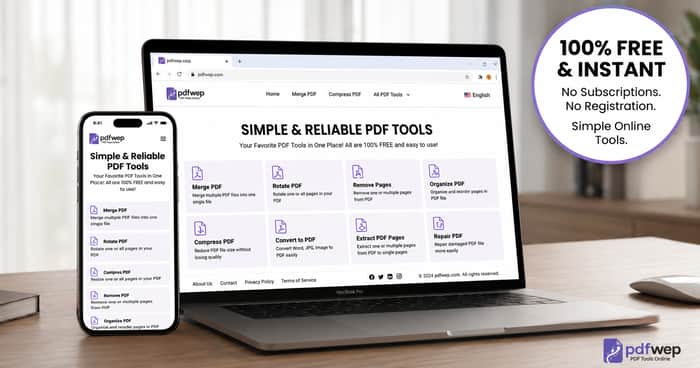
On the homepage of pdfwep, users are greeted not by marketing jargon or pricing tables, but by the tools themselves. Whether you need to merge, compress, or organize pages, the utility is available instantly in your browser with zero friction.
Why Indie Hackers and Digital Creators Need Lean Utility Frameworks
As builders, our cognitive energy is our most valuable asset. If we waste twenty minutes trying to format an invoice or struggle to compress an e-book for publication, we are stealing time from our core product development. By integrating free online PDF tools directly into your daily asset management routine, you eliminate administrative friction entirely.
Here is how optimizing your file management strategy transforms your digital workflow:
1. Seamless Collaboration via Strategic Merging:
Sending a client or investor an email containing multiple detached sheets looks unprofessional and unorganized. By combining project proposals, financial forecasts, and design mockups into a single, cohesive PDF document, you provide a unified experience that is highly professional and easy to navigate.
2. Optimizing Data Transmission through Intelligent Compression:
Large file sizes clog communication channels. High-resolution graphics can easily push a document past the attachment limits of standard email or platforms like Slack. Using advanced cloud compression ensures your files are minimized to an agile size while preserving the crisp typography required for professional reading.
3. Complete Page Flexibility:
Documentation is alive and constantly changing. The ability to purge outdated pages from an older operating manual, rotate misaligned scans, or rearrange layout sheets on the fly gives your business the agility it needs to keep materials accurate.
The Roadmap Ahead and Embracing a Value-First Model
Launching on IndieHackers is a monumental milestone for this project. This community understands the grit it takes to build a product from scratch, optimize its performance, and position it against massive corporate players. My strategy for growth isn't rooted in aggressive monetization; it is built on a value-first philosophy. By providing an excellent, uncompromised free tool, I aim to earn trust and build an organic user base.
Succeeding as an independent creator requires shifting focus from what you can extract from a user to what you can solve for them. By taking document processing to a highly optimized, browser-first environment, I hope to save creators and small business owners hours of administrative headaches.
I would love to get your honest feedback on the interface, the processing speeds, and the overall user experience. What features or additional document utilities would bring the most value to your daily independent product workflows? Let me know your thoughts, suggestions, or questions in the comments section below!

The no-subscription angle is a real trust lever for small utilities. I am taking a similar path with Kinetic Override: Android 15+ macro recorder, no account, no ads, local profiles, and a narrow promise instead of trying to look like a giant automation platform.