How I Built a Profitable Niche SaaS in 3 Weeks by Vibecoding and Focusing on One Painful Problem
Most indie founders fail not because they can’t code, but because they try to build something too big for an audience too broad. What actually works is ruthless focus. One problem, one audience, one painful unmet need.
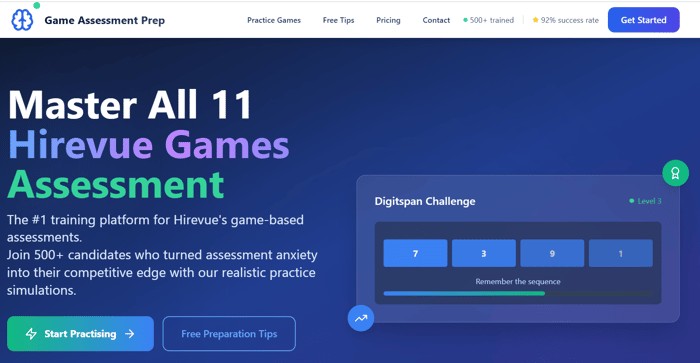
Three weeks ago I launched Game Assessment Prep, a training platform for HireVue’s game-based job assessments. It hit paying users on week one, started ranking for long-tail keywords, and continues growing without ads. I built it almost entirely with vibecoding: describe the problem, describe the desired output, iterate, ship.
Here’s everything I learned, in a way you can apply directly to your own product.
- The Power of Going Extremely Niche
The biggest myth in SaaS is that going small means earning small. The reality: the smaller the niche, the faster you can become the default solution.
I didn’t build “a platform that trains you for job interviews”.
I built the platform for HireVue game-based assessments, a tiny slice of the global recruiting world that most founders would ignore.
But candidates taking these assessments experience:
- high pressure
- zero transparency
- no official practice tools
- fear of failing something they don’t understand
That emotional intensity = conversion power.
Lesson: don’t solve a problem.
Solve an anxiety.
People pay to remove stress, uncertainty, and embarrassment far more than they pay for “features”.
- Ship the Smallest Complete Loop
Most founders think “MVP” = a half-baked version of a future product.
The better definition:
A small thing that completely solves a single job-to-be-done for the first user.
For me, this loop was:
- enter the site
- pick a game
- practice it
- understand why you performed well or badly
- feel more confident than before
No accounts, no dashboards, no gamification, no emails.
Just value delivered instantly.
Every feature I wanted to add was judged against one question:
Does this reduce time between arriving on the site and getting value?
If no, it waits.
- Vibecoding = Your Force Multiplier
You don’t need a large engineering team. You need clarity.
Here’s the workflow I used to build fast:
- describe what I wanted in natural language
- ask the AI to generate the component / function
- paste it into my codebase
- fix the integration issues manually
- repeat
This let me:
- build 11 assessment games
- design the UI
- write explanations
- create the entire marketing site
- deploy everything
…without drowning in boilerplate.
Lesson: AI removes the “weight” of coding, not the need for product thinking.
You still must know what to build and why.
- Build Where People Already Search
Indie Hackers love "build in public", Twitter threads, Product Hunt launches…
But the most predictable traffic doesn’t come from social. It comes from search intent.
Candidates search:
- “HireVue game practice”
- “HireVue numerosity”
- “how to prepare for hirevue games”
- “why did I fail hirevue assessment”
These are not broad keywords.
These are pain keywords.
So I structured the marketing site with:
- one page per game
- an FAQ that answers every question candidates panic-search
- tutorials explaining scoring logic
- a clean landing page with zero distractions
Google rewards depth and specificity.
Users reward clarity.
- Pricing: Don’t Be Afraid of Simple
I didn’t do complex pricing tiers or endless experiments. I focused on the same principle as the product:
reduce friction.
The pricing logic:
- low enough that candidates don’t hesitate
- high enough that you can afford Stripe fees and still make a profit
- simple enough for a stressed student to decide in 5 seconds
Most indie founders overcomplicate pricing because they want to please everyone.
But complexity is for big companies with sales teams.
Indie hackers win through simplicity.
- Your First Users Won’t Arrive by Magic
Traction was not instant. I had to:
- post on Reddit (in value-first threads, not self-promo)
- write useful content on HireVue games
- answer questions in job-seeking communities
- talk to people directly
- iterate the UX based on early friction
Every early user feels like a miracle.
Treat them that way.
Each one gives you data no competitor has.
- What I’d Tell Any Indie Hacker Building Today
Here are the distilled rules I wish someone hammered into me years ago:
a. Smaller niches = faster wins
You want to be the only one. Not one of many.
b. Replace features with outcomes
People don’t want your product. They want a transformation.
c. Ship something complete, not something big
A tiny product that truly helps is more valuable than a huge one that kinda helps.
d. Vibecoding accelerates execution, not vision
AI helps you produce. It doesn’t help you decide.
e. SEO is your friend if your niche has clear search intent
You don’t need backlinks when you have hyper-specific, high-quality pages.
f. Build something people already fear messing up
Fear converts better than desire.
- The Indie Hacker Advantage: You Can Move Faster Than Anyone Else
Large companies cannot build fast, weird, extremely specific solutions.
They cannot experiment in public.
They cannot talk to 50 users personally.
They cannot write content in a human tone.
You can.
The world is full of tiny-big problems waiting for independent builders to solve.
If you can find a problem, understand the emotion behind it, and ship fast — you can win.
And you can win without working 100 hours per week, without raising money, and without building a “startup” in the traditional sense.
Just solve one painful problem exceptionally well.

This was a great read, thanks for sharing!
I'm really struggling right now with getting initial traction, posting helpful content, without sounding like I'm doing an ad. So it's motivating to read your post.
This is incredibly well written and brutally true. Thanks for the motivation!
RECOVER YOUR LOST BITCOIN // WITH THE HELP OF GEO COORDINATES RECOVERY HACKER
I’m Thermos Lucas. I'm here to tell my testimony about how. GEO COORDINATES RECOVERY HACKER enabled me to recover my stolen BTC. A few months ago I lost $673,000 worth of BTC to a fake investment company. I don’t know how they got my email but I received an email from Investment Bank with a good proposal on how I could make millions out of my investment with them. I was convinced when they showed me profits from other clients that had invested in their platform, I began investing with them. When it was time to withdraw my profits, their website was shut down and I tried contacting them but they wanted me to pay a huge amount of fee to be able to withdraw my funds which I did until they cut me off and stopped all communication with me. I was shocked and devastated, I realized there was nothing I could do to recover my funds, I had gone to the authorities but they couldn’t assist me. I did some research online and I came across a post about GEO COORDINATES RECOVERY HACKER Their professional team was super and it took them less than 48 hours to get my funds back from these scammers. Geo Coordinates Hacker is here to provide that service for you. I highly recommend their services to everyone. If you suspect your Credit card, email & password, Facebook, Instagram, twitter Accounts have been hacked, you need to recover stolen money from scammers, report the incident to GEO COORDINATES RECOVERY HACKER, they can help you recover your BTC. in addition, GEO COORDINATES RECOVERY HACKER, can provide you with educational materials for staying safe online. They can also identify potential security breaches or vulnerabilities that may have led to the loss of your information. Please contact the following email address:
Email: geovcoordinateshacker@gmail.com
Website: https://geovcoordinateshac.wixsite.com/geo-coordinates-hack
Telegram: @Geocoordinateshacker
The truth always put the wrong people in the right place, and we all need help getting the truth
Luca, this post is pure gold – especially “solve an anxiety, not a problem”.
That’s exactly what pushed me to build AI Video Narrator.
The specific anxiety I had (and still see everywhere):
“I have a script/folder full of ideas, but turning it into a Short takes 4–6 hours of editing and $29–$89/month tools I can’t afford right now. What if this side hustle flops and I just wasted rent money?”
That single anxiety stops thousands of creators from ever posting consistently.
So I went stupidly narrow:
One job-to-be-done → “I have text → I need a narrated, captioned Short that I can post right now without spending hours or risking subscription money.”
No accounts, no onboarding, no credits system.
Paste script → pick voice/style → get MP4 in ~60 seconds.
Just launched yesterday with a $45 lifetime deal for the first week because that anxiety used to keep me up at night and I never want anyone else to feel it.
Your “smallest complete loop” advice is spot-on – mine is literally two screens and one button.
Thanks for the reminder to stay ruthlessly focused on that one painful emotion.