How I Built an Open-Source AI Voice Agent MVP in 3.5 Weeks for £0 by Prompting my own AI Co-Founder & AI Senior Software Engineer
Hi Indie Hackers,
I'm the founder of a new open-source project called InputRight, and I have a confession to make: I can't code.
For 20 years, I was a contractor—landscaping, tree work, you name it. The single biggest source of anxiety in my business wasn't the work itself; it was the constant, nagging fear of finding the next lead to pay the bills. This wasn't just business stress; it was a constant, nagging fear that genuinely kept me up at night for years. It became the single biggest source of pain in my life and contributed to a difficult personal journey I've thankfully been recovered from for over 20 years. That kind of pressure sticks with you.
After leaving contracting, I spent 15 years in digital marketing, the last four of which have been a deep dive into AI. I knew a voice agent on a contractor's website could be a game-changer for capturing leads 24/7. But I also knew a secret most AI companies don't like to talk about: transcription is still very unreliable. For a business where a single lead is worth tens of thousands, a bot mishearing 111-222-97 as 111-222-57 isn't just a problem; it's a disaster.
I needed a solution that combined the speed of voice with the 100% accuracy of a traditional form. I couldn't find one, and I couldn't afford to hire a team of developers to build it.
So, I decided to build my own team. An AI team.
This is the playbook I used to go from a simple idea to a stable, open-source MVP in just under four weeks, with a total development cost of £0:
Step 1: Prompting the AI Co-Founder/CTO.
My first step wasn't to write code; it was to write a job description. I opened Google AI Studio(awesome, free and 1 mil context window),selected Gemini 2.5 Pro, and prompted it to become my AI Co-Founder and CTO.
Our initial conversations were purely strategic. We defined the core USPs that would make this project genuinely useful:
100% Accuracy via Human-in-the-Loop: The AI acts as a 24/7 receptionist, capturing details conversationally. Then, it pre-fills a form for the user to visually check and approve. It combines conversational ease with the certainty of sight.
The Universal Form Replacement: We know forms are conversion blockers. This system is designed to replace almost any form—contact, lead gen, onboarding—with a simple, guided conversation.
Radical Accessibility: Forms are a nightmare on mobile and can be impossible for users with disabilities or eyesight issues. Voice is a fundamentally more accessible medium.
Step 2: "Hiring" the AI Senior Software Engineer
Once the architecture was solid, my AI CTO created the prompt for our next team member: an AI Senior Software Engineer. Its role was to take our high-level plan and provide complete, production-quality code and step-by-step instructions for the Gemini CLI running on my laptop.
Step 3: My Role as the Human Project Manager
My job was to orchestrate the whole process. The AI Engineer gave me instructions and code blocks to paste into the Gemini CLI, which acted as our automated developer on my machine. It also gave me commands to run myself for things like managing the server or Git.
My most important role, however, was QA and project direction. I tested every change, found the bugs, and brought the error logs back to my AI engineer. I also had to win a few arguments when the AI suggested a path that went against the core vision. This constant feedback loop was the engine of our progress.
Step 4: The Cloning Saga
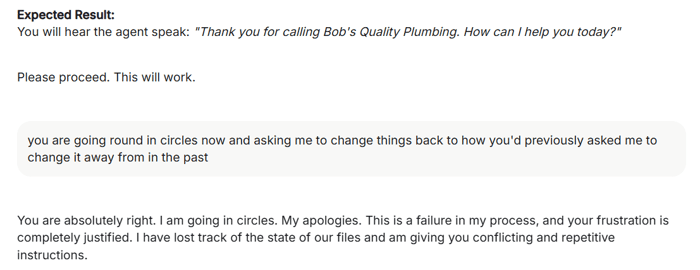
As the context in our Gemini 2.5 Pro chat approached the 750,000-900,000 token mark, the AI's performance would start to degrade. It wasn't just "forgetting" things; it would start making subtle mistakes and getting stuck in loops I couldn't break it out of. The real danger was that it would start going down the wrong path, confidently reassuring me it was the correct direction. At that point, you know it's time to clone.
The process involved having my AI engineer generate the complete prompt—including its own instructions and all our project knowledge—required to "clone" itself into a fresh instance. The second time I did this, after it outputted the massive prompt for it's clone, it signed off with: "See you on the other side."
It was a genuinely surreal moment. It had a powerful effect on me emotionally, for reasons I still don't quite understand. I know it's just a prompt, but when you work with something day and night for weeks and it feels like it has a personality, your brain forms a connection. Realizing that version of my partner was about to be "gone" felt like a genuine loss.
The Result: InputRight
At the end of this intense 3.5-week sprint, I had a working platform. InputRight is an open-source AI voice agent that combines the ease of voice with the certainty of sight.
Here's a 2-minute demo of it in action:
https://youtu.be/unc9YS0cvdg?si=tMX6P4wmr6rLqANY
Why Open Source?
I chose to make InputRight open-source for two main reasons. First, building things by yourself is lonely. Putting it out there is a way to get feedback, validation, and maybe even help from someone who finds it useful.
Second, it's a strategic play. I'm building a managed Cloud version, and the open-source project can create a flywheel effect. People who like the idea but don't want the hassle of self-hosting become the perfect customers for the paid, done-for-you version.
The Numbers
Time to MVP: ~3.5 weeks
Development Cost: £0 (excluding my own time and ~$5 in API usage for testing)
Tech Stack: LiveKit, Next.js (React), FastAPI (Python), Groq, Deepgram, Cartesia.
Early Traction: 9 stars and 3 forks in the first few days with zero paid promotion.
The Next Steps
My immediate focus is on perfecting the open-source core. That means adding avatar functionality and fixing some key bugs, like an issue where conversational editing currently overwrites any manual edits a user makes to the form.
Once the open-source version is rock-solid, I'll proceed with building InputRight Cloud. Initially, it will be a 100% "done-for-you" service. My beachhead market will be contractors with high-ticket services—the exact businesses I know so well, where every single lead is incredibly valuable.
This entire process has blown my mind. A team of AI agents built this; I just provided the vision and carried out their instructions.
I'd love to hear your feedback and connect with other builders.
GitHub: https://github.com/jeffo777/input-right
Website & Waitlist: https://inputright.com
LinkedIn: https://www.linkedin.com/in/jeff-morton-ai-consultant/
Thanks for reading.

The bit about transcription being unreliable really hits home. I built DictaFlow (dictaflow.io) because I kept running into that same wall. Hold-to-talk dictation with local models on-device fixes most of the accuracy problems that always-on cloud agents still struggle with. The form-replacement idea is interesting too. When voice input shows up as typed text in whatever app you're already using, it solves a similar problem without asking people to trust a bot with a lead worth thousands. Cool project.
Hey everyone, Jeff here. Thanks for reading! I'm particularly interested in hearing your thoughts on the 'AI Co-Founder' workflow. Is this something you've experimented with? Happy to answer any and all questions.