How I built Goals & Key Results feature in LeanPlanner to stop goals from becoming wishlists (Perfect for solo founders)
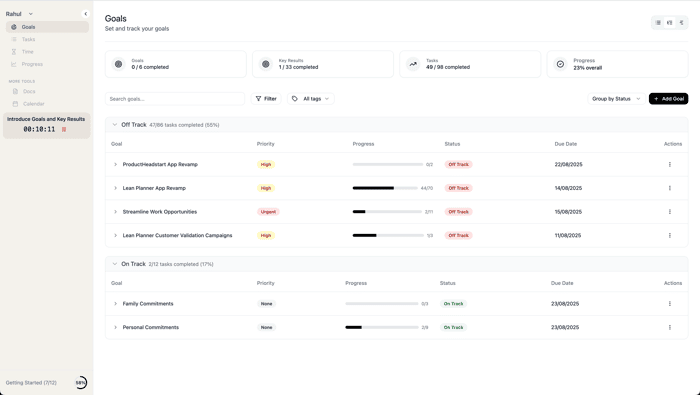
TL;DR — I shipped a Goals & Key Results feature in LeanPlanner that ties outcome-focused goals directly to the day-to-day planner and tasks. The result: fewer vague promises, more tiny wins, and faster shipping. If you’ve ever set a “big goal” and watched it quietly die in your backlog — this is for you.
I’m building LeanPlanner because I kept doing the same thing: set ambitious goals on Monday, dig into emails and meetings, and realize on Friday I’d made zero progress. OKRs are great on paper, but for solo founders and small teams they often live in a Google Doc — disconnected from the messy, daily work that actually moves the needle.
So I built Goals & Key Results that live inside your planner. Not another spreadsheet. Not another ritual. Something that makes goals actionable.
Here’s what it does and why it works.
Problem we fixed
Goals that are vague (“grow users”) → no clear next step.
Metrics-only KRs that never translate into tasks.
Goals living separately from your daily planner → low visibility and low momentum.
What we added (quick)
- Create Goals with a clear outcome and due date.
- Add measurable Key Results
- Add Tasks to those key results so that you have a clear roadmap
- Automatic progress bar that aggregates KR completion into Goal progress.
- Weekly review & reminders to keep goals visible .
Templates for common indie-hacker goals (launch, validate, get 100 signups, increase MRR).
How it actually works (the simple workflow)
Create a Goal. Example: “Launch LeanPlanner landing page — June 30.”
Add 3–5 Key Results. Make them measurable. Eg: “Landing copy completed,” “Design approved,” “Tracking + analytics live,” “100 waitlist signups.”
Attach tasks to KRs. Turn KR “Landing copy completed” into tasks: first draft, review, finalize.
Ship. Progress updates are visible every day; small wins build momentum and the goal doesn’t feel abstract.
Why this is different for indie makers
Outcomes → Actions: Instead of “work on marketing,” you have specific KRs that force clarity.
No context switching: Your goals are visible as soon as you open the planner and you can add tasks from your goals directly to today or add due dates so that they show on your upcoming tasks page - where you plan your day, so execution becomes natural.
Examples (copy these)
Goal: Launch landing page (30 days)
KR1: Copy first draft — Done
KR2: Design approved — Done
KR3: Tracking live + analytics dashboard — 1/1
KR4: 100 waitlist signups — 40/100
Goal: Validate pricing (6 weeks)
KR1: 10 paid trials at $9/month
KR2: 20 customer interviews completed
KR3: Pricing page A/B test running
KR-writing templates (use these)
“X% increase in [metric]” — for growth work
“Ship [feature] to production” — binary, great for launch milestones
“Complete N interviews / demos” — for validation
“Get N paying customers” — outcome-focused and obvious
What I learned building it
People don’t need more complexity — they need clearer connections between outcomes and tasks.
Visibility beats memory: simply showing goals in the daily view raises the odds of completion massively.
Start small: 3 KRs per goal is a better predictor of success than 10 fuzzy ones.
If you’re an indie founder trying to turn ideas into launched products: give it a try. I’d love feedback on the flow and the templates — what KR formats actually move you forward?
Try it at https://web.leanplanner.app and tell me which templates you want next. If you’ve shipped something with a similar system, drop your process — I’ll read every reply.
If this post helped, a tiny upvote or comment helps get it in front of other builders who are stuck turning goals into real work.
