How I Built TempMail3: A Fast, Developer-Friendly Disposable Email Service

Like many indie hackers, I constantly spin up new projects — small SaaS experiments, prototypes, or just weekend hacks. One recurring bottleneck?
Email verification.
Every new signup flow requires testing with fresh email addresses. Using my personal inbox quickly became a mess. Existing disposable email tools felt either outdated, painfully slow, or unreliable. Some didn’t even support API integrations, which made automated testing a nightmare.
That’s what pushed me to build TempMail3.com — a simple yet powerful disposable email service designed for developers and makers.
Why I Built It
The idea started out of necessity. During one of my side projects, I had to generate dozens of test accounts per hour. Manually creating Gmail/Yahoo accounts was unrealistic, and most disposable email services just weren’t built with developers in mind.
I wanted something that:
- Works instantly, with no signup friction
- Updates in real-time without refreshing
- Has a clean API so I could plug it directly into test scripts
- Doesn’t store anything longer than necessary (privacy + clutter-free)
So instead of fighting existing tools, I decided to roll up my sleeves and build my own.
Key Features
Here’s what makes TempMail3 stand out:
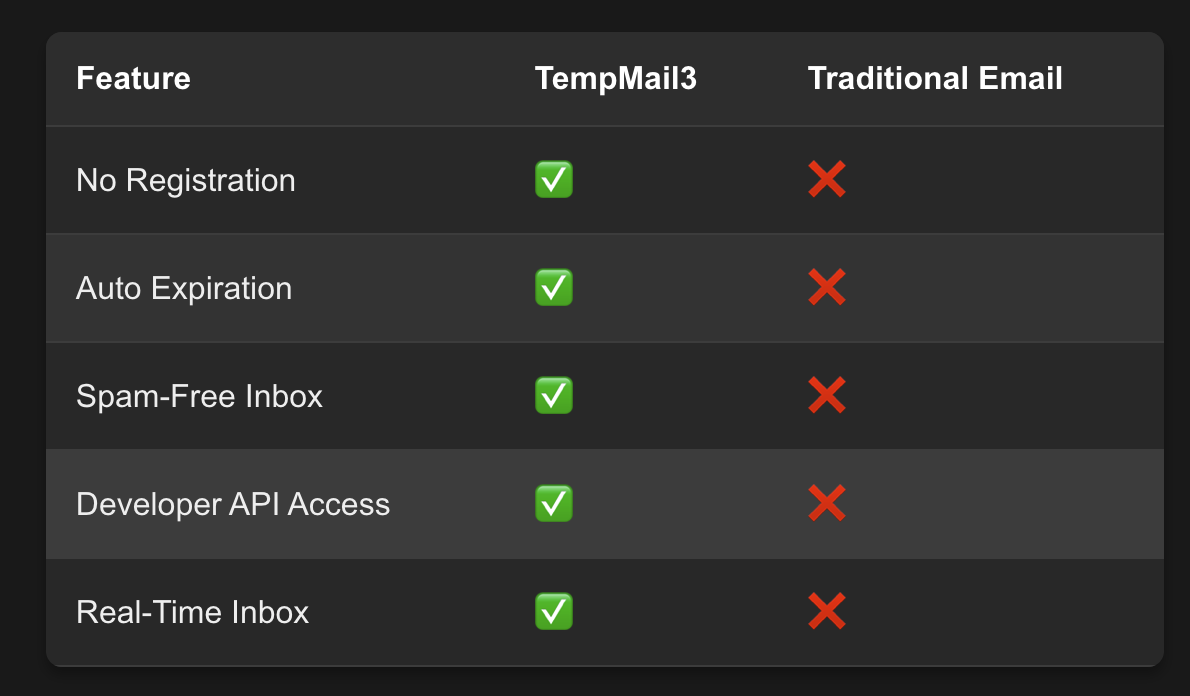
- ⚡ Speed First: Real-time inbox updates via WebSockets.
- 🛠 Developer API: Fetch inboxes programmatically for automated testing.
- 🔐 No Registration: Just open the site and get a disposable email address.
- ♻️ Auto Expiration: Mailboxes self-destruct after use, no clutter.
- 🚫 Spam-Free: Since addresses are temporary, junk never builds up.
Under the Hood (Tech Stack)
I kept the infrastructure lightweight but robust enough to handle scale:
- Backend: Node.js, with workers for email parsing and routing.
- Database: Redis, ideal for ephemeral data storage and lightning-fast reads/writes.
- Frontend: Vanilla JavaScript + WebSockets to stream inbox updates.
- Queue System: Ensures email delivery stays consistent even under spikes in traffic.
The stack is minimal by design — fast, cost-efficient, and perfect for an indie project that still scales under real usage.
Who Uses It?
- SaaS founders testing signup flows and onboarding emails
- QA teams running automated test suites that need disposable emails on demand
- Indie hackers (like me) who want a throwaway inbox without any extra hassle
Comparison Snapshot
A quick side-by-side view:
Lessons Learned
- Disposable ≠ Unreliable: With the right infrastructure, temp email can be as fast as your personal inbox.
- APIs Matter: A lot of existing services overlook developer workflows. Once I added API support, adoption grew faster.
- Simplicity Wins: The best feedback I’ve received so far was: “It just works.”
Final Thoughts
TempMail3 started as a weekend project to solve my own pain point, but it’s now something I use in nearly every project. Other indie hackers and dev friends told me it saved them time and headaches, which makes me glad I built it.
If you’re tired of juggling email clutter during testing, you might find it useful too.
👉 Try it here: tempmail3.com
Would love to hear your feedback or ideas for improvements. Indie Hacker stories are built on sharing — so if you’ve solved a similar problem in your projects, let’s swap notes!

Nice writeup — the Redis-for-ephemeral-data choice makes a lot of sense here, and WebSockets over polling for inbox updates is the right call for the "instant" feel you're going for.
I work on the flip side of this problem — building an email validation API — so this is a fun one to read from the other direction. A couple of things I'm curious about from that angle:
How are you handling domain rotation? One thing that made disposable-detection genuinely hard on my end is that services like yours (not picking on you specifically, just the category) tend to cycle through subdomains or spin up near-identical clones under new names once the main domain gets blocklisted by verification tools. Curious whether you've designed TempMail3 with that kind of longevity/rotation in mind, or if it's more single-domain by design.
Also — with auto-expiring mailboxes, how do you handle the edge case where a signup flow sends a delayed verification/welcome email after the mailbox has already expired? That's the one failure mode I'd expect QA teams to hit occasionally.
Good example of "simplicity wins" though — API-first was clearly the right call given how much adoption you mentioned coming from that alone. Nice case study either way for how far a minimal, well-chosen stack (Node + Redis + WebSockets) can go without over-engineering.