How I Forecast the Revenue Potential of SEO Before Creating Content
For years, I made SEO decisions in quite a haphazard way.
Find a relevant keyword. Check the search volume. Look at the difficulty. Then decide whether it seems worth targeting.
That worked — but it leaves out the thing I actually care about most:
If I rank for this keyword, how much revenue could it generate?
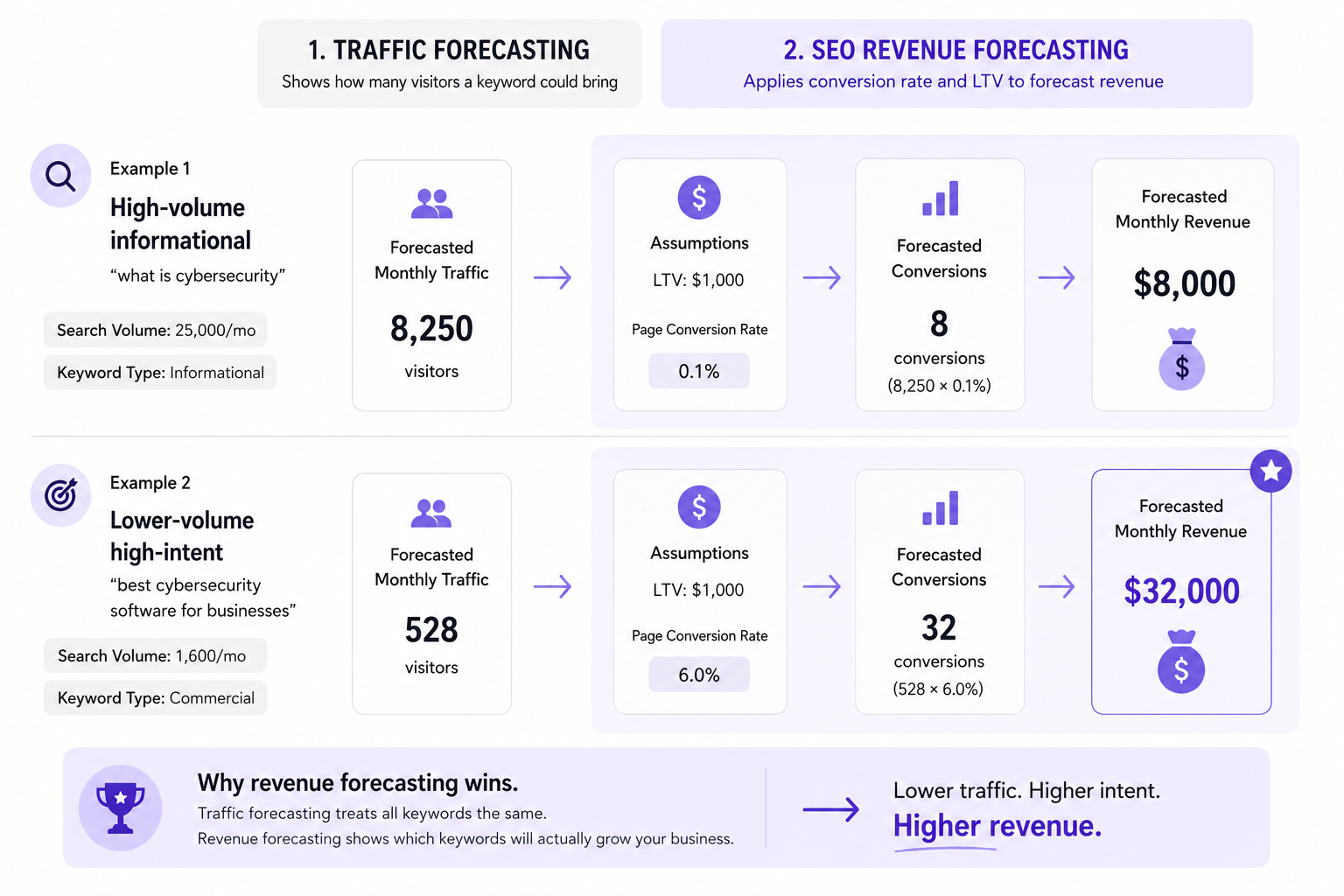
A keyword with 5,000 monthly searches can be almost worthless if the people searching are nowhere near buying.
Meanwhile, a keyword with 200 searches can be extremely valuable if it attracts exactly the right prospects at the point they are comparing products.
So before I create an SEO page, I now build a rough revenue forecast.
It isn’t meant to predict the future down to the last pound.
It gives me a consistent way to compare opportunities and decide which pages are most likely to produce a commercial return.
Here’s the process I use.
Step 1: Start with the keyword and monthly search volume
First, I find a keyword that has clear commercial relevance and pull its estimated monthly search volume from an SEO tool.
(I use Ahrefs, but any tool will work really.)
Let’s use this fictional example:
-
Keyword: employee onboarding software
-
Monthly search volume: 1,000
Search-volume data is never perfectly accurate, but that’s fine.
I’m using the same data source across all my keywords, so it still gives me a useful basis for comparison.
Step 2: Estimate how many searchers would click
Your page will only receive a percentage of the available searches, and that percentage depends heavily on where it ranks.
I normally forecast the potential at position one first.
For a standard organic result, I use a click-through rate of around 33%. This is taken from an average of a few benchmark reports I’ve seen.
So the calculation becomes:
1,000 monthly searches × 33% CTR = 330 monthly visitors
This gives me an estimate of how much traffic the page could attract if it reached the top position.
Step 3: Estimate the page conversion rate
Next, I estimate how many of those visitors could become customers.
This is where search intent matters much more than search volume.
Someone searching for “what is employee onboarding?” is probably looking for information.
Someone searching for “employee onboarding software” is much closer to choosing a product.
I therefore use different conversion-rate assumptions for different types of pages.
My usual starting assumptions are:
-
Core product pages: 5%
-
Alternative pages: 5%
-
Competitor comparison pages: 7%
-
Industry pages: 4%
-
Feature and use-case pages: 3%
-
Best-software list pages: 2%
-
Template pages: 3%
These aren’t universal benchmarks.
They are working assumptions that I can adjust based on the product, price, sales process and any real conversion data available.
For this example, I’d classify “employee onboarding software” as a core product keyword and use a 5% conversion rate:
330 visitors × 5% conversion rate = 16.5 customers per month
Obviously, you can’t acquire half a customer.
But keeping the decimal makes the forecast more useful when comparing lots of keywords.
Step 4: Add customer lifetime value
Traffic and conversions still don’t tell me what the opportunity is actually worth.
For that, I multiply the estimated number of customers by average customer lifetime value, or LTV — which is how much a customer will generate during their entire time using your product.
Let’s say the average customer is worth £1,000:
16.5 customers × £1,000 LTV = £16,500 in potential revenue
The full formula is:
Monthly search volume × expected CTR × page conversion rate × customer LTV
Or, using the example:
1,000 × 33% × 5% × £1,000 = £16,500
That gives me an estimated monthly revenue potential for reaching position one.
This is the revenue generated by one month’s worth of organic traffic, based on the lifetime value of the customers acquired.
It is not the same thing as £16,500 of monthly recurring revenue.
Step 5: Calculate the available uplift for an existing page
If I already rank somewhere for the keyword, I don’t count the entire £16,500 as an untapped opportunity.
Some of that value is already being captured.
Instead, I estimate the revenue at the page’s current position and subtract it from the potential revenue at position one.
For example, if the page currently ranks fifth and I assume a 5% CTR:
1,000 × 5% × 5% × £1,000 = £2,500 in current estimated revenue
The available uplift would therefore be:
£16,500 − £2,500 = £14,000
This is particularly useful because it helps separate two very different opportunities:
-
Creating a completely new page for a keyword I don’t rank for
-
Improving an existing page that is more likely to reach position one quickly
An existing page in position five may be a faster win than starting from scratch, even if its total revenue potential is slightly lower.
If I have real conversion data for a similar page, I’ll always use that instead of a generic assumption.
The model gets much more useful as you replace estimates with your own data.
Why I find this more useful than search volume or CPC
Search volume tells me how often something is searched.
It doesn’t tell me whether those searches are likely to become customers.
CPC is a useful signal because advertisers tend to bid more on commercially valuable searches.
But it still doesn’t tell me what a keyword is worth to my specific business.
The same keyword could be worth £500 to one company and £50,000 to another because their conversion rates and customer values are completely different.
Revenue forecasting makes SEO data more relevant to my business.
It also changes what I prioritise.
I often find that a collection of relatively low-volume comparison, alternative, feature and industry keywords has more commercial potential than a huge informational keyword.
That doesn’t mean informational content has no value. It can build awareness, links and topical authority.
But if my immediate goal is customer acquisition, I want to know which pages have the clearest route to revenue.
I don’t treat the forecast as fact
There are a lot of variables in SEO, and I’m not pretending this calculation removes them.
I don’t know exactly where a page will rank, what CTR it will achieve or how well it will convert before it exists.
Even the search-volume number is an estimate in reality.
But I don’t need the forecast to be perfectly accurate for it to be useful.
If I apply the same logic to 50 potential pages, I can quickly see which opportunities appear to be worth £500, which might be worth £5,000 and which could be worth £50,000.
That is a much better starting point than sorting a keyword spreadsheet by search volume and hoping the traffic eventually turns into money.
I’ve now built this into RevPages
I originally did these calculations manually in spreadsheets.
It worked, but collecting the keywords, assigning page types, checking existing rankings and applying the formula to every opportunity took a long time.
So I’ve now built this functionality into my SEO tool, RevPages.
You enter your website and customer LTV, and RevPages finds relevant SEO opportunities, estimates how many customers each one could generate and forecasts the potential revenue.
It also checks whether you already rank and prioritises the opportunities based on both revenue potential and how achievable they appear to be.
So, before spending hours or thousands of pounds creating content, you can get a clearer idea of which pages are most likely to produce a return.
I’ve also created a completely free SaaS SEO ROI calculator.
You can use it to determine how many customers SEO would need to produce to match your spending, or forecast how much revenue it could generate for your business.

I love this approach because it takes into account conversion rates and customer lifetime value, which makes the forecast way more actionable than just looking at search volume alone. I also appreciate how you present it as a comparison tool instead of a hard-and-fast revenue prediction.
the 33% ctr at position one is the shakiest input tho. ai overviews sit above organic on exactly these commercial queries now, so that benchmark is doing a lot of lifting
The revenue framing is much more actionable than search volume alone. Have you compared the forecast against actual outcomes yet—especially whether the highest-scoring opportunities are actually producing the strongest revenue after ranking?
I’ve found the revenue number only holds when the page answers a buyer decision, not when it is just one entry in a keyword list. Before approving a page, I score who is deciding, what they are comparing, and whether 3-5 supporting pages can reinforce the cluster. High-volume terms without that map have been worse for us than a smaller cluster tied to one purchase moment. I treat the forecast as a prioritization filter, then replace the CTR and conversion assumptions with observed data as soon as a comparable page has traffic.