How I got my first sale from a forgotten project
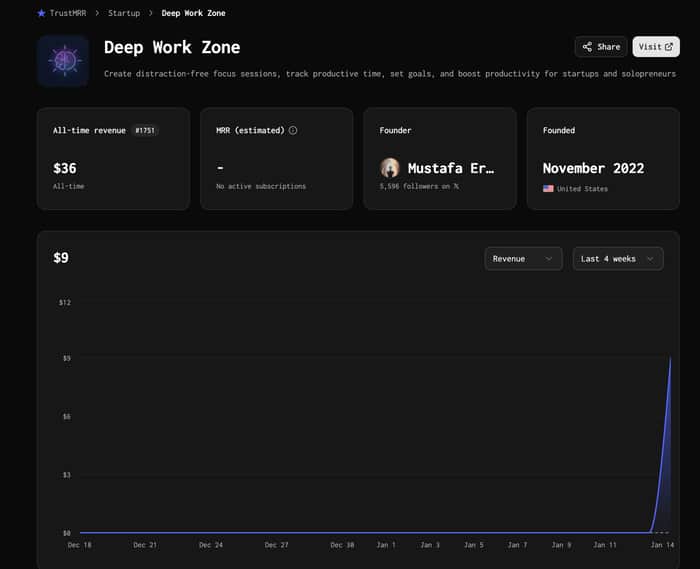
I built Deep Work Zone a while back — a productivity app for distraction-free focus sessions.
Launched it. Nothing happened. Moved on to other projects.
Recently, I added it to TrustMRR.
Got my first paying customer.
The lesson?
Your product might not be the problem. Your distribution might be.
We spend months building, days launching, and zero time on ongoing distribution.
Before you kill a project, ask yourself:
→ Have I really tried different channels?
→ Is it in front of the right audience?
→ Or did I just launch once and give up?
Sometimes all a "failed" project needs is a new home.
Don't bury your old projects. Reposition them.

"Your product might not be the problem. Your distribution might be."
This is such an underrated insight. Most founders (myself included) treat launch day as the finish line when it's really just the starting point for distribution experiments.
What made TrustMRR the right channel for Deep Work Zone? Was it the audience overlap, the discovery mechanism, or something else? Curious what signals told you it was worth trying there vs. other directories.
The distribution point is real. I spent a month building a niche software directory, seeding it with 570 tools, writing 50 blog posts for SEO. Zero revenue. Then I built a cold email pipeline, started sending 40 emails a day to software vendors who weren't listed, and got my first paid customer within two weeks. Same product. The only thing that changed was putting it in front of the right people. Most of the building time should probably be distribution time.
The distribution point resonates. I spent 2 months heads-down building, thinking the product would speak for itself.
Reality check: got rejected by one platform, had to pivot to another. Now realizing the "where to post" question is just as hard as "what to build."
Did you actively test multiple channels before TrustMRR worked, or was it more accidental discovery?
Thansk, I´ll tray that
The "forgotten project" framing is interesting because it implies we should keep mental inventory of what we've built, not just what we're building.
I have a folder of side projects I haven't touched in months. Some are genuinely dead ideas, but a few are probably just waiting for the right distribution moment. The hard part is knowing which is which.
One thing I've noticed: the projects that deserve a second look are usually the ones where I built something I actually wanted to use, vs the ones I built because I thought someone else might want it. The former tend to have better product-market intuition baked in, even if I couldn't articulate the target audience at launch.
Worth auditing that folder now.
Nice win. I think a lot of products aren't dead, just undiscoverable.
This hits hard. "Months building, days launching, zero time on ongoing distribution" - that's the trap.
I'm on Day 4 of launching MeetDone and already feeling the pull to go back to building features instead of doing the uncomfortable marketing work. Your post is a good reminder to stay focused on distribution.
How long did the project sit before you added it to TrustMRR? And did you change anything about the positioning, or just the channel?
Thanks for sharing, great takeaways! I’ve made some small projects before , but never promoted them properly.
This is very relatable.
I’ve seen many “dead” projects start working the moment they reach the right audience. Building feels hard, but distribution is the real long game — launch is just day one, not the end.
Sometimes a “failed” project just needs a new place to belong.
Don’t bury your old projects — reposition them.
This hit me hard. Every new launch comes with the same struggle: traffic. It’s exhausting and discouraging, and I’ve wanted to quit more than once. But after putting in so much time, I keep it alive, hoping that one day, at the right moment, things will click.
I just launched my first app (SelfOS, a productivity tool) a week ago — built with AI, no coding background.
Right now I'm figuring out distribution. Reddit karma limits, Indie Hackers posting restrictions... it feels like building was the easy part.
Your point about "one launch attempt isn't enough" is a good reminder to keep pushing. What other platforms besides TrustMRR would you recommend for productivity apps?
It’s so true... I almost gave up when I got banned on Reddit and saw zero traction on a couple of other platforms.
But I launched this to a local community 24 hours ago and was blown away by the response: 5,000 views and 60+ users on day one.
Sometimes we really do give up way too soon.