How I’ll choose the next startup idea

Have you spent weeks or months seeking a startup idea?
I understand that. You want to succeed and don’t want to waste time, but the opportunities out there drain your energy. Or even worse, you think if you spend more time researching, you’ll find the ideal startup idea.
I’m Wilbert, a solo bootstrapped founder. I made several products – one has sold, one is alive, and I’ll launch a new one soon. In this article, I’ll share my principles for choosing the next startup idea.
But first, let’s start with why.
Why it’s crucial to choose the right idea
Just ship it!
— Indie Makers
If you have no experience in shipping and launching products, read the quote above. Instead of researching, make. Build anything you want to see in the world – an OpenAI wrapper, a macOS app, you name it – and launch it. And you should stop reading this article right now. You need to practice executing, not ideating.
But if you’ve launched a few products before, there you go. Taking time to research will save you months or even years of building the wrong product. Well, it doesn’t mean you’ll be successful tomorrow. And it doesn’t mean you’ll not pivot either. What I mean is: Decrease your chance of failure. Adjust your direction when you really need it.
At the end of the day, you must shorten the time to revenue.
I’ve learned about it for years. As I build a new product, I set the principles on how to choose the right idea. And it helped me to focus and say no. I didn’t waste days or weeks to research. The chance is, you’ll find it useful to choose your next idea.
Narrow the options
Setting boundaries is the main idea here. Without it, analysis paralysis will knock on the door in no time. That said, here are my criteria for picking a startup idea:
1. I can be the first customer
Marketing is hard – at least for a technical founder like me. And one way to make it easier is to use your product every day. You’ll be on fire to tell the world that your product is solving a valuable problem. You can tell your struggles, alternative solutions, or why you keep going. Telling your stories is easier because you have the full context.
And here’s the kicker.

Being the first customer makes you know what to build and not to build. Step by step, you are carving your niche. And that separates you from a dozen similar competitors. At this point, don’t let yourself get distracted by the impostor syndrome – a whisper of I’m not different enough. So long as you’re using the product, you’ll find a way.
So now the question is, are you trying to make a product for you? Or are you trying to make a product for some imaginary people that you don’t care about?
2. I can find competitors on Google search
It is one of my favorite ways to feel the market demand. If I find few or no competitors, I’ll throw the idea off. That is because you must make the potential customers aware of their problems. Not only that, you must convince them about your solution too. It’ll take some amount of time and money that indie makers can’t afford. Don’t underestimate it.
It’ll be a different story if I can find at least 10 competitors. Let me show you an example.
I’ll start by searching for the category name. For example: Let’s say I want to build a product in the web scraping category. I’ll search for web scraping software, or web scraping tools, you get the idea. Here’s an example of the Google search result for web scraping software:
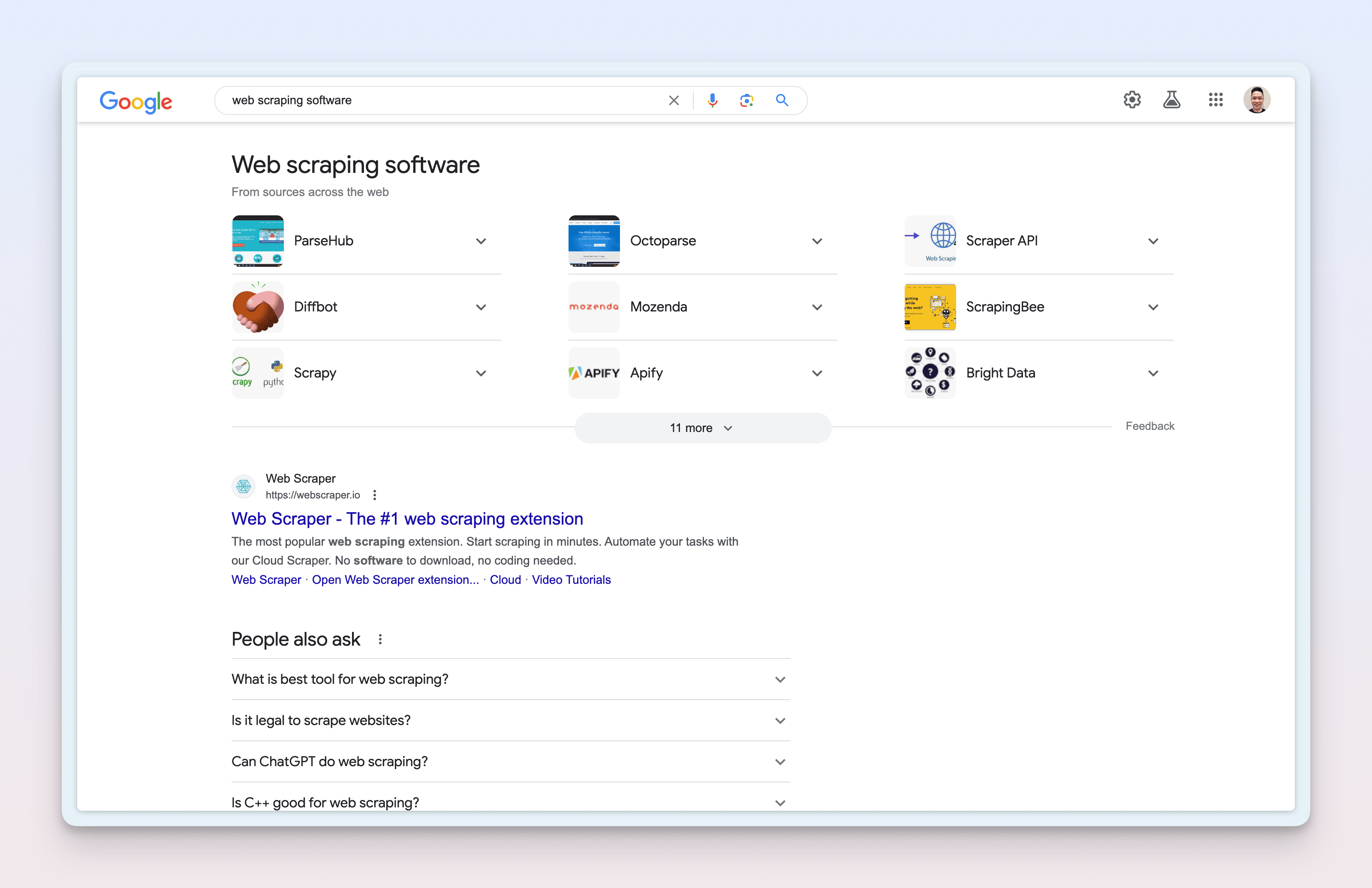
Can you find 20 products there? We can see 9, but there are 11 more. So that’s a good sign – different people want this kind of product. And I can go on to see the details of every competitor’s website. But at some point, I’ll try to shut off my brain and see it as a validation to move forward with an idea.
3. I can grow the business as an indie
I know it’s a subjective matter – different people have different goals. There is no silver lining to decide whether an idea fits for me as an indie. But we’ll start to see some lights when we inverse the statement. Instead of answering how I can grow the business as an indie, answer how I can’t grow the business as an indie. Now we can find some things to avoid:
Entering the VC-funded territory
Following every footstep of venture-funded companies will doom your startup. They have teams and want to conquer the market. As they feed their ambitions, they’ll try to build features to please everyone. Instead of following them, build a simpler product to get your startup off the ground. And here is my rule of thumb: The product scope should consist of 3 big things – at most – to get started.
Neglecting your competitive advantage
Ask yourself, what am I good at?
Do you want to build an API-first business? Make sure you love to deal with AWS Lambda, API documentation, and so on. Do you want to build a user-facing product? Make sure you are comfortable tinkering with interface design and usability. You should be able to identify where you can excel or at least have some interest in learning more.
Pricing your product too low
It’ll be a disaster to sell a $5/month product forever. Do you want to reach $10,000 MRR? Good luck to find 2,000 customers, let alone in 2 years. In contrast, you should aim to sell at least a $50/month product – 10x the price of the former. And that means you must 10x the product value as well. If you don’t have any idea how to 10x the value, ask your customers. A variation of what can I do to make a $50/month product worth it for you will surprise you.

To grow our business, let’s make sure to avoid those 3 things. More often than not, we’ll position ourselves toward success 80% of the time.
Closing thoughts
The purpose of this article is not to assure success. Even if you choose the right idea, you still need to do the ultimate validation – people pay for your product.
As you can still get wrong about an idea, don’t delay execution. Build, launch, and find out whether your idea is what people want to buy. If not, think about the next direction you can hop into and pivot. As you go, you’ll revisit how you choose the next startup idea. Either to start a new product or iterate the current one.
As a thought exercise, can you see that choosing the right idea is recursive?
You are welcome to re-read this article again in the future.

I'm very fascinated with other indies' mental heuristics when it comes to idea/market selection.
In addition to your 3 points (which I wholly agree with, especially #3), I also have the following other requirements for my ideation process:
It must be resilient to platform risk (no building on top of another company, no single-API product).
It must have baked-in virality (no back-facing products with 0 visibility, if I can't plaster a "powered by" link on my customers' product, I don't want it).
It must target the creator/solopreneur economy (they're accessible like consumers but think like businesses).
It must be the right timing (can't be a stale/shrinking market, it must be something quite "hot" in 2024 to put it plainly).
Solid points, Jay. And glad to see a reply from someone who has skin in the game :)
I’m curious on #3. Can you elaborate on why you target that market? What I know is creators/solopreneurs love to do everything by themselves and are price-sensitive. Wouldn’t it be harder to sell to them?
From my experience, a lot of creators are marketers/audience-builders by nature.
They're not tech-savvy for the most part.
We're talking about the guy who sells info products on Twitter and LinkedIn, not SaaS founders or developers.
So they're the perfect customer for software products that help them either build an audience or monetize that audience.
I've already created 2 products that do the former and the latter respectively to pretty good success.
Huge respect. Thanks Jay for sharing :)
Hi Wilbert.
You wrote that better to sell $50 per months product as it is easier to get less amount of users.
But It is a hard challenge to provide $50 value as indie from scratch. Firstly you try to validate your idea and launch mvp with less value, so your cost could be $5/months, and only if people want to pay for the product, you will expand services and gain value.
The question is what steps you think is good for the project launching? Example: mvp 5$ monthly product, got 15 clients, add services and raise price to $10 monthly, again got 15 new clients, etc.
Any ideas? Thanks
Hi Mike!
I can’t find any silver bullet on product launching. And it is not only because what works for me may not work for you. There are so many contexts I don’t know about your situation that may determine the launch outcome.
But here’s a principle to cling to.
Operate at a high velocity. Wherever you start, you’ll need to validate – as you said – and iterate. Your runway is also limited, you can’t do it forever. That said, you’ll need to keep the momentum going with progress. So don’t delay shipping. The more you keep going with speed, the faster you’ll figure it out without the burnout.
Good luck.
Make sense, make sense.
Do you think launching on free membership is good idea? On the one hand, your clients will be happy to get value for free, but on the other hand you will get people who do not want to pay. Are they my clients?
Free or not will deserve another post to cover. However, you can try it. Serve a free plan and try to convert those people to paying customers. You can stop that later if that's not a viable option.
Asking them point-blank with a monetary figure isn't going to yield the answers you want, because of a conflict of interest.
Very few customers would want to arm you with knowledge that will assist you in extracting more money out of them!
To customers, paying isn't a perk or satisfying; it's a necessary evil to get what they want from you.
I know you said "a variation of," but in my opinion a good example of that should align the interests of both parties, e.g.:
"What can I do to make the product 5x more valuable or useful to you?"
Honestly, I was really tired of constantly scrolling through countless blogs and RSS feeds just to stay updated with technology and industry news. So, I decided to take matters into my own hands and create own solution with my friend)
I am only testing it, so will appreciate your feedback on Peekly AI
What a great information. Thank you!
Your idea should be a pain killer and not an vitamin to your target users.
Depending on the maturity of the industry and how much budget your target audience can allocate, vitamin can also be a good product
Yes, but too much nuance to cover about that.
If we're being honest as an indie, selling vitamins is hard. You'll spend your time convincing people to buy products rather than helping them solve valuable problems.
That said, don't make it complicated. Sell painkillers, because the challenge ahead is waiting.
Choosing the right startup idea is about self-awareness, market validation, and sustainable growth strategies. It's a strategic to success.
That's a good high-level summary, Azura ;)
Hey Wilbert, I really enjoyed this! Any tips for choosing your first idea and launching your first product? I'm a solo bootstrapper who has a bunch of ideas percolating but have some trouble choosing the right one. At this point I think I'd just want to copy something that seems doable and do it.
Thank you, Rashid. Glad you enjoyed it.
About your question on choosing the first idea, I'll start with this: I assume you are a technical founder. As a dev, you tend to do more product work rather than marketing. This is where you can amplify your edge. Strive to narrow your ideas until you find the one that allows you to do less to no marketing.
But is there any market like that?
Absolutely. You may consider app's marketplace. And yes, they'll do the marketing for you – or at least you'll need to support them.
For some inspiration, I'll list some marketplaces I can recall:
Note that I can't explain all the ways to narrow your ideas here. It's not wise to get you into analysis paralysis. But the principle remains the same. Don't get too far from your circle of competence.
I hope you can find the right idea.
Be careful about app marketplaces.
If they cut you off, you're done for.
Just something to be aware of!
Hey thanks for taking the time to reply. You hit the nail on the head - I am a technical founder. Contrary to most advice, I like how your suggestion lowers the barrier entry for us devs who may naturally shy away from marketing related work. I'll be having a look at that!
I'm a technical founder too, that's why I can feel you. Good luck with your first product, Rashid!
Thank you for sharing the importance of both, increasing the price as well as increasing the value of the product in the same ratio. Very useful to plan a new product ahead.
Thanks for sharing your insights and thoughts for choosing a starting point. Your experience as a solo bootstrapped founder adds a valuable perspective to the process.
I just built a couple of products just on random ideas. Didn't make a dollar. LOL.
The idea of finding customers by talking is really hard for me.
Your ideas on how to validate are very useful. I will think about those terms next time I build a product.
Great advice!
I assume you are a developer yourself. What languages/tools do you generally use for your projects?
Wow, this post really resonates with me! As a fellow solo bootstrapped founder, I've also launched a few products and understand the importance of choosing the right startup idea. The principles shared in this article are spot on, especially the part about being the first customer and finding competitors on Google search. It's so important to have a personal connection with your product and ensure there's a market demand for it.
The part about growing the business as an indie is also something I've been thinking about a lot. It's easy to get caught up in trying to follow the footsteps of VC-funded companies, but it's crucial to focus on building a simpler product and leveraging your unique strengths. And of course, pricing your product appropriately is key to sustainable growth.
Overall, this is a fantastic article that offers valuable insights for anyone looking to choose the right startup idea. It's definitely something I'll be referring back to in the future.
good article
pivot is such a beautiful word
It may be, but it also rarely works.
Hi Wilbert, nice post!
You wrote that “If you have no experience in shipping and launching products, read the quote above. Instead of researching, make”. Could you expand on your reasoning or experiences that led you to this conclusion a little more?
I’m a developer who would like to start my own business, but I get stuck trying to find an idea that seems worth validating. If you’ve had a similar experience or have relevant insight I’d love to hear about it!
I was on a similar trajectory when starting up, so I know that clueless moment. I was stuck on researching what to do for months. Yes, for months. And that didn't lead me to anything.
But something changed when I decided to build something.
I started to solve my problem, which was about emoji picking on macOS. I felt the pain of using the built-in emoji picker and I tried to seek a solution. I couldn't wrap my head because no solution fits my needs. I made an app for that, made thousands on the launch day, and sold that for 5-figure after 2 years. After that though, I also have a bunch of ideas from my experience running the business.
So what's the takeaway here?
When starting, researching a perfect idea will only lead to frustration. Stop doing that. You'll gain more experience, money, and ideas when you start shipping something.
I hope that makes sense :)
Thanks! That’s very helpful 🙂
Research can inform future pivots and adjustments, ensuring they're based on data and market reality. Regardless of experience level, the ultimate goal is to reach users and generate revenue, highlighting the importance of efficient product development. While advocating for either action or research based on experience, finding a healthy balance between the two is essential for any product journey. Even beginners can learn through research, especially user research and competitor analysis, to inform their building process.
Great article, I indeed gained many ideas from it. Thank you.
You’re welcome, Hoothin. Can’t wait to see what you’ll make.
I agree with your thoughts at many points.
Thx for encouraging me to START :)
Glad to hear. Let’s go!
Thank you so much!
My pleasure, Lena :)
If you're interested, you can sign up for the waitlist of my upcoming product powered by AI that helps indie hackers surf the net smarter. https://docs.google.com/forms/d/12_61gyfbikrw-2g3iNmfEgB3iW-Mci-AGiqpEDnPwQ4/edit?pli=1
You'll sell more if you stop promoting and start to learn marketing. Sleep on it.
alright... thanks
Shameless plug, but I've actually written over 200 ideas (I used to run an idea newsletter called Unvalidated Ideas, and I think there are at least 10 GEMS in there. I put all the ideas into a book so you can buy it all at once instead of subscribing (thanks to all the subscribers that supported me over the years!)
I personally think most of the 200 were at least fit to publish, but I stopped writing the newsletter because I ran out of
If you're into this, and you're an indie hacker (i.e. you have an account on here, and actually build shit) -- send me a quick email and I'll give you a discount code for $10 off.
Just a note though -- having someone you know in an industry with a REAL pain point is always better than having an idea. But ideas generally don't hurt because they get your brain moving and thinking, and applying principles cross-functionally.
But but.., you need more shame here. Rather than plugging your product everywhere, start providing real values to your potential customers.
If you think your reply here provides value, you don't.
OK Wilbert, how is this for value -- I'll post 4 ideas I think are really good.
Anyone reading this should instantly have some stuff they could go off of to build something new.
Executive Level Perks Bundle
One stop shopping for executive perks.
Build a all-in-one purchasing experience (and review/voting experience) for perks that cost less than straight salary & stock for companies to offer to their highest paid executives.
Great example is the Mayo Clinic Executive Health Program
Cheap House, Fast Internet
Start a listing site for a new generation of home owners who are looking for places to live that are cheap and have fast internet.
Content/Newsletter publishing Workflow
Build/adapt a Kanban workflow for people managing newsletters.
Right now building a newsletter involves writing, but most of the work of scaling a newsletter is:
Hooking into both platforms like Substack and Beehiiv would make this even better -- this way you could actually cross publish the newsletter, and the actual writing is the last of your concerns.
Build and curate essential kits
Build a simple content site where people can curate and build essential kits for whatever profession they're in.
There are already examples of this, but they're usually in certain niches -- PC building, Audio setups, r/battlestations, etc.
These niche setups are actually all the same -- they're a list of stuff that people use, where to buy it, and how to put it together in a way that helps them do X. If you gather that all in one place, you'd have an amazing cross-niche database of how people enjoy and spend their money (!) and time.
Hey Wilbert! I must say, the struggle is real when it comes to finding the perfect startup idea. But with your determination and creativity, I have no doubt that you'll come up with something amazing! Keep hustling, my friend.
Thank you for the kind words :)
its really amazing information you share .
Hope it helps you in some ways.
Hey Wilbert. Great article you wrote there. I just went through similar steps and especially the point of I as a indiehacker am able to build it narrowed down my niche. Additionally, I believe an essential consideration is to gauge customers' openness to adopting a standalone product. This aspect is crucial, given the challenges with integrating into established ecosystems.
Yes, that's a good point.
Now let's think about it – someone is going to die because he lacks oxygen, will he refuse the oxygen from the hospital? No, right? He'll accept it because he wants to live. My point is: Solve a valuable problem that people want to buy.
Pardon my exaggeration, but you get the idea.
Thats Great
Regards
Thanks Emma :)
It seems like important advice that comes from experience. I haven't made a product yet, but I would like to try it someday. I should make good use of the advice from this article when I do. Thank you.
Sounds great! Let me know if you have questions in the future.