How I’m Building a Bootstrapped Business in 2025 with Just AI and Time (No Capital, No Team)
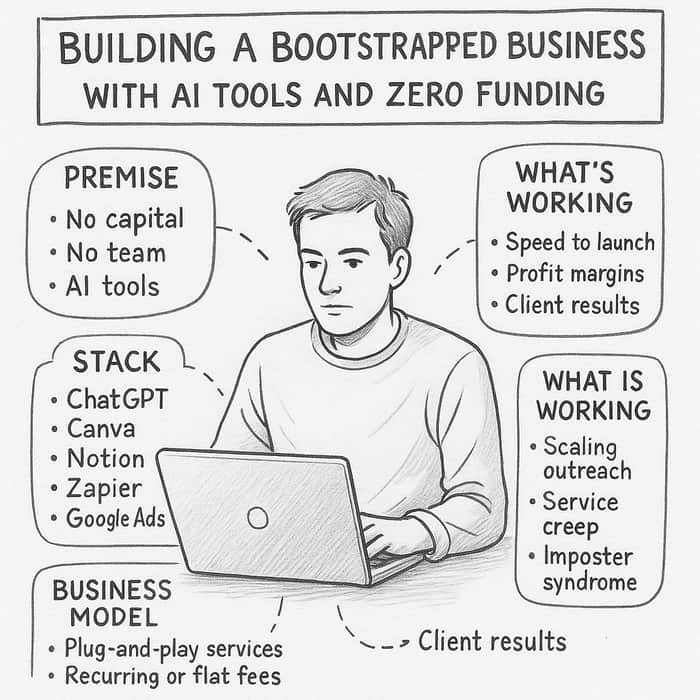
In a world where funding announcements and Series rounds dominate headlines, there's another quieter revolution underway — solopreneurs leveraging AI to build profitable, sustainable micro-businesses without raising a single dollar. I'm part of that wave.
Here’s a transparent breakdown of what I’m doing, what’s working, and what isn’t — shared for fellow indie hackers navigating the same terrain.
The Premise: Build Something Small, Smart, and Self-Running
I didn’t have venture capital. In fact, I didn’t even have ₹10,000 spare to “test” with. What I did have:
A laptop
Time (plenty, because I was unemployed)
Curiosity
A digital marketing background
And most importantly, I had AI tools that could compress the time and skill gap usually needed to build anything functional.
The Stack I’m Using (Free or Low-Cost)
Content Creation:
ChatGPT for long-form content, email copies, ad scripts
Canva + Midjourney for visuals and branding
Landing Pages & Websites:
Notion, Framer, and WordPress (depending on complexity)
Automation & Ops:
Zapier, Make, and Airtable to automate client onboarding, lead scoring, email drip campaigns
Marketing:
Google Ads (₹500–₹1000 test budgets with precise targeting)
LinkedIn cold outreach (AI-personalized via Waalaxy or PhantomBuster)
Sales & Funnels:
Systeme.io and ConvertKit (basic free plans) for email capture and basic upsell/downsell flows
The Business Model
I’m not chasing vanity metrics. The goal is simple:
Find micro-problems in niches like local services, solo coaches, or overwhelmed Shopify owners.
Offer plug-and-play services like automated lead gen, landing page design, or email automation setup.
Charge recurring or flat fees.
Use AI to execute 80% of the work, manually finalize the remaining 20%.
What’s Working So Far
Speed to Launch: Each service line takes 48–72 hours to set up now.
Profit Margins: Since there’s no team, no office, and no tools over $50/mo, margins are ~85%.
Client Results: Some clients have doubled inquiries within 2–3 weeks thanks to basic automation and structured retargeting.
What Isn’t Working
Scaling Outreach: Cold email & LinkedIn campaigns are still trial-and-error. Deliverability + personalization are challenges.
Service Creep: Clients often want “one more thing” outside the automation scope. Drawing boundaries is hard but necessary.
Imposter Syndrome: Even with tools doing 80% of the job, the mind often questions—"Am I really building something sustainable?”
What I’ve Learned
Start extremely niche — I began by targeting “solo nutritionists in Tier-2 India cities.” That clarity changed everything.
Don’t chase SaaS dreams from Day 1 — services with AI can fund your product ideas later.
Learn just enough tech to not be dependent — automation is easier when you know what’s happening under the hood.
Final Thought
This AI wave isn't just for large enterprises. It’s a once-in-a-generation opportunity for solo creators to build something meaningful — even without coding or funding. All it requires is the willingness to test, fail fast, and focus on real problems.
Are you building solo with AI too? I’d love to swap ideas or breakdowns with others on this journey. Let’s grow together — no fluff, no hype, just real execution.

The "AI handles 80%, you refine the 20%" framework is exactly right. The founders I see struggling are the ones trying to make AI do 100% — it doesn't work yet, especially for anything client-facing.
One thing I'd add: the biggest bottleneck for solo AI-powered businesses isn't building — it's distribution. AI compressed the build cycle from months to days, but it hasn't compressed the trust-building cycle at all. People still need to see you, hear from you, and trust you
before they buy. That part is still fundamentally human and still takes time.
The niche focus on local services and small shop owners is smart. Those are people who aren't on Twitter debating AI tools — they just want their problem solved. Less competition, more willingness to pay.
I focus on one tiny problem, then use simple AI tools to handle repeats like emails, drafts, and quick research. That frees my time for the parts that actually move the business forward.
The deliverability + personalization challenge you mentioned for cold email is the exact wall I keep running into too. The technical side (building the product) is increasingly solvable with AI tools, but distribution still requires either an existing audience, a residential IP and organic account history, or money for ads. None of those come free.
What's worked for me when targeting very specific niches (in my case, clinical educators) is going one level smaller on targeting. Instead of 'PA program directors,' targeting 'PA programs at state schools that added new clinical rotations in the last year' — that specificity made personalization easier and open rates went up noticeably. The lead list is shorter but the signal is much cleaner.
The scope creep issue with clients is something almost every productized service founder hits. Having a literal feature request form that automatically generates a quote for out-of-scope work has been mentioned as a good boundary-setter — removes the awkward negotiation. Have you tried any specific framing when clients push outside the defined scope?
If you’ve got a leads CSV + outcomes, I can replace points-rules with a trained scorer, can show it in a 90-sec video. If you're interested :)
This is super exciting to read for someone that is just starting to try to figure this out. Alone.
Sounds good actually. I love the breakdown.
Man, this is such a solid breakdown. The Tier-2 nutritionist niche part really hit — love how focused you got. Respect for sharing the wins and the struggles!
what has been your best performing customer acquisition channels (and for which target group)?