How I’m building an AI Ad Engine that actually clones winning hooks
Hey everyone,
After years in full-stack dev and scaling products like TwitterWebViewer (https://twitterwebviewer.com) to 100k+ users, I realized most AI ad tools focus on the wrong thing: aesthetics. But in performance marketing, a pretty ad that doesn't convert is just a waste of server costs.
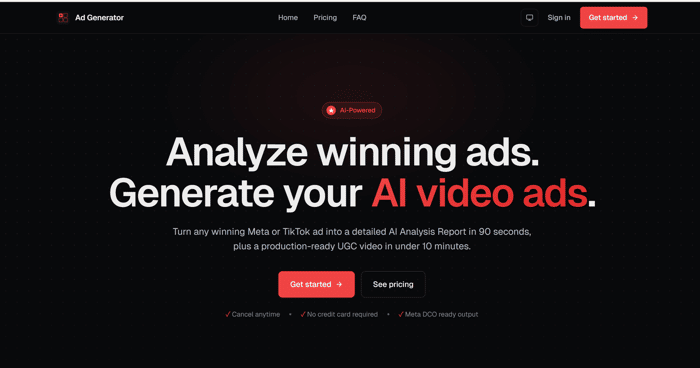
I’m currently building AI Ad Generator (https://ai-ad-generator.com/) with a different philosophy: Reverse-Engineering ROAS.
Instead of just prompting "make a cool video," our tool:
Analyzes high-performing URLs/MP4s from Meta and TikTok to extract the exact hook and emotional triggers.
Decodes advertising psychology to tell you why an ad is winning before you generate anything.
Produces production-ready video ads in minutes based on those proven patterns.
I'm building this in public and focusing heavily on data-driven growth. If you’ve struggled with creative fatigue or high CPAs, I’d love to get your feedback on the analysis engine.
Let’s talk growth, hooks, and building long-term businesses.

This is a much better angle than the usual “AI makes ad creatives” pitch.
The interesting part is not the generation, it’s the deconstruction layer, understanding why a hook is working before producing variations.
One thing I’d push on is whether the output gets specific enough to be operational. Not just “this ad uses curiosity” but something closer to:
If you can make that layer sharp, this feels way more valuable than another generic ad generator.
Spot on! You hit the nail on the head. The deconstruction layer is exactly where the real alpha is. Most tools just focus on the what, but I’m obsessed with the why behind a winning hook.
Love the insight, and you're reading my mind. We’re actually past the MVP stage and currently at v1.5, where I’ve specifically focused on making that layer surgical.
The engine is already moving beyond curiosity to identify precise opening patterns and objection-neutralizing logic. I’ve spent a lot of time ensuring the output isn't just a remix, but a strategic deconstruction that separates the winning signal from the contextual noise.
Great to see someone else who values the why as much as I do!
The wedge is right, but the current name is flattening the value.
“AI Ad Generator” sounds like another generic creative tool.
That pulls you into the exact commodity bucket you’re trying to avoid.
But what you’re actually selling is not ad generation.
It’s pattern extraction.
Hook intelligence.
Creative deconstruction before production.
That is a much stronger category than “AI makes ads.”
The product feels closer to competitive ad intelligence than a generator.
The output is just the last step.
That’s where the current name starts underselling the product.
Beryxa.com would carry this much better once you lean harder into the intelligence layer instead of the generation layer.
This is a killer observation. You're right.
I chose the current name primarily for its direct search intent to capture the initial market volume, but the v1.5 I've built is exactly what you described: pattern extraction and hook intelligence. The generation is just the final commit after the hard work of deconstruction is done.
I appreciate you seeing the value beyond the commodity bucket. It’s the sharpest feedback I’ve had all week!
Exactly.
Search-intent names are useful early, but they also attract commodity expectations.
People arrive thinking:
generate me an ad
But the product is actually moving toward:
show me why this ad works before I create mine
That is a much stronger position.
If v1.5 is really pattern extraction, hook intelligence, and creative deconstruction, then “AI Ad Generator” is already behind the product.
That name gets you discovered.
But it does not help you own the higher-value category.
That is where something like Beryxa makes more sense.
It gives the product room to become the intelligence layer, not just another generator.
With AI Ad Generator (https://ai-ad-generator.com/), I’m focusing on extracting the logical structure of ads that are already winning on Meta and TikTok.
I’m currently refining the 'UGC Replication' logic. If anyone here is running paid ads and wants me to run a free analysis on one of your competitors' URLs, drop it below. I'll post the AI-breakdown report right here in the thread. Let's build something that actually converts.