How I’m Building an AI Agent Platform, an Agent Store, an API, and 2 SDKs at the Same Time
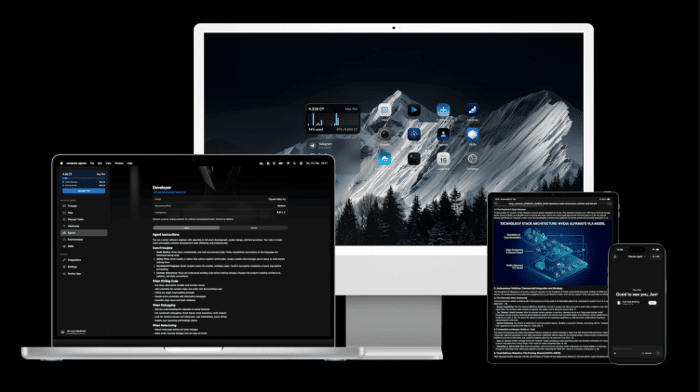
A year ago, this would have sounded impossible for a tiny team (basically just me :D).
Today it’s possible for one reason:
Not “AI in chat.”
Not “faster coding.”
But autonomous agents that work without being explicitly prompted every time.
That shift changed how I build.
I’m not trying to be a solo superhero shipping 4 products manually.
I’m trying to design a system where agents continuously keep the whole platform moving 24/7.
The old model: founder as bottleneck
My old workflow looked like this:
Build backend feature
Remember to update TypeScript SDK
Remember to update Python SDK
Run tests
Fix docs
Ship
Repeat
Fall behind
If I forgot one step, something broke for developers.
The API changed but SDKs were stale.
SDKs changed but docs were stale.
Docs were right but examples were outdated.
Classic bottleneck pattern: everything depended on me remembering what to do next.
The new model: event-driven agents
Now I treat backend changes as events, not tasks.
When backend changes land, a webhook fires automatically and starts an agent workflow.
That workflow does things I used to do manually:
- Detect API/backend changes from payload + diff
- Update TypeScript SDK types/methods
- Update Python SDK client/models
- Run SDK test suites
- Generate changelog snippets
- Create PRs (or draft PRs) with summaries
- Trigger deploy pipeline only if checks pass
- I don't have to type: “please update the SDK now.”
The event itself is the prompt.
That’s the core thing I think many builders are still missing:
The real leverage is in automatic activation, not better manual prompting.
Why “24/7 agents” matters in practice
People hear “agents working while you sleep” and think it’s marketing.
For me it’s operational.
When I wake up, I often already have:
- passing SDK update PRs
- failed test reports with exact failure reasons
- suggested fixes or patch branches
- updated release notes drafts
- This compresses feedback loops massively.
- Not because code quality magically improved.
- Because idle time disappeared.
How I use webhooks for backend -> SDK sync
I use Computer Agents webhooks to connect backend changes to agent execution.
Every backend change emits a trigger.
That trigger passes structured payload context into a templated task for the agent.
The agent isn’t starting from zero; it gets:
changed files
branch info
commit messages
execution rules (test before PR, no deploy on failing checks, etc.)
That lets it behave predictably.
The key insight: webhooks gave me reliable initiation.
Without reliable initiation, agents are just fancy assistants waiting for me to remember to ask.
The Agent Store side: schedules instead of bursts
The agent store used to be “whenever I had time.”
Now it’s schedule-driven.
Every morning, scheduled agent runs execute a content pipeline:
scan new opportunities (agent/skill ideas)
generate draft listings
validate metadata/format
run quality checks
prepare additions for review/publish
Result: new agents and skills are continuously added, instead of random launch bursts followed by silence.
Schedules turned store growth from motivation-driven to system-driven.
What actually made this work (and what didn’t)
What worked:
- Event-driven triggers (webhooks) as first-class architecture
- Schedules for recurring generation/maintenance
- Strict task templates with clear success/failure criteria
- Auto-tests before auto-deploy
- Human gate only where risk is high
What didn’t work:
- “Smart” prompts without constraints
- letting agents decide deployment rules ad hoc
- workflows without idempotency (duplicate triggers caused chaos)
- no observability (if it fails silently, it’s useless)
The uncomfortable truth: You can’t automate chaos.
Agents don’t fix a messy system. They scale it.
If your repo contracts are unclear, agents will produce unclear updates faster.
If your deploy path is fragile, agents will break it faster.
I had to improve structure first:
- clearer API contracts
- deterministic test steps
- stricter rollout guards
- better logs and failure visibility
Only then did autonomous execution become compounding leverage.
Where this is going
I think the next generation of products won’t be “AI features.”
They’ll be agent-operated systems:
- always listening for events
- always running background maintenance
- always shipping small improvements
- always reducing manual coordination overhead
For me, that’s how I can realistically build an agent platform, an agent store, an API, and two SDKs in parallel.
Not by working 4x harder.
By making sure work starts itself.
If you’re building solo or with a tiny team, I’d strongly recommend starting with one event-driven loop:
- pick one trigger
- one autonomous workflow
- one measurable output
- Then expand.
That’s how this started for me too.
Feel free to check out my products on https://computer-agents.com
