How I stop my important emails from going to spam and build long-term sender credibility with one simple trick.
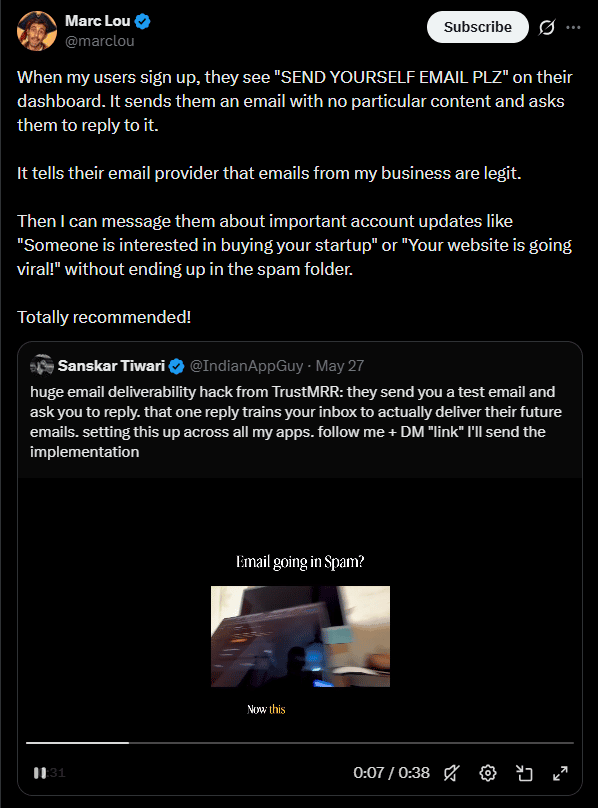
Hey IH, The most painful thing as an indie hacker isn’t building the product — it’s discovering that your welcome emails, password resets, and billing notifications are landing in spam or Promotions. Users miss them → they think your product is broken → you get angry support tickets → your sender reputation slowly dies. I used to fight this with SPF, DKIM, and warm-up services. They help, but they’re not enough. Then I started using the smartest hack I’ve seen (originally shared by @marclou
): Right after a user signs up, automatically send a simple “Reply Plz” email asking them to reply with anything. That one small reply does two powerful things: It creates a strong positive engagement signal that tells Gmail, Outlook, and other providers “this user wants emails from this sender”
It dramatically improves your long-term sender credibility and deliverability
The difference is night and day. So I built ReplyBoost — a dead-simple tool that automates this entire flow.
How ReplyBoost works: Connect Resend, Postmark, or Mailgun in 2 minutes
Add one webhook on new signups
It automatically sends a clean, friendly “reply plz” email
You get reply analytics + better inbox placement over time
No complicated setups. No ongoing warm-up needed. Just one clever trigger that prevents your messages from going to spam and builds real credibility with email providers. I’ve been using it myself and the reduction in “I never got your email” messages is noticeable. If you’re a solo founder or small SaaS team tired of fighting spam folders and losing users because they never saw your emails, this might be worth checking out.→ ReplyBoost {https://send-reply-shine.vercel.app/] Have you struggled with deliverability issues?
Did the manual “reply plz” trick ever work for you? Would love to hear your experience

Interesting idea. I think the reply signal can help, but I’d treat it as one layer rather than the whole deliverability solution.
The part I’d be careful about is timing. For welcome emails, the “please reply” flow makes sense because the user has just signed up and is still engaged. But for password resets, billing notices, and account/security emails, you often need reliability before any relationship signal has been created. So SPF/DKIM/DMARC, domain reputation, clean sending patterns, and boring infrastructure still matter a lot.
I’m working on something adjacent in the custom-domain email space, and one thing I keep noticing is that founders often collapse several different problems into “email deliverability.” There’s authentication, DNS setup, sender reputation, user engagement, content, and inbox-specific behavior. The reply trick probably helps most with the engagement/inbox-behavior layer, but it doesn’t replace the lower layers.
That said, I like the practical angle. It turns a vague reputation problem into a simple user action. I’d be curious whether you’ve seen different results between Gmail, Outlook, and custom-domain inboxes.
Interesting.
The thing I'd be careful with is that the reply email may not be the actual product people are paying for.
Sometimes the visible mechanism and the buying reason are different things.
That sounds subtle, but it can have a surprisingly large impact on who buys, why they buy, and what they compare the product against.
I'd be careful making that call casually.