How I Use Crawlbase’s Crawling API to Gain a Competitive Edge in Google Ads
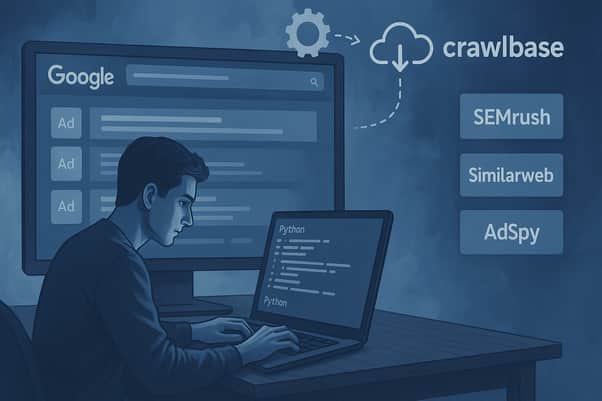
Introduction: Why Competitive Intelligence Is Essential in Paid Search
In the world of paid search, every impression and every click has a price — and behind every winning Google Ads campaign is a well-researched, data-driven strategy.
But building that strategy is harder than it looks.
Most marketers and founders operate with incomplete information. We know who we’re competing against. We can guess their high-level messaging. But unless we have real-time access to their live ads, we’re often optimizing campaigns based on partial signals or assumptions.
That's where real-time competitive intelligence becomes a critical edge. And recently, I found a way to build that intelligence layer efficiently — by using Crawlbase’s Crawling API.
Why Competitive Research Matters More Than Ever
Google Ads has evolved into a fierce, dynamic auction.
Every keyword you target, every bid you place, and every ad you run competes directly against others doing the exact same thing.
It’s not enough to create good ads. You have to create better ads, smarter bidding strategies, and stronger funnels than the competition.
Real-time competitor analysis allows you to:
- Identify high-priority keywords based on live bidding patterns
- Study evolving ad messaging and creative trends
- Benchmark landing page experiences
- Detect new competitors early
- Adjust your offers and CTAs proactively
But you can’t rely purely on static snapshots or marketing folklore. You need access to what's happening now — and that's exactly the gap that Crawlbase’s Crawling API fills.
Traditional Tools vs. Real-Time Data Collection
Before I started working with Crawlbase’s Crawling API, I primarily used standard SEO and PPC tools like SEMrush, SpyFu, and Ahrefs.
These platforms are useful. They offer keyword rankings, historical ad snapshots, and estimated spend data. But they share two big limitations:
-
Time lag
Most datasets are aggregated and updated in batches, meaning you might see competitor moves days or weeks after they happen. -
Lack of specificity
You get what the platform provides. You can’t easily customize the view to fit your niche, local market, or highly specific keyword groups.
I realized that if I wanted real agility, I needed a method that gave me fresh, unfiltered access to the actual search results users were seeing.
That led me to experiment with direct scraping approaches — and eventually to standardize my process using Crawlbase’s Crawling API.
What Makes Crawlbase’s Crawling API So Useful?
There are several reasons why I landed on Crawlbase’s Crawling API after trying a handful of options.
-
Handles Anti-Bot Mechanisms
Google is notoriously aggressive about blocking bots. Crawlbase’s Crawling API takes care of rotating IPs, spoofing headers, and navigating CAPTCHAs, so I could focus purely on the data. -
Structured Output
Instead of scraping raw HTML and parsing manually, I could request structured JSON data, making it far easier to extract ad units specifically. -
Flexibility
Crawlbase’s Crawling API let me define exactly which keywords, locations, and devices I wanted to simulate — replicating real-world scenarios without being detected. -
Scalability
Whether pulling ten queries or a thousand, Crawlbase’s Crawling API scaled effortlessly without me needing to manage infrastructure. -
Reliability
Consistent uptime and predictable request behavior made it production-worthy for recurring ad intelligence tasks.
How I Use Crawlbase’s Crawling API Step-by-Step
Building a competitor ad monitoring system with Crawlbase’s Crawling API was straightforward once I had the workflow clear.
Step 1: Define Target Queries
I identified the keywords and search queries most important to my market segment — including branded, non-branded, and competitor-specific terms.
Step 2: Set Up Crawl Requests
Using Crawlbase’s Crawling API, I set up automated calls to fetch Google search results for those keywords on a regular schedule (daily or weekly, depending on how dynamic the market was).
Step 3: Parse Ad Data
Because Crawlbase’s Crawling API returned structured data, I could easily isolate ad headlines, descriptions, URLs, sitelinks, and positions.
Step 4: Store and Analyze
I logged each crawl’s results into a simple database, allowing me to track changes in ad creative, shifts in ranking, or the appearance of new competitors over time.
Step 5: Take Action
Based on the data collected via Crawlbase’s Crawling API, I optimized my own ads, adjusted bids, refreshed creative, or shifted keyword focus — always staying a step ahead.
Key Insights Gained from Using Crawlbase’s Crawling API
After several months of using Crawlbase’s Crawling API consistently, I learned a few powerful lessons:
-
Competitive pressure varies by keyword
Some terms were battlegrounds with aggressive ad turnover; others had dominant players running consistent ads month after month. -
Messaging trends evolve fast
Competitor CTAs, offers, and value props shifted seasonally — often in ways no third-party tool flagged in time. -
Landing page strategies reveal priorities
Monitoring landing pages linked from ads gave deeper clues about product launches, promotional cycles, or new service expansions. -
Ad extensions are tactical signals
The type and frequency of sitelinks, callouts, and structured snippets used pointed toward changing marketing objectives.
Without real-time crawling enabled by Crawlbase’s Crawling API, I would have missed many of these shifts until it was too late to react competitively.
Ethical and Legal Considerations
It’s worth noting that collecting public search result data must be done thoughtfully.
While Google’s terms discourage automated data collection, public advertisements are by nature designed to be visible to users. I ensured that my use of Crawlbase’s Crawling API remained ethical:
- Minimal load per search
- Focused only on public-facing ad content
- No user data accessed or manipulated
- No interference with normal search operations
Ethical scraping principles mattered not just for compliance, but for maintaining the integrity of the data itself.
Why I Recommend Building Internal Visibility Systems
Waiting for someone else’s tool to tell you what’s happening puts you perpetually one step behind.
Building a lightweight, internal ad monitoring system using Crawlbase’s Crawling API means:
- You control the timing
- You control the keywords
- You control the output
- You react faster to competitive moves
In today’s performance marketing landscape, agility beats size.
The ability to see changes as they happen — without dependency on external reporting cycles — has been one of the most impactful upgrades to how I approach growth strategy.
Potential Use Cases Beyond PPC
While my primary focus was Google Ads competitor tracking, Crawlbase’s Crawling API opened other possibilities too:
- Monitoring marketplace listings (e.g., Amazon product ads)
- Tracking travel or hospitality promotions (dynamic pricing)
- Aggregating local business ads across cities
- Capturing seasonal campaign shifts across industries
Anywhere public web data changes frequently and impacts customer acquisition, Crawlbase’s Crawling API can be adapted for powerful insights.
Final Thoughts: Data-Driven Growth Isn’t Optional
Competition in paid search — and digital marketing more broadly — isn’t getting easier.
Winning requires sharper instincts, faster reactions, and clearer data.
For me, using Crawlbase’s Crawling API to build a custom ad intelligence workflow has been a game changer, giving back control over when, how, and why I adjust my campaigns.
Whether you’re a solo founder, growth marketer, or product builder, integrating real-time competitor monitoring into your playbook will put you ahead of 90% of your competition still operating on stale or incomplete information.
If you haven’t explored this approach yet, I strongly recommend looking into how Crawlbase’s Crawling API can fit into your toolkit.
Visibility drives better decisions — and better decisions drive better results.
