How is Spenco AI Expense Tracker different?
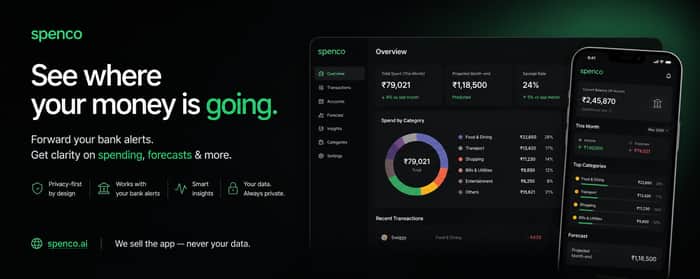
Hey IH 👋, I'm Akash. I build AI systems for a living, and for the past year I've been building Spenco AI (https://spenco.ai), an expense tracker for India, on nights and weekends.
"Another expense tracker" is a fair reaction. There are dozens on the Play Store, many are free, and some have 10M+ installs. So here's what I'm doing differently and why.
- It predicts. It doesn't just keep records.
Most money apps show you what you already spent. You open them on the 30th, see where the money went, feel bad, and repeat next month.
Spenco starts from the other end: what will my balance be at month-end? It looks at your salary date, EMIs, SIPs, rent, recurring bills and how fast you've been spending lately. From that it shows:
your projected closing balance for the month
your daily burn rate and how many days your money will last
committed vs spendable: EMIs and SIPs are taken out first, so the number you see is money you can actually spend
It updates with every new transaction. The idea is to tell you on the 18th that you're heading for trouble, while you can still change course.
When I studied the market, I couldn't find an Indian manual or SMS-based tracker that does cash-flow forecasting. Most do bill reminders at best.
- No SMS permission, no bank login, no access to your inbox
Most Indian finance apps read all your SMS or ask for bank credentials or account-aggregator consent. I didn't want to build that, and plenty of users don't want to grant it.
Spenco uses email forwarding instead. You set up one Gmail or Outlook filter that forwards only your bank alert emails to a private Spenco address. Each alert becomes a parsed transaction with merchant, amount and category.
You decide exactly which emails we see
One setup covers GPay, PhonePe, Paytm, cards, ATM withdrawals, NACH and standing instructions, because all of them trigger a bank email
It works today with HDFC, ICICI, Axis, Kotak, Canara, PNB and Bank of Baroda
The honest tradeoff: forwarding only picks up alerts from the day you set it up. Older history comes from uploading a bank statement PDF (Currently under development)
- Built for how Indians handle money
Global apps like Money Manager, Monefy and Bluecoins are polished, but they're manual-entry tools that know nothing about Indian finance. Spenco treats Indian money patterns as first-class:
EMIs are tracked as recurring commitments, not one-off spends
SIP debits count as scheduled outflows, not discretionary spending
Salary is modelled as take-home pay, since PF and TDS are deducted before it lands
Rent, broadband, recharges and auto-renewing subscriptions are detected as recurring
- AI chat that answers from your own data
You can ask things like "How much did I spend on Swiggy and Zomato last month?" or "Can I afford a ₹40,000 purchase before my salary lands?"
The answers are calculated from your own ledger. The model isn't guessing about an account it has never seen, and that difference matters a lot for money questions.
- We make money from the app, never from your data
Many "free" finance apps in India make their money by pushing loans and credit cards. Spenco has no ads, no lending partners and no data resale. The subscription is the whole business model.
Starter: free for your first year, then ₹499/year (about ₹1.40/day). It includes transactions, insights, the email parser, the dashboard and limited AI chat.
Pro: ₹1,999/year. It adds the forecast dashboard, net worth, spending planner, statement upload, group expenses and unlimited chat.
One promise: anything free today stays free. I won't move features behind the paywall later.
Where I'd love your help
It's live on iPhone, Android and web. You can try a read-only demo without signing up at https://demo.spenco.ai.
🍎 iPhone: https://apps.apple.com/in/app/spenco-ai-expense-tracker/id6776898606
🤖 Android: https://play.google.com/store/apps/details?id=com.spencoai.spenco
Three questions for the IH crowd:
Is "prediction-first" a strong enough hook, or do people still shop for trackers on "easy logging"?
Does forwarding emails feel like too much setup compared with a one-tap SMS permission, even with the privacy benefit?
Pricing: I chose annual-only with a free first year. Would you have done monthly instead?
I'm happy to go deep on the stack too: LLM parsing of bank emails, the forecasting model, or going solo in a crowded category. Ask away 🙏

The prediction-first thesis is clear, but email forwarding is the friction point. Have users actually completed the setup and kept using Spenco afterward?
Prediction-first is the stronger hook because it gives someone a reason to change their behaviour before the month is gone.
I’d be more cautious about the free first year. You’ll learn whether people use it, but you may wait 12 months to learn whether they’ll pay. A shorter Pro trial with monthly and annual options could test willingness much sooner. Are you optimising for adoption first, or trying to validate pricing as well?