How Market Sentiment Influences Cryptocurrency Prices
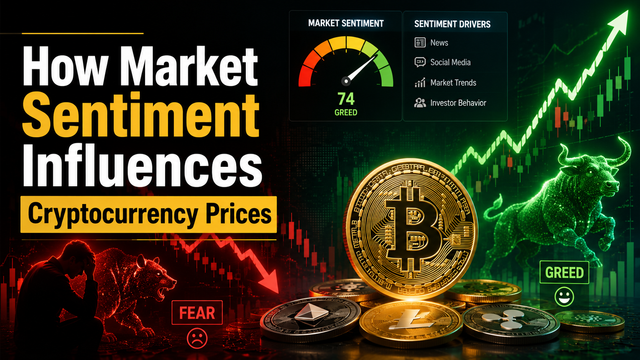
Cryptocurrency prices can move rapidly even without major changes in a project’s technology or long-term potential. One important reason is market sentiment, which describes how investors collectively feel about the market at a given time. When confidence rises, buying pressure may increase. When fear takes over, selling can spread quickly.
Crypto markets operate around the clock and attract investors. News, social media, price momentum, regulation, and rumors can all influence behavior. Understanding sentiment cannot guarantee profitable trades, but it can help investors explain sudden price movements and recognize when the market is becoming unusually optimistic or fearful.
What Market Sentiment Means in Cryptocurrency
Market sentiment is the overall attitude investors have toward a market or asset. In cryptocurrency, this attitude can shift from excitement to caution within a short period.
Positive sentiment develops when traders expect prices to rise. More investors may buy Bitcoin, Ethereum, or other assets because they believe further gains are likely. This environment is usually described as bullish.
Negative sentiment appears when investors expect prices to fall. Concerns about regulation, security, economic weakness, or market losses can encourage traders to reduce exposure. This is commonly called bearish sentiment.
Sentiment matters because markets ultimately reflect decisions made by people. Even when research and technical analysis are involved, fear, greed, hope, and uncertainty can influence those decisions.
Why Cryptocurrency Is Especially Sensitive to Emotion
Cryptocurrency markets can react strongly to sentiment because digital assets are volatile and often difficult to value through traditional methods. Public companies can be assessed through established financial measures, but many crypto assets do not fit that framework.
Investors therefore rely heavily on expectations about adoption, technology, regulation, network growth, and future demand. When expectations improve, prices can climb rapidly. When confidence weakens, declines may be equally sharp.
The market also never closes, so major announcements can trigger immediate reactions. Social media intensifies this effect because viral posts, influencer comments, trending discussions, and rumors can quickly change public perception.
How Fear Can Push Cryptocurrency Prices Lower
Fear often pushes investors to protect capital. Traders expecting further losses may sell assets they previously believed in.
A decline can then become self-reinforcing. Early selling pushes prices lower, increasing anxiety among other investors. More people sell, leveraged positions may be liquidated, and downward pressure becomes stronger.
Common causes of fear include:
- Regulatory uncertainty or enforcement actions
- Exchange failures and security breaches
- Sudden Bitcoin or Ethereum declines
- Weak economic conditions
- Negative comments from influential figures
Extreme fear does not necessarily mean prices will keep falling. Sometimes pessimism becomes strongest after much of the selling has already occurred. Investors should therefore avoid treating every fearful period as an automatic buying signal.
How Greed Can Drive Prices Higher
Greed works in the opposite direction. When crypto prices rise steadily, investors often become more confident that the trend will continue.
This can attract buyers who fear missing potential profits. FOMO may encourage people to enter after large price increases without carefully considering valuation or risk. Rising demand can push prices higher and attract another wave of buyers.
During highly optimistic periods, traders may use more leverage or ignore warning signs. Greed can strengthen an upward trend, but excessive confidence can also make the market fragile. If expectations become unrealistic, even modest negative news can trigger sharp profit-taking.
Using Sentiment Indicators to Understand the Market
Because emotions cannot be measured directly, analysts use indicators to estimate how investors are feeling. These tools may consider volatility, trading volume, momentum, social activity, search interest, surveys, and other behavioral signals.
One widely followed measure is the Crypto Fear and Greed Index. Investors looking for the fear and greed index crypto explained in practical terms can view it as a snapshot of whether market behavior is leaning toward fear or greed.
Lower readings generally suggest stronger fear, while higher readings suggest greater optimism. The index does not predict future prices with certainty. Its value is mainly contextual.
Sentiment indicators are more useful when combined with price trends, trading volume, support and resistance levels, project fundamentals, and broader economic conditions.
The Role of News and Headlines
News can strongly affect cryptocurrency sentiment because traders often react to new information immediately. Positive developments such as clearer regulation, institutional adoption, or successful upgrades may increase confidence.
Negative reports about hacks, bankruptcies, government restrictions, legal disputes, or technical failures can quickly increase uncertainty and selling pressure.
However, not every headline has lasting importance. Some developments matter long term, while others create temporary volatility. Before reacting, investors should consider the reliability of the source, the significance of the event, and whether its effects are likely to last. Emotional responses to every headline can lead to poorly timed trades.
Social Media and the Speed of Crowd Psychology
Social media is a major force in cryptocurrency sentiment because information can spread globally within seconds. Traders can quickly learn about updates, events, and community concerns.
The same speed also allows misinformation, exaggerated claims, and rumors to spread. Enthusiastic posts may attract buyers, while negative rumors may cause panic selling before facts are confirmed.
Social activity can therefore reveal what the crowd is thinking, but it should not be treated as proof that a claim is accurate or a price move will continue. Investors who verify information independently are less likely to make decisions based only on online excitement or fear.
Sentiment and Bitcoin’s Influence on the Wider Market
Bitcoin often shapes sentiment across the wider cryptocurrency market because it is the most closely watched digital asset. Strong Bitcoin rallies can make traders more comfortable taking risk, allowing capital to move toward Ethereum and smaller altcoins.
Sharp Bitcoin declines can have the opposite effect, creating broader weakness across many assets.
This relationship is not identical in every market cycle, but Bitcoin remains an important reference point for crypto confidence. Watching its direction alongside broader sentiment measures can help investors understand whether optimism or caution is spreading throughout the market.
Why Sentiment Should Not Be Used Alone
Sentiment is useful, but relying on it alone is risky. Extreme fear can continue for weeks, while strong greed can persist as prices rise beyond expectations.
A more balanced approach combines sentiment with other information. Investors may review:
- Long-term price trends and market structure
- Trading volume and liquidity
- Project fundamentals and real-world use
- Token supply and distribution
- Regulatory and economic developments
This broader view helps reduce impulsive decisions. Sentiment is best used to answer, “How does the market feel right now?” It should not automatically answer, “What should I buy?” Keeping those questions separate encourages more disciplined analysis.
Managing Personal Emotions During Volatile Markets
Understanding the crowd is useful, but investors also need to recognize their own emotional reactions. Fear may cause selling after a large decline, while greed may encourage buying after a major rally.
A written investment plan can help reduce impulsive behavior. Investors can decide acceptable risk, position size, time horizon, and conditions for buying or selling before volatility increases.
It can also help to avoid checking prices constantly. Constant exposure to short-term moves can exaggerate normal volatility. Better decisions often depend on controlling reactions rather than predicting every move.
Turning Market Mood Into Better Decisions
Market sentiment is a major force behind short-term cryptocurrency price movements. Fear can intensify sell-offs, greed can accelerate rallies, and social media can amplify both emotions .
Sentiment indicators help investors recognize when the market is unusually pessimistic or optimistic. Their greatest value comes when they are used alongside market data, project fundamentals, news, and sensible risk management.
Cryptocurrency will continue to experience excitement and uncertainty. Investors who understand crowd psychology are better prepared to separate emotional noise from useful information. The aim is not to remove emotion entirely, but to recognize when it is shaping the market and respond with patience, context, and discipline.
