How Matt earned millions with his roguelite game
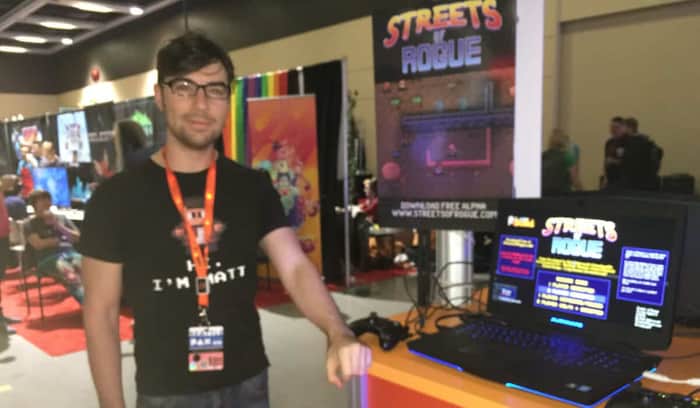
Matt Dabrowski’s indie journey is a case study of determination and persistence.
Dabrowski has been building video games since the late 1990s until he was laid off in 2015. Rather than find another gig, he took the leap into entrepreneurship and began building the roguelite video game Streets of Rogue.
He intentionally took a methodical approach to build the game and didn’t begin to see returns for years. Between 2015 and 2019, he invested hundreds of hours and more than $18,000 into the game to hire contractors for music and art.
Dabrowski’s strategy ultimately paid off. Since 2019, Streets of Rogue has sold around 1 million copies across a variety of platforms, generating about $8 million in revenue.
And in 2021, the company through which he published the game acquired the IP for $6.5 million. Learn more about his exit here.
I spoke with Dabrowski about his journey, what he’s learned, and his advice for aspiring indie game makers.
What did you do before you started your first company?
I did quality assurance for video games and then moved into doing QA for other companies, from ad agencies to an online shoe store.
Why did you get into gaming specifically?
Game development has been my dream career since I first played a video game. I spent a huge chunk of my youth (and beyond) playing games and learning about games. While I’ve taken jobs outside of that world, my intention was always to return to games. There’s really been no other serious choice for me.
How’d you navigate the risk of building Streets of Rogue?
To be honest, there wasn’t a massive risk involved in creating and releasing Streets of Rogue. Development started in my free time as I was earning a living at a full-time job. When I was laid off, I had enough savings to live off for quite some time, as I tend to be pretty frugal.
I managed to keep development costs low by doing just about everything myself, with the total amount of money paid to contractors being a little under $20,000. While I would still consider this a large investment, I had enough faith in the game I was making to be fairly certain that I would recoup what I had spent. The marketing costs were covered by my publisher.
What did it feel like to make $1M+ in revenue?
Pretty ridiculous. Up to that point in my life, I never had any expectation that I would achieve something at that level, nor was it a goal of mine to do so. I honestly expected to be more of a cog in the machine in the video games industry. The idea that I could earn a living creating my own work wasn’t something that seemed remotely viable until recent years.
Any advice for founders setting a million-dollar goal?
Doing a bunch of market research — or just having a really good sense of the indie game space — before embarking on a project is pretty essential. A lot of decisions are made early in a project that can potentially doom it, or give it a fighting chance. While technically any game release has a shot at being a hit (see Flappy Bird), you can improve your odds dramatically by choosing a project that has hooks and features that are known to capture people’s interest.
Any advice for people taking on a risk like this?
You are probably capable of more than you think you are, and it’s possible to gain a working knowledge of a lot of aspects of game development that might seem completely out of your reach. That said, very few people are complete jacks-of-all-trades when it comes to game development, and it’s important to recognize when hiring someone will provide enough benefit to be worth it.
On outsourcing tasks
If you’re absolutely terrible at art, you could either spend a bunch of time honing that craft to create a game that looks attractive enough to garner people’s attention, or you could hire an artist. Both are viable paths, but the latter will speed up development pretty significantly, and likely result in a more attractive end result. Personally, I started Streets of Rogue with the intention of being a one-man army and doing everything myself, but my collaborations with contractors ended up being absolutely essential.
What’d you learn through the long process of building this game?
It’s easy to get overwhelmed working on a large game where every single programming and gameplay-related task falls on your shoulders. Breaking everything into very small tasks and not spending TOO much time obsessing over the big picture has been very beneficial. Completing smaller tasks tends to be satisfying and motivating.
As a solo founder, how did you balance your time?
I’ve been fortunate enough that the vast bulk of my work time has been spent on game development, as opposed to other aspects of releasing a game – namely marketing. This is in large part because my publisher handles most of the stuff that I don’t particularly want to.
In the absence of a publisher — or even with one, depending on the publisher and what their role in relation to you is — achieving success will likely mean spending a good deal of time on marketing, at least once your game is to the point where it’s worth marketing.
On common pitfalls when building a game
One of the common things I see in Reddit posts about failed game launches is a lack of awareness about the game’s actual prospects. They’ll be surprised at a game’s poor reception when one look at the game’s store page from an outside observer and some harsh-but-necessary feedback could have sent things in a completely different direction.
On incorporating user feedback
Streets of Rogue was originally released for free as an alpha. I incorporated user feedback into the game over a year and a half period before the game actually went on sale. When it did, I had a very good idea of the sort of response I was going to receive. There were very few surprises on launch day, which was a good thing for certain.
On market research and developing ideas
I lurk in a bunch of gaming-oriented communities online. This gives me a good sense of what qualities are attractive to people in a game. With Streets of Rogue and its sequel, I tried to make something that stood a chance of connecting with a lot of people while still being the sort of game that I’m personally very passionate about. While I have a lot of ideas for games, I can recognize that many of them are too niche in their appeal to be hits.
Any advice for aspiring game makers?
For those just beginning their career in games: Your first release is probably not going to be a hit, and that’s OK. Start small, keep your expectations in check, and use what you learn to power your next project.

This was a great read! Thanks for sharing @bobburch
Really loved this:
Having really high expectations is ultimately detrimental to motivation, I think. It's way better to expect less and be more enthused about getting it. 😂 Thanks for the good thought!
Interesting read an advice everyone working on their first product or project should take.
Awesome read! Thanks for sharing
This is super inspiring! Thank you for sharing.
This is super inspiring. Love seeing how people build their passions while also working full time. Must've been so exciting to see this game take off!