How Much Does an AI Crypto SEO Consultant Cost?
Crypto SEO isn't just about ranking on Google anymore. A crypto exchange wants to show up when someone searches for the best trading platform. A DeFi project wants visibility for high-intent queries. A Web3 wallet needs to earn trust before anyone connects funds. And increasingly, all of these businesses also need to be discoverable through AI-generated answers — ChatGPT, Google AI Overviews, Perplexity, and similar tools.
That's the job of an AI crypto SEO consultant. The question most people actually want answered first: what should this cost?
Pricing in 2026 varies widely. A focused audit might run a few hundred dollars; a specialist crypto SEO retainer can run several thousand dollars a month. The gap isn't really about keyword count — it's about expertise, competition, technical complexity, content quality, authority-building, and AI visibility work.
Quick Answer: 2026 Pricing at a Glance
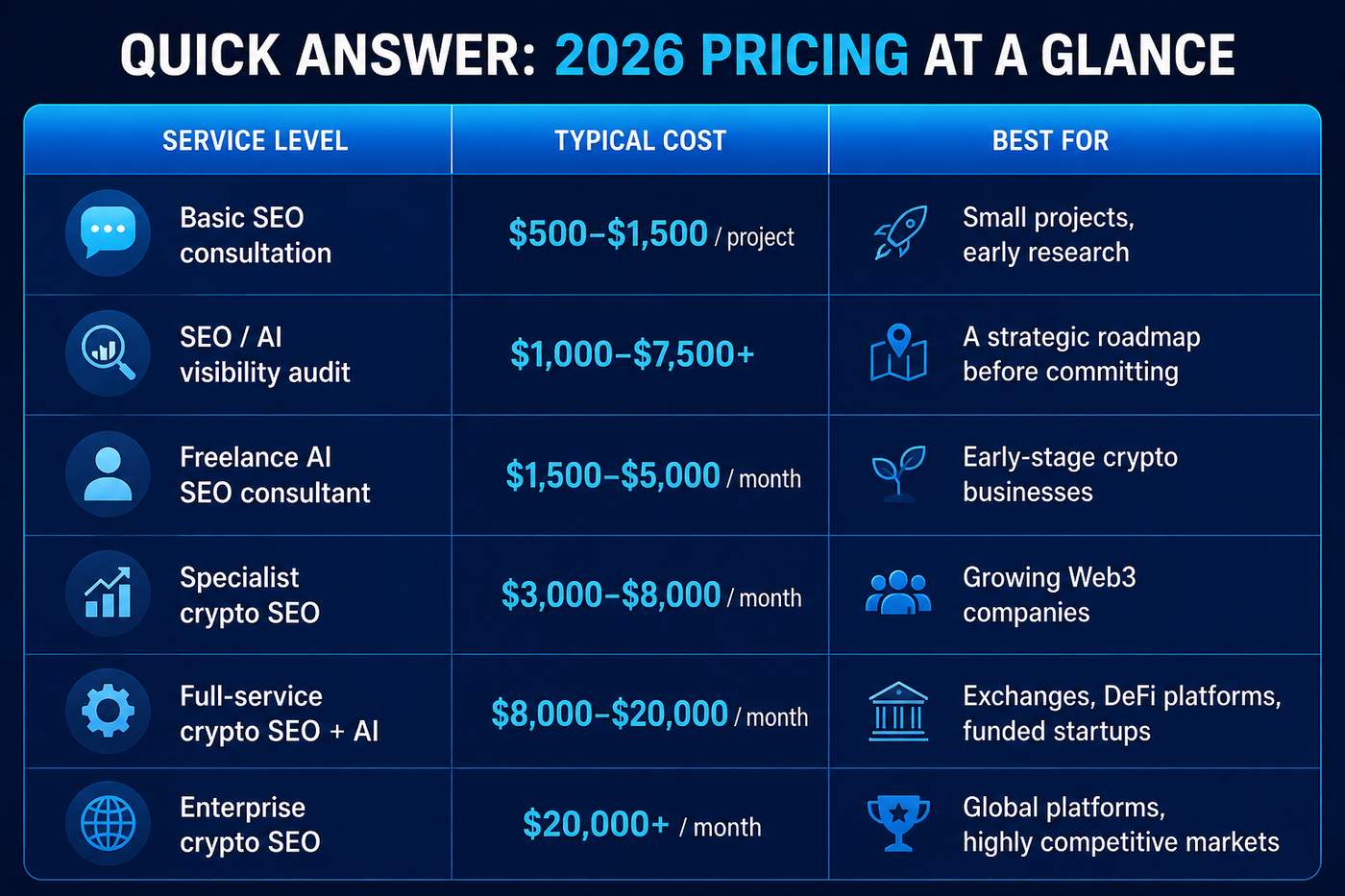
These are market ranges, not fixed rates — treat any consultant who quotes a flat number without asking about your site, market, and goals with some skepticism. Published examples in the crypto SEO space show entry-level programs around $1,500–$5,000/month and full-stack programs at $8,000–$20,000/month, with some providers publishing $7,500 one-time audits. Indian-market AI SEO pricing shows a similarly wide range, from roughly ₹20,000/month for freelance-level work up to ₹2,50,000+ for established consultants.
If someone tells you every AI crypto SEO consultant should cost $1,000/month, be careful. If someone quotes $20,000/month without explaining what's included, be equally careful. Scope matters more than the headline number.
What Is an AI Crypto SEO Consultant?
An AI crypto SEO consultant blends traditional SEO with AI-driven search optimization and crypto-specific strategy — rather than treating your site like a generic SaaS or ecommerce business.
Typical scope of work includes:
Crypto keyword research and search intent analysis
Technical SEO and on-page optimization
AI-assisted content strategy and Generative Engine Optimization (GEO)
AI citation monitoring and entity optimization
Schema implementation
Digital PR and authority building
Crypto-specific link acquisition
International SEO
Conversion-focused landing pages
Performance reporting
The real differentiator is specialization. A general SEO professional understands keywords and backlinks. A crypto specialist also understands tokenomics, staking, DeFi mechanics, exchange structures, wallets, smart contracts, and the regulatory sensitivities around Web3 content — and that knowledge shapes the strategy in ways generic SEO can't.
Why Crypto SEO Costs More Than Regular SEO
Compare ranking for "best accounting software" against "best crypto exchange for US traders." The second involves financial intent, trust signals, product comparisons, regulatory nuance, and a much higher potential customer value — and it's fought over by major exchanges, financial publishers, blockchain media, affiliate sites, and venture-backed competitors all at once.
A few reasons this environment is harder and more expensive to compete in:
High commercial value. A single crypto customer can carry significant lifetime value, which makes high-intent keywords extremely competitive.
Heavy competition. Exchanges, wallets, and DeFi platforms aggressively target the same commercial terms.
Trust is a ranking and conversion factor. Users are cautious with financial products — a page that looks thin or anonymous struggles on both fronts.
Technical complexity. Crypto sites often combine dynamic token pages, network pages, trading interfaces, documentation, APIs, account systems, and international versions, all of which need to work well with search engines.
AI search adds a layer. A company can rank well on Google and still be invisible when someone asks an AI assistant "What are the best crypto exchanges for beginners?" That gap is becoming a real competitive factor.
What an AI Crypto SEO Consultant Actually Does
Using "AI SEO" in a title isn't enough — a strong consultant connects AI search optimization to solid SEO fundamentals.
AI-powered keyword research. Instead of chasing isolated keywords, AI tools can map a topic cluster around a full user journey — e.g., expanding "crypto exchange" into fees, security, beginner guides, comparisons, and asset-specific searches — producing a stronger content architecture than a scattered blog.
Search intent analysis. "What is Bitcoin?" is a research query. "Best crypto exchange with low fees" is closer to a buying decision. Separating informational, commercial, navigational, and transactional intent keeps budget from being spent on traffic that never converts.
Technical SEO. No amount of AI optimization fixes a broken site. This means auditing crawlability, indexation, site architecture, internal linking, canonicalization, page speed, Core Web Vitals, structured data, JavaScript rendering, and duplicate content — especially important for crypto sites with large numbers of dynamically generated pages.
AI search optimization. This is the newer layer: making sure your company is understood, retrieved, and referenced by AI systems, not just ranked by Google. That involves entity consistency, structured and answer-focused content, schema, authoritative citations, and ongoing AI-visibility monitoring across platforms like Google AI Overviews, ChatGPT, and Perplexity.
Where SEO Circular Fits In
If you're evaluating AI crypto SEO consultants, SEO Circular is worth a look. Its approach treats crypto SEO as more than keyword ranking — the focus is on visibility across the full customer journey while adapting to how AI search now works, essentially answering three questions: Can people find you? Can search engines understand you? Can AI systems recognize and recommend you?
A few things that stand out in its approach:
Crypto-specific keyword strategy organized into structured topic clusters (protocol mechanics, tokenomics, APY, security, fees, competitors) rather than disconnected blog posts.
AI search visibility work aimed at giving search engines and AI systems clearer signals about a company's products and expertise.
Authority building through credible publications, industry references, and expert contributions rather than link schemes.
Combined technical + AI SEO, on the premise that a technically healthy site is what makes AI optimization work in the first place.
Business-focused reporting — the goal isn't "we increased your keyword count," it's "we increased the qualified search demand reaching your business."
As with any consultant, ask for a clear strategy, deliverables, and reporting framework before committing.
What Drives the Price Up or Down
Two crypto companies can get very different quotes for reasons that have nothing to do with the consultant's honesty:
Site size — a 20-page startup site is a fraction of the work of a global exchange with thousands of indexed URLs.
Competition — a niche blockchain term is easy; a competitive exchange or trading term is not.
Geographic targeting — one country vs. US/UK/EU/Asia/Middle East/LatAm simultaneously changes the workload substantially.
Content volume and quality — four well-researched articles a month cost differently (and perform differently) than twenty shallow ones.
Link building — high-quality authority building is often the single largest line item in a monthly budget.
AI visibility tracking — monitoring how often a brand appears in AI-generated answers requires its own research and reporting, and is sometimes sold as a separate audit running from a few thousand dollars up for crypto-specific work.
How Consultants Price Their Work
Monthly retainer — the most common model. A $3,000/month retainer might cover technical SEO, keyword research, four content pieces, on-page work, link-building strategy, AI visibility tracking, and monthly reporting. A $10,000/month engagement typically adds a dedicated team, more content, digital PR, technical development, and international SEO.
One-time audit — useful if you want a diagnosis before committing to ongoing work. Covers technical problems, keyword opportunities, competitor gaps, content weaknesses, AI visibility, and authority gaps. Specialist crypto audits cost more than generic ones because the research itself is more specialized (some providers list $7,500 one-time audits).
Hourly consulting — makes sense if you already have an internal team handling execution and just need strategy, technical review, content briefs, or training. The tradeoff: you still own implementation.
Project-based — a fixed fee for a defined scope like a site migration, technical cleanup, content architecture overhaul, or AI visibility audit. More predictable cost, but narrower scope than a retainer.
What You Should Get for Your Money
Before signing anything, get a detailed scope covering:
Strategy — business goals, target audience, competitors, keyword opportunities, content priorities
Technical SEO — crawl analysis, indexation, architecture, performance, schema, internal linking
Content — topic clusters, briefs, new content, and optimization of what already exists
AI SEO — AI query research, brand visibility monitoring, citation analysis, entity optimization
Authority — link strategy, digital PR, relevant publications, brand mentions
Reporting — not just a spreadsheet of keyword positions, but a line connecting visibility → traffic → engagement → leads → revenue, where the data supports it
Is a Cheap Consultant Worth It?
Sometimes. A $1,000/month consultant who genuinely understands your market can outperform a $10,000 agency producing generic content. But cheap SEO gets expensive fast if it produces poor-quality backlinks, duplicate content, AI-generated spam, incorrect financial information, or indexation problems. Crypto is not the place to gamble on shortcuts — treat any promise of hundreds of backlinks, guaranteed rankings, or instant AI citations as a red flag.
How Long Does It Take to Work?
SEO compounds — think months, not weeks.
Months 1–3: technical audit, keyword research, competitor analysis, site architecture, content strategy
Months 4–6: content expansion, internal linking, authority building, digital PR, AI visibility tracking
Months 7–12: scaling what works, expanding keyword clusters, improving conversion pages, strengthening authority, going international
Most published crypto SEO guidance frames this as a 6–18 month compounding investment rather than a 30-day campaign.
A Simple Way to Set Your Budget
Start from your own unit economics rather than a rate card. If your platform generates roughly $500 in gross value per qualified customer, and SEO drives 100 additional qualified customers a month, that's $50,000/month in potential gross value. A $5,000/month SEO investment is then 10% of that — not a guarantee of return, but a useful frame.
The right question isn't "Is $5,000 expensive?" It's "What would an additional $5,000 of qualified organic demand be worth to my business?"
Questions to Ask Before You Hire
Have you worked with crypto or Web3 businesses before?
Can you show relevant case studies?
How do you approach AI search optimization, and which platforms do you monitor?
How do you measure AI visibility?
What kind of backlinks do you build — do you use private blog networks?
Who writes and reviews the content, and how do you handle financial/technical accuracy?
What's included in the monthly fee, and how often will I get reports?
What happens if the strategy isn't producing results? Is there a long-term contract?
Which tasks need developer involvement?
How do you connect SEO performance to business revenue?
Red Flags
Be cautious of any consultant who:
Guarantees a #1 ranking or promises AI citations on demand
Uses thousands of low-quality backlinks
Can't explain their strategy or doesn't understand your product
Produces generic, AI-written filler content
Reports only keyword positions, with no revenue connection
Has no visible technical SEO process
Hides their link-building methodology
Wants a large upfront payment without a clear scope
No legitimate consultant can guarantee that Google or an AI system will rank or cite a brand — the job is improving the signals that make visibility more likely, not controlling the algorithm.
Bottom Line
For most crypto companies, $3,000–$8,000/month is a realistic starting point for serious specialist SEO. If you need full-service work — AI visibility, content production, authority building, technical SEO, and international expansion — expect $8,000–$20,000+/month. Smaller businesses can start with a focused audit or consulting engagement and scale up as results come in.
Buy expertise and outcomes — not hours, keyword counts, or AI-generated content volume.
FAQ
How much does an AI crypto SEO consultant cost?
Roughly $1,500–$5,000/month for focused work; $8,000–$20,000+/month for comprehensive programs. It depends on competition, site size, content needs, and geographic scope.
Is AI crypto SEO more expensive than traditional SEO?
Usually — it adds AI visibility work, entity optimization, citation monitoring, and extra research on top of standard SEO.
Can a crypto startup afford this?
Yes. Start with an audit or a smaller monthly engagement and scale as traffic and revenue grow — you don't need an enterprise program on day one.
How much does a crypto SEO audit cost?
Anywhere from a few hundred dollars for general audits to several thousand for specialist crypto audits; some providers list $7,500 one-time audits.
Does AI SEO replace traditional SEO?
No — it works best layered on top of a technically sound site with useful content and credible external references.

