How Non-Technical Founders Are Quietly Shaping SaaS for Industry Professionals
Imagine this: You’re an experienced professional from a specific industry—maybe interior design, landscaping, accounting, healthcare, or event planning. You've encountered recurring, frustrating problems over the years that generic software simply can’t solve elegantly. You can spot exactly what needs fixing and how it should be done—but you feel limited, held back by your non-technical background.
Sounds familiar?
If it does, you're actually in a fantastic position. Industry-specific SaaS solutions built by non-technical founders are on the rise—and they're surprisingly successful.
Let me explain.
Why this matters (to people like you and me):
Most mainstream SaaS tools aim for everyone—and thus, they rarely perfectly fit the workflow of specialized professionals. For instance, a general CRM has a hundred features but lacks exactly what a freelance wedding planner truly needs on event day.
When you possess deep industry knowledge and expertise—but lack coding chops—an incredible opportunity emerges. You can see industry pain points clearly. You know exactly what features will save your clients dozens (if not hundreds) of hours per week. And because generic software doesn't speak your industry's language or workflows, there's less direct competition.
That's the huge opportunity I want to explore today: industry-specific SaaS solutions designed by insiders like yourself—without the need for complex technical knowledge (yes, it's entirely possible).
Step-by-Step Guide: How Non-technical Founders Build Industry-Specific SaaS
So, how can someone without a coding background get started building and successfully launching a specialized SaaS solution?
Here's an approachable, practical path:
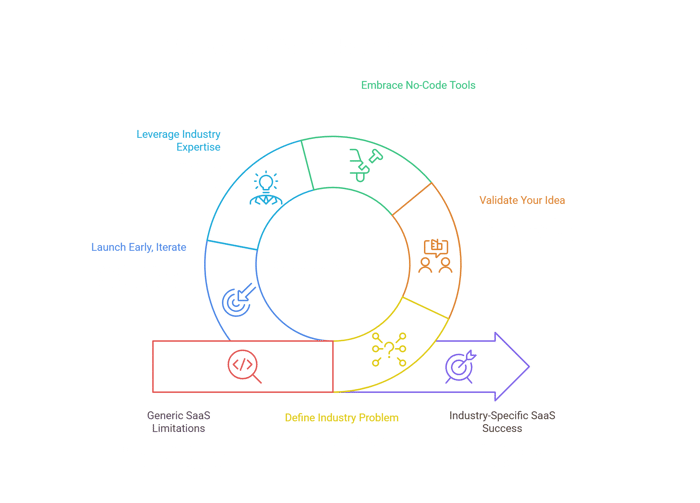
1. Clearly Define Your Industry Problem
Start by identifying the core pain points in your current profession. Be precise:
- What frustrates you or your colleagues most?
- Where are the bottlenecks, inefficiencies, or unnecessary costs?
- Could a tailored software solution meaningfully improve productivity or client happiness?
For instance:
"As a former landscaping contractor, I realized crew scheduling and real-time tracking were overly complicated, forcing us to rely on paperwork and spreadsheets—super inefficient and error-prone. Existing generic scheduling apps were either too simplistic or overly complex without understanding my industry's daily challenges."
2. Validate Your Idea
Before spending substantial time and effort, validate your idea:
- Reach out to your professional network. Ask your peers if your solution addresses their frustrations.
- Engage in discussions within communities or online groups. Professionals love talking about what frustrates them!
- If possible, create a simple mock-up or wireframe (even a simple Figma or Canva prototype).
When I started validating my idea for an event-management SaaS, I messaged around 15 friends who run agency events. Their enthusiasm gave me the confidence to continue building.
3. Embrace No-Code Tools and Platforms
There's been a game-changing development in software building: no-code and low-code tools.
Whether it's creating an MVP, releasing full production apps, or iterating rapidly based on user feedback, you no longer need years of programming experience.
Tools to consider:
- Platforms like Fuzen.io (my favorite)—perfect for building and launching custom SaaS and internal business apps without coding.
- Others like Bubble, Airtable, or Glide are also helpful depending on your project scope.
4. Leverage Industry Expertise & Empathy
Non-technical founders often fear technology will be their biggest hurdle. But here's the secret: your strongest advantage is your deep empathy and industry-specific insights.
You don't need fancy tech-speak. Your solutions speak the language and solve the exact problems professionals face daily.
Example:
One indie SaaS founder I know had zero coding experience. Yet, she successfully launched software designed specifically for interior designers to track clients, timelines, budgets, and material orders. The product resonated immediately because the workflow matched real-world design processes.
Her users instantly recognized themselves in the product.
5. Launch Early, Gather Feedback, Iterate Quickly
An advantage of SaaS built on no-code solutions is that rapid adjustments are possible:
- Don't wait for perfection; get your MVP into the hands of real users quickly.
- Encourage honest feedback, analyze usage data, and rapidly adopt requested changes.
- Each iteration brings you closer to a product professionals genuinely love and repeatedly use.
The Proof: Real-Life Examples & Success Stories
Let’s quickly examine a few inspiring success stories:
- Jane’s accounting-integrations SaaS: Jane, a CPA herself, built software targeting accountants tired of manual invoicing. Within months she reached profitability due to laser-focused niche targeting, despite minimal software building experience.
- Tom’s landscaping crew management app (mentioned previously): Quickly adopted locally, it became indispensable due to how perfectly it mirrored real-world workflows.
- Anna's CRM specifically for freelance makeup artists: Instead of competing with Salesforce or HubSpot, Anna built a simple yet elegant solution—no fluff, just exactly what freelance makeup artists needed.
Why Fuzen.io Might Be the Perfect Companion for Your Journey (And This is Subtle!)
When I built my first niche SaaS tool (an event management SaaS), I was intimidated by "coding." Discovering no-code platforms like Fuzen.io eventually allowed me not just to start but also iterate rapidly. Rather than guesswork, I simply implemented feedback directly from my audience. Customers loved it—because I was building exactly what they asked for.
(Quick disclosure: I'm not affiliated with Fuzen.io, just a genuinely big believer after finding massive value as I've built and launched several niche SaaS solutions myself.)
Final Thoughts & Key Takeaways for Non-Technical Founders
Here's the big takeaway I want you to remember:
- Deep industry expertise combined with no-code solutions is incredibly powerful—and becoming more accessible every single day.
- The key is putting your users’ needs at the forefront, solving problems you've genuinely experienced yourself.
- Industry-specific SaaS solutions created by empathic, industry insiders (even without a shred of coding skills) will often beat generic tools by a wide margin.
If you're sitting on an idea, now’s your moment. You have the expertise; no-code has lowered the barrier; and targeted solutions with true empathy are increasingly rewarded.
What niche-specific professional pain point would you love to solve with an industry-focused SaaS? Have you ever hesitated due to lack of technical expertise—and are you willing to reconsider now?
I'd honestly love to hear your story below. Maybe your experiences can inspire someone to cross that bridge into indie-hacking success!
