How One Afternoon of Keyword Research Changed My Approach to SEO
Keyword research is one of those tasks that sounds simple until you actually sit down to do it.
You start with a few ideas, type them into a tool, and suddenly you're staring at hundreds of suggestions, dozens of metrics, and more data than you know what to do with. Search volume, CPC, keyword difficulty, competition scores, trends, regional differences—the information is valuable, but switching between multiple tools can quickly become exhausting.
I ran into this exact situation while working on a new SaaS landing page.
The Challenge of Finding the Right Keywords
The goal seemed straightforward: find keywords that had enough search demand to drive traffic but weren't so competitive that ranking would take years.
Like many marketers, I started by checking a few different keyword research platforms. One tool had search volume data, another had CPC estimates, and a third offered competition metrics.
The problem wasn't a lack of information.
The problem was having to piece everything together manually.
By the time I'd compared the numbers across multiple dashboards, I had spent more time collecting data than actually planning the content strategy.
Looking for a Better Workflow
I wanted something simpler.
Instead of opening several tabs and cross-referencing spreadsheets, I wanted a single place where I could quickly evaluate keyword opportunities and make decisions.
That's when I started experimenting with the SERPSpur Keyword Research Tool.
Why the Tool Stood Out
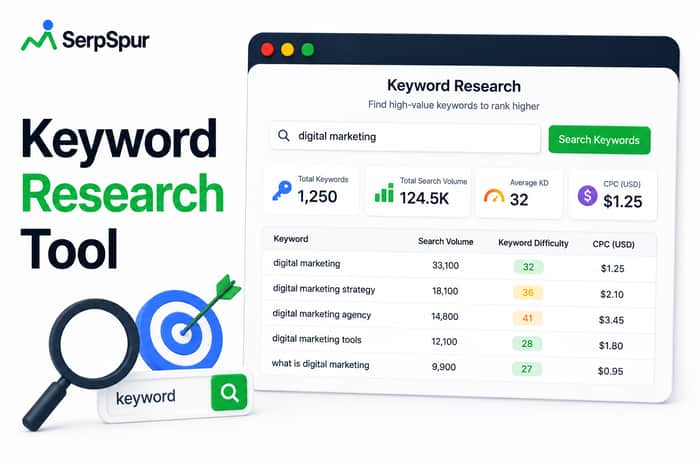
The first thing I noticed was how much information was available in one view.
Rather than jumping between different reports, I could see:
- Search volume.
- Cost per click (CPC).
- Keyword difficulty.
- Ads competition.
- Country-specific data.
Having these metrics together made it much easier to identify opportunities without interrupting my workflow.
The Country Filter Was Surprisingly Useful
One feature that ended up being more valuable than I expected was the country filter.
Initially, I was focused on broad English-speaking markets, but switching between regions revealed something interesting.
A keyword that was highly competitive in one country had significantly lower competition in another while still maintaining healthy search demand.
In my case, I discovered a UK-specific keyword opportunity that I'd probably have overlooked using my usual research process.
That single insight influenced both the content strategy and the landing page messaging.
Looking Beyond Search Volume
One mistake many people make during keyword research is focusing only on monthly search volume.
Traffic is important, but it's only one part of the equation.
I've learned that a better keyword often has:
- Reasonable search demand.
- Lower competition.
- Commercial intent.
- Affordable advertising costs.
- A realistic chance of ranking.
Looking at multiple metrics together helps create a much clearer picture of the opportunity.
Saving Time on SEO Research
Perhaps the biggest benefit was simply efficiency.
Instead of spending hours gathering data from multiple platforms, I could focus on what actually matters:
Building content.
Planning landing pages.
Understanding search intent.
Creating better user experiences.
The less time spent managing tools, the more time available for strategy and execution.
Why Simplicity Matters
SEO can become unnecessarily complicated.
Many platforms offer hundreds of features, but day-to-day work often comes down to a handful of essential tasks.
Keyword research should help you make decisions, not overwhelm you with information.
Having access to clear metrics in a simple interface makes the entire process more productive and less frustrating.
A Useful Tool for SaaS and Content Marketing
While I originally used the tool for a SaaS landing page, I can see plenty of other applications.
It's useful for:
- Blog content planning.
- E-commerce product pages.
- Local SEO campaigns.
- Affiliate websites.
- Startup marketing.
- Competitor research.
- PPC campaign planning.
Whether you're launching a new business or growing an existing website, finding the right keywords remains one of the most important parts of a successful SEO strategy.
Final Thoughts
The afternoon I spent researching keywords reminded me that good SEO isn't just about having more data.
It's about having the right data presented in a way that helps you make better decisions.
The SERPSpur Keyword Research Tool made that process easier by combining important metrics into a single workflow and helping uncover opportunities I might otherwise have missed.
The country-specific filtering alone was enough to change my approach to planning the landing page.
If you're tired of juggling multiple keyword research tools and switching between different dashboards, it might be worth exploring a simpler approach.
You can check out the SERPSpur Keyword Research Tool here:
https://serpspur.com/tool/keyword-research-tool/
Sometimes, the best SEO strategy isn't finding more keywords.
It's finding the right ones.

Interesting.
Sometimes the keyword itself isn't the thing changing the strategy.
It's the story we start telling ourselves about what the keyword means.