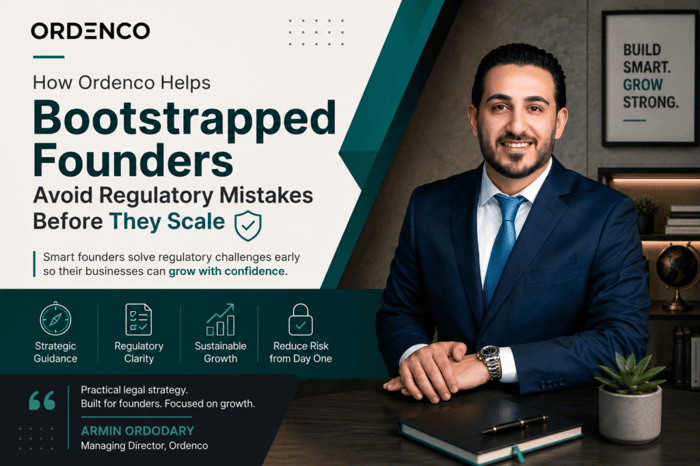
How Ordenco Helps Bootstrapped Founders Avoid Regulatory Mistakes Before They Scale
Most bootstrapped founders do not ignore compliance because they are careless. They ignore it because growth feels more urgent.
When you are building with limited cash and a small team, the priorities seem obvious: ship the product, find customers, improve retention, and keep revenue moving. Regulatory questions can feel like problems for a later stage, something to address after the company is bigger, better funded, or operating with an in-house legal team.
That sequence often creates avoidable risk.
The right time to think about compliance is not after growth has created complexity. It is before the next stage of growth makes early assumptions expensive to reverse.
For indie hackers and bootstrapped startup builders, this does not mean building a large compliance department. It means identifying the few regulatory decisions that could affect where the company can operate, what it can sell, how it should be structured, and whether its growth model is sustainable.
Why Regulatory Blind Spots Hit Bootstrapped Founders Harder
Large companies can make regulatory mistakes and still have resources to respond. They may have internal counsel, compliance teams, insurance, external advisers, and enough cash to absorb delays.
A solo founder usually has none of those protections.
One licensing issue can interrupt a launch. A poorly planned move into another jurisdiction can create unexpected obligations. A business structure that worked at the prototype stage may become unsuitable once the company takes payments, hires contractors, stores customer information, or serves users in multiple markets.
The mistake is rarely one dramatic act. More often, risk builds through a series of reasonable-looking decisions:
- Launching in a new market without checking whether the activity is regulated there.
- Using the same terms, policies, and operating model across different jurisdictions.
- Assuming a platform, payment provider, or incorporation service has handled every compliance requirement.
- Waiting until an investor, bank, partner, or customer requests documentation.
- Treating regulation as a one-time setup task rather than something that changes with the business.
These are common regulatory mistakes for startups because founders tend to think in terms of products and customers, while regulators often think in terms of activities, responsibilities, and risk.
A company may describe itself as a software platform, marketplace, consultancy, fintech product, data business, or creator tool. What matters from a regulatory perspective is not only the label. It is what the company actually does, who it serves, where those people are located, what money or information moves through the business, and which promises the company makes.
Compliance Should Scale Before Complexity Does
A startup should begin thinking about compliance as soon as it starts creating obligations outside the founding team.
That point may arrive earlier than expected. It can begin when the company accepts its first payment, collects personal information, signs a commercial agreement, hires someone, markets into another country, or introduces a service that falls within a regulated category.
Early compliance does not require founders to predict every future rule. It requires them to understand the decisions that are difficult to undo later.
For example, changing a website policy is relatively simple. Rebuilding a product because its core workflow creates an unauthorized activity is not. Updating a contract may be manageable. Restructuring multiple entities, payment flows, or customer relationships after expansion can be far more disruptive.
This is why lean legal strategy should focus on sequencing. Founders need to know which issues must be resolved now, which can be monitored, and which become relevant only after a defined trigger.
Ordenco helps founders turn regulatory uncertainty into a practical sequence of decisions.
That positioning matters for bootstrapped businesses. Founders do not need long theoretical reports that describe every possible risk. They need a clear view of the risks connected to their actual business model and growth plans.
How Ordenco Approaches Founder Compliance
Ordenco’s approach begins with how the business works in practice.
Before discussing complex rules, the first step is to understand the product, customers, revenue model, transaction flow, company structure, and intended markets. That creates a more useful foundation than beginning with generic compliance documents.
Through Ordenco regulatory advisory services, the firm helps businesses examine regulatory exposure in the context of commercial strategy. The goal is not to slow growth. It is to prevent a founder from scaling in a direction that later requires costly correction.
A practical founder compliance framework usually considers three layers.
The first is the company’s current activity. What does the business offer today? Does it hold funds, process sensitive information, facilitate transactions, provide regulated advice, or operate in a restricted sector?
The second is jurisdiction. Where is the company established, where are its customers, and where are its services being marketed or delivered? A business may be compliant in its home jurisdiction but create new obligations when it begins serving users elsewhere.
The third is the next growth event. Is the startup preparing to enter a new country, launch a new feature, hire employees, pursue investment, introduce a subscription, or partner with a larger company? Each change may create different requirements.
This framework keeps compliance connected to real decisions. It also helps founders avoid paying for work that is not yet relevant.
A Practical View From Ordenco’s Managing Director
Managing Director Armin Ordodary describes the underlying principle this way:
“Founders do not need to choose between moving quickly and acting responsibly. The real objective is to understand which decisions create lasting obligations, address those early, and avoid building growth on assumptions that may not survive regulatory scrutiny.”
That distinction is important. Compliance for bootstrapped founders should not become an endless attempt to eliminate all uncertainty. No early-stage business can do that.
Instead, founders should aim for informed risk-taking. They should know what they are assuming, what could change, and what evidence supports the decision to move forward.
A good regulatory strategy gives a founder enough clarity to act, not a false promise that every future issue has been removed.
The Three-Step Compliance Check Before Your Next Growth Stage
Before launching a major feature, entering a market, or increasing sales activity, founders can use this three-step checklist.
1. Map the Activity
Write down what the business actually does, not only how it describes itself.
Identify how money, data, services, and contractual responsibilities move between the company, customers, suppliers, and platform partners. Pay particular attention to any activity involving payments, financial decisions, personal information, regulated products, consumer commitments, or third-party funds.
2. Map the Jurisdictions
List where the company is incorporated, where the team works, where customers are located, and where the product is actively marketed.
Do not assume online delivery removes geographic obligations. Cross-border scaling can create requirements linked to customers, employees, taxes, consumer rights, licensing, data handling, or local business activity.
3. Map the Next Trigger
Define the next event that could change the company’s regulatory position.
It might be reaching a revenue threshold, launching in a specific country, adding a new payment flow, hiring an employee, accepting investment, signing an enterprise customer, or introducing a regulated feature.
Assign a review point before that event occurs. This turns compliance into a planned growth task rather than an emergency response.
What Founders Should Review Before Scaling
Three areas deserve particular attention before a bootstrapped startup enters its next phase.
Jurisdiction Planning
Where a company operates can affect far more than incorporation. Founders should consider the location of customers, contractors, employees, partners, infrastructure, and commercial activity.
The cheapest or fastest setup is not always the best structure for the company’s intended path. Jurisdiction planning should reflect where the business expects to earn revenue, build a team, raise capital, and establish long-term operations.
Licensing Before Growth
Some founders assume licensing becomes relevant only after a company reaches significant scale. In many sectors, the activity itself creates the requirement.
A startup should assess licensing risk before investing heavily in a product, entering contracts, or marketing a service broadly. The earlier the question is asked, the more options the founder may have to adjust the model.
Structure and Responsibility
Founders should understand which entity signs contracts, receives revenue, employs people, owns intellectual property, and carries operational responsibility.
An unclear structure can create problems during banking reviews, partnerships, investment discussions, or expansion. It can also make accountability difficult when different parts of the business operate across borders.
The right structure should support the company’s current reality while leaving room for its likely next stage.
Regulatory Strategy Is Part of Product Strategy
For bootstrapped founders, regulatory compliance can feel separate from building. In reality, it can affect the product itself.
Rules may shape onboarding, payment flows, customer communications, data collection, pricing, geographic availability, and the responsibilities assigned to each user. Discovering those constraints late can force a company to redesign important parts of its service.
Bringing regulatory thinking into product and growth decisions early helps founders preserve flexibility. It allows them to adapt before customers, revenue, and operational dependencies make change harder.
This is not about replacing founder instinct with bureaucracy. It is about giving that instinct better information.
Scale With Fewer Expensive Surprises
Bootstrapped founders cannot prepare for every possible regulatory development. They can, however, avoid treating compliance as something that begins only after a problem appears.
The practical approach is to focus on the business model, the jurisdictions involved, and the next growth trigger. From there, founders can decide what requires action, what needs monitoring, and what can reasonably wait.
Ordenco positions regulatory strategy as part of responsible growth planning, not as an obstacle placed in front of ambitious founders.
The best time to examine a regulatory blind spot is before revenue, customers, and contracts turn it into a structural problem.
