How SaaS Founders Prevent Product-Market Fit from Expiring
A Practical Guide to Protecting Revenue, Defending Competitive Advantage, and Re-Validating Product-Market Fit in the Age of AI
Most SaaS founders believe Product-Market Fit (PMF) is something you find once and then scale forever.
That belief is comforting.
And dangerously wrong.
In reality, Product-Market Fit is conditional, fragile, and constantly changing, especially in markets reshaped by AI, faster buyer expectations, and collapsing switching costs.
A product that felt essential six months ago can quietly become optional.
Sales cycles stretch.
Buyers hesitate.
Champions go silent.
Nothing appears broken in the dashboards but something feels heavier.
By the time revenue confirms the problem, the market has already moved.
The founders who win today are not the fastest builders.
They are the earliest to notice when Product-Market Fit begins to weaken and the most disciplined about defending it.
This article explains how SaaS founders prevent Product-Market Fit from expiring and how to detect early warning signals before growth slows.
The Hidden Truth Most SaaS Founders Miss
Product-Market Fit rarely disappears overnight.
It expires gradually.
The first signals do not appear in churn or revenue.
They appear in conversations.
For example:
• Prospects say “interesting” instead of “we need this.”
• Demos land but don’t convert.
• Internal champions stop pushing deals forward.
• Buyers delay decisions until “next quarter.”
These are not sales problems.
They are alignment problems.
When PMF is strong, sales feels inevitable.
When PMF weakens, sales becomes persuasion.
And persuasion does not scale.
Why AI Is Accelerating Product-Market Fit Expiration
The rise of AI has dramatically shortened the lifespan of Product-Market Fit.
AI does not just introduce new competitors.
It changes buyer expectations.
Buyers now expect:
• Faster time-to-value
• Lower switching costs
• Instant automation
• More flexible alternatives
As AI lowers the cost of workarounds and experimentation, buyers can postpone decisions longer and combine tools instead of committing to one platform.
This means SaaS companies must continuously re-validate their Product-Market Fit rather than assuming it will remain stable.
Coaching Question
How has AI changed the buyer’s tolerance for the problem your product solves?
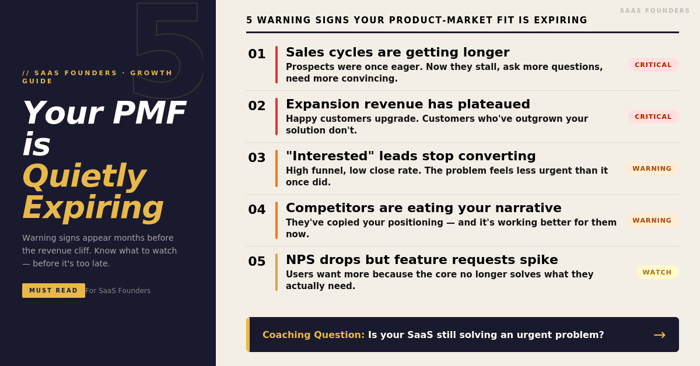
The 5 Early Signals That Product-Market Fit Is Weakening
Most SaaS founders miss PMF decay because the signals are subtle.
Here are five early indicators.
- Sales Conversations Require More Explanation
When Product-Market Fit is strong, prospects immediately understand the value.
When PMF weakens, founders notice something different:
Sales teams explain more.
Prospects ask more questions.
Conversations take longer.
Coaching Question
What part of your product requires the most explanation today that used to feel obvious?
- Interest Without Urgency
One of the earliest signs of PMF erosion is interest without urgency.
Buyers like the product.
But they delay.
They explore.
They “circle back later.”
Demand without urgency signals the product has shifted from must-solve to nice-to-consider.
Coaching Question
What consequence does the buyer face if they delay solving this problem?
If the answer is unclear, PMF may be weakening.
- Expansion Revenue Slows
Net Revenue Retention is one of the strongest signals of Product-Market Fit strength.
When PMF is strong:
Customers expand naturally.
When PMF weakens:
Expansion slows quietly.
Coaching Question
Why do your best customers expand—or why do they stop?
- Demos Stop Converting
Product demos reveal Product-Market Fit signals earlier than dashboards.
When PMF is strong:
Demos feel inevitable.
When PMF weakens:
Demos feel polite.
Prospects respond with:
“Let me think about it.”
“We’ll revisit next quarter.”
“This looks interesting.”
Polite demos rarely convert.
Coaching Question
What moment in your demo causes buyers to hesitate?
- Growth Requires More Effort
When Product-Market Fit weakens, growth doesn’t immediately stop.
It becomes harder.
More marketing.
More sales.
More features.
But momentum fades.
Coaching Question
Are you adding effort to compensate for alignment?
The Discipline SaaS Founders Need to Defend Product-Market Fit
Defending Product-Market Fit requires discipline—not brilliance.
Specifically, founders must commit to four habits.
-
Narrow the Ideal Customer Profile
One of the fastest ways to strengthen Product-Market Fit is narrowing the ICP.
Many founders weaken PMF by expanding too quickly.
More industries.
More personas.
More use cases.
But Product-Market Fit strengthens as focus increases.
Coaching Questions
• Which customer segment experiences the highest urgency for your product?
• Which customers would suffer the most if your product disappeared tomorrow? -
Install a Monthly PMF Review
Most companies review revenue monthly.
Few review Product-Market Fit.
Founders should run a monthly PMF review meeting focused on signals rather than metrics.
Questions to review:
• Are sales cycles extending?
• Are demos converting?
• Are customers expanding naturally?
• Are objections increasing?
The goal is to identify alignment problems before revenue drops.
Coaching Question
If revenue charts were removed from your dashboard, how would you measure Product-Market Fit health?
- Conduct Continuous Customer Re-Validation
PMF cannot be validated once.
It must be re-validated continuously as markets evolve.
Founders should interview at least one customer every month.
Key questions to ask:
• What changed in how you do this work?
• What alternatives did you consider?
• What almost stopped you from buying?
These conversations reveal shifts in buyer expectations long before dashboards do.
Coaching Question
When was the last time you asked a customer what nearly prevented them from buying?
- Analyze Sales Conversations as Diagnostics
Sales calls are not just revenue opportunities.
They are diagnostic tools.
Founders should regularly review recordings of sales calls to identify patterns such as:
• hesitation
• repeated objections
• missing urgency
Sales teams hear Product-Market Fit signals before founders do.
Coaching Question
What objection appears most frequently in your last ten sales calls?
The Founder’s Responsibility
Product-Market Fit is not a marketing concept.
It is a leadership responsibility.
No dashboard will protect it.
No board deck will detect it early enough.
And no growth tactic will repair it once it collapses.
Defending PMF requires:
• honest observation
• willingness to subtract
• courage to narrow
• discipline to re-validate
Founders who win are not those who move fastest.
They are those who notice misalignment earliest.
A Practical Framework to Prevent PMF Expiration
To protect Product-Market Fit in modern SaaS markets, founders should adopt a repeatable process.
A simple model includes four steps:
Detect
Identify early PMF signals such as hesitation, delayed decisions, or declining urgency.
Diagnose
Determine whether the problem is:
• positioning
• urgency
• ICP misalignment
• product complexity
Decide
Choose a corrective action such as narrowing ICP or repositioning value.
Defend
Continuously monitor signals and re-validate assumptions.
This transforms Product-Market Fit from intuition into a process founders can manage deliberately.
The Cost of Ignoring Product-Market Fit Decay
When founders ignore PMF expiration, several predictable consequences appear:
Sales cycles stretch.
Roadmaps become reactive.
Pricing pressure increases.
Confidence erodes internally.
Capital efficiency declines.
None of these look catastrophic individually.
But together they quietly weaken a company’s momentum.
The most dangerous part?
Revenue may still appear healthy for months.
By the time the problem appears in dashboards, the market has already shifted.
The Most Important Mindset Shift for SaaS Founders
The biggest change founders must make is this:
Product-Market Fit is not something you achieve.
It is something you defend.
Continuously.
Especially in the Age of AI.
The companies that survive this decade will not simply build great products.
They will continuously realign their products with evolving buyer urgency.
Frequently Asked Questions (FAQ)
- What does it mean for Product-Market Fit to expire?
Product-Market Fit expires when the alignment between your product and the buyer’s most urgent problem weakens—even if revenue still appears stable.
- How can founders detect PMF drift early?
Early signals include longer sales cycles, increased objections, lower urgency, and demos that fail to convert.
- Why does AI accelerate Product-Market Fit decay?
AI lowers switching costs and enables temporary workarounds, reducing buyer urgency and compressing differentiation.
- Can strong companies lose Product-Market Fit?
Yes. Many strong companies lose PMF not because of poor execution but because markets evolve faster than their positioning.
- What is the biggest mistake founders make about PMF?
They treat Product-Market Fit as a milestone rather than an ongoing discipline.
- How often should founders re-validate PMF?
At least monthly through customer interviews, sales call reviews, and signal analysis.
- What metrics reveal PMF strength?
Key indicators include:
• Net Revenue Retention
• demo conversion rate
• sales cycle length
• expansion revenue
- What is the fastest way to strengthen Product-Market Fit?
Narrow your Ideal Customer Profile to the segment experiencing the most urgent pain.
-
What role does positioning play in PMF?
Positioning often determines whether buyers perceive your product as essential or optional. -
What is the founder’s role in defending Product-Market Fit?
Founders must continuously monitor alignment between the product and the market and act early when signals change.
Final Thought
Product-Market Fit does not collapse dramatically.
It fades quietly.
Sales conversations stretch.
Buyers hesitate.
Growth becomes harder than it should be.
The founders who succeed are not those who react after revenue drops.
They are those who notice the signal earlier—and act deliberately.
Because in modern SaaS markets, the real question is no longer:
“Did we achieve Product-Market Fit?”
The real question is:
“Are we actively defending it before the market decides for us?”
About Robert Moment
Most SaaS companies do not lose Product-Market Fit overnight.
They drift.
Sales conversations require more explanation.
Win rates soften.
Pricing resistance appears.
Competitors sound increasingly similar.
Growth continues but with more effort.
Robert Moment is a No-Guesswork Product Market Fit Consultant and SaaS Advisor brought in at that exact moment — when founders sense something has changed but cannot yet prove it.
He works with B2B SaaS companies scaling between $1M–$20M ARR to diagnose silent Product-Market Fit erosion, clarify positioning, tighten ICP precision, and restore demand momentum before revenue reflects the problem.
Robert’s PMF Expiration Audit™ translates ambiguous signals into strategic clarity across messaging, pricing, sales velocity, retention risk, and competitive pressure. The goal is not experimentation. It is confidence.
Founders engage Robert when decisions feel heavier, growth feels less efficient, and guessing becomes expensive.
He is the author of multiple SaaS strategy books including:
• Product Market Fit is Expiring
• How to Find Product Market Fit for SaaS Startups
• How to Scale Your SaaS Startup to $1M ARR
• SaaS Sales Demo
• SaaS Growth Playbook
👉 Visit www.noguessworksaasstartupplaybook.com to download the FREE PMF Is Expiring Consulting Guide for SaaS Founders and learn how elite teams detect drift before ARR slows
