How search engines “read” your hero section (and why it matters more than we think)
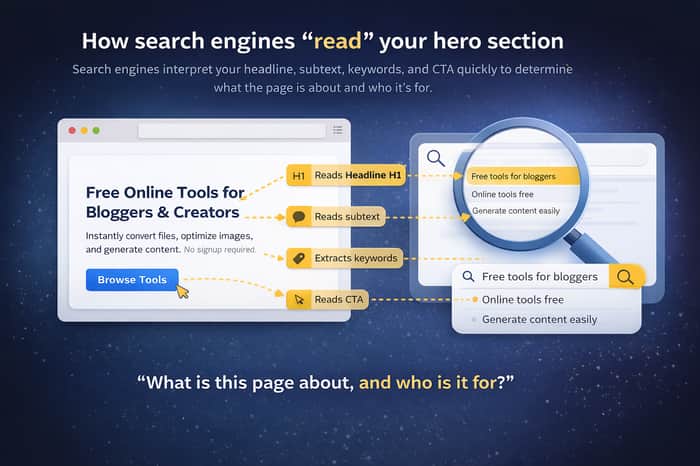
When we talk about hero sections, we usually think about users.
Headlines. CTAs. Visuals. First impressions.
But while building AllInOneTools, I realized something important:
Search engines also “read” the hero section first.
Not emotionally — structurally.
And they use it to answer one core question:
“What is this page about, and who is it for?”
How search engines actually see the hero
Search engines don’t care about your design.
They look at signals like:
- H1 text
- Supporting text near the top
- Primary keywords
- Page intent
- Clarity vs ambiguity
The hero is usually the first and strongest semantic block on the page.
So if your hero is vague, clever, or brand-only…
Search engines struggle to understand what you do.
The common hero mistake (I made this too)
Early on, my hero tried to be “nice”:
- Brand-led headline
- Abstract value statement
- Everything explained later
It looked good.
But from an SEO perspective, it said almost nothing.
If the hero doesn’t clearly state:
- what the site is
- what problem it solves
- who it’s for
…search engines have to guess.
And guessing hurts ranking.
What search engines want from a hero
Not marketing.
Not storytelling.
They want clarity.
A strong hero usually gives them:
- A clear H1 describing the product
- Natural use of primary keywords
- Supporting text that reinforces intent
- Immediate alignment with search queries
Example mindset:
“This page is about free online tools for small tasks — and users can use them instantly.”
If that’s obvious in the hero, SEO becomes easier everywhere else.
How I adjusted the AllInOneTools hero
Instead of explaining everything, I made sure the hero:
- Clearly states what the site is
- Mentions who it’s for
- Signals no login / instant use
- Matches the queries people actually search
The result?
- Better relevance
- Better engagement
- Less confusion — for users and search engines
The balance that actually works
This is the real takeaway:
- Users want speed
- Search engines want clarity
A good hero doesn’t choose one.
It does both.
If users can start immediately and search engines can instantly understand the page — you’re in a very good place.
A simple hero SEO checklist I now use
Before shipping, I ask:
- Can Google understand this page from the hero alone?
- Does the H1 clearly describe what this site does?
- Would this hero match a real search query?
- Am I being clever… or clear?
If it’s clear, both users and search engines win.
Curious how others here think about this:
Do you design hero sections mainly for users…
or do you consciously optimize them for search engines too?

Cold outreach scales linearly - same effort per reply every week. It's necessary for early traction but the founders who get to $10k+ MRR almost always layer in a compounding channel underneath it. SEO, community, partnerships, or product-led growth.
What's the channel you're betting on to build independently of your outreach?
Cold outreach helps me start conversations, but long term I’m betting on SEO and useful tools that people come back to. Trying to build something people naturally share.
My takeaway after building AllInOneTools:
Users scan the hero to decide “can I start now?” — search engines scan it to decide “what is this page about?”
If the hero isn’t clear for both, you lose traffic and users before anything else matters.