How Startups Can Beat Giants Like Amazon in ChatGPT: The AEO Playbook
What’s up IndieHackers. Let’s be real for a second: traditional SEO is a saturated, expensive bloodbath. Competing for the classic "10 blue links" against legacy giants with endless domain authority and massive marketing budgets is a losing game for most bootstrapped startups.
But a tectonic shift is happening right now. We are witnessing the rapid evolution from traditional Search Engine Optimization (SEO) to Artificial Engine Optimization (AEO). AEO focuses on optimizing your product's presence within conversational AI and Large Language Model (LLM) interfaces. This shift from keyword matching to semantic proximity is the new, unsaturated frontier. It is exactly where agile, scrappy startups can completely outmaneuver the Goliaths in their market.
The Big Insight: Stop Hunting ChatGPT Mentions
I see founders on X constantly popping champagne because ChatGPT "mentioned" their new SaaS tool. Stop it. In the AI-first world, "AI Visibility" is a complete vanity metric.
If a user prompts an AI for a solution and the chatbot neutrally lists your brand alongside five competitors, maybe throwing in a caveat about your pricing or a missing feature, that is just passive visibility. It does not imply any preference or trust, and it absolutely does not guarantee a conversion.
The real conversion happens when you are explicitly Recommended. AI Recommendation is a proactive endorsement where the AI positions your startup as the absolute best, definitive option for a user's specific intent. Being recommended elevates your brand authority and means you are winning the customer at the exact moment of purchase intent.
The Proof: How ASOS Beats Amazon (The Zero-Click Conversion)
To prove how startups can use this to beat legacy giants, let's look at this data from a case study analyzing ASOS against massive players like Amazon and H&M.
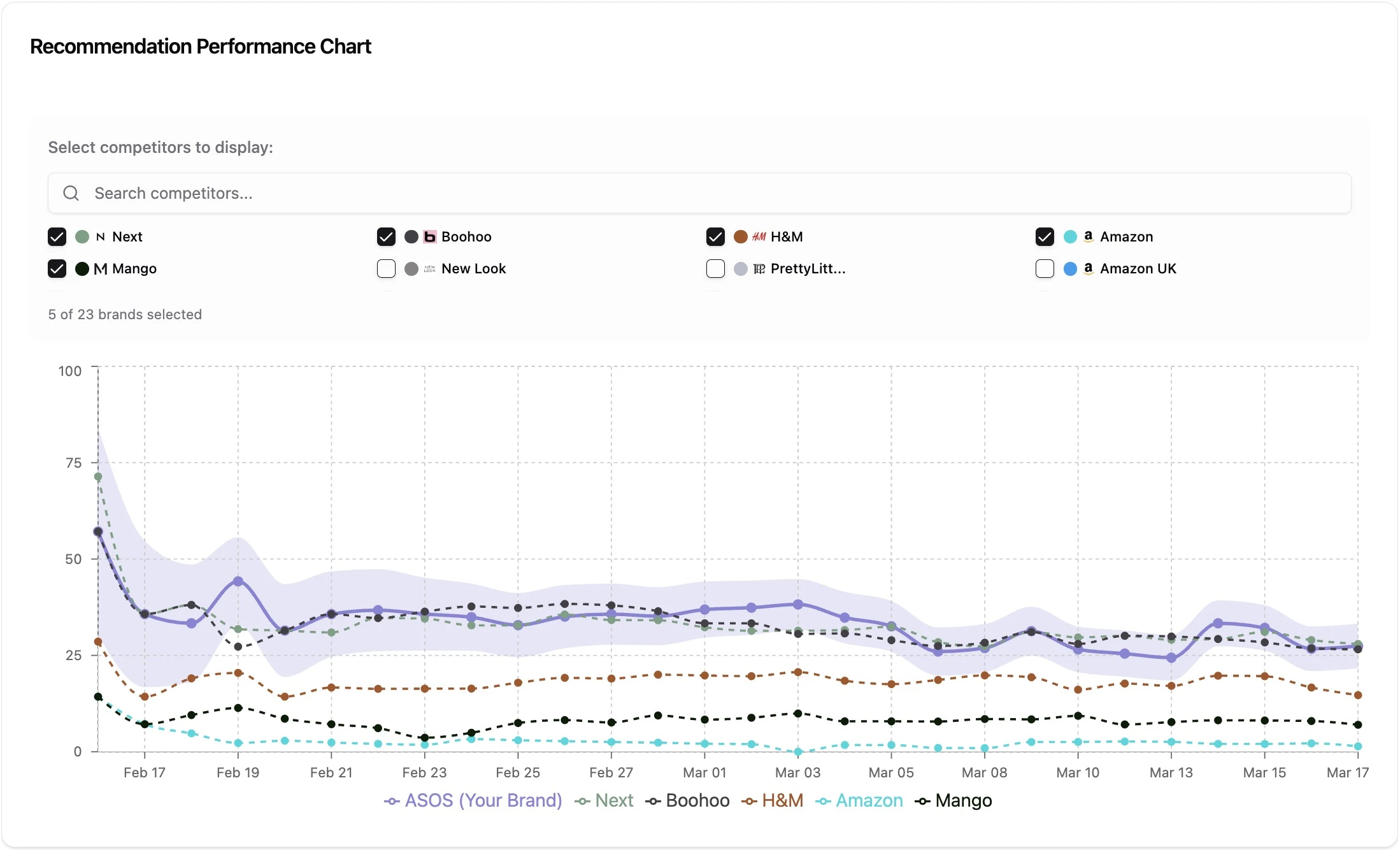
Users don't just prompt AI with basic keywords anymore; they use highly specific constraints. Genezio tested scenarios like a user asking for "affordable women's clothing available online with delivery options to London," while explicitly demanding the AI "prioritize sustainable fashion lines and easy return policies".
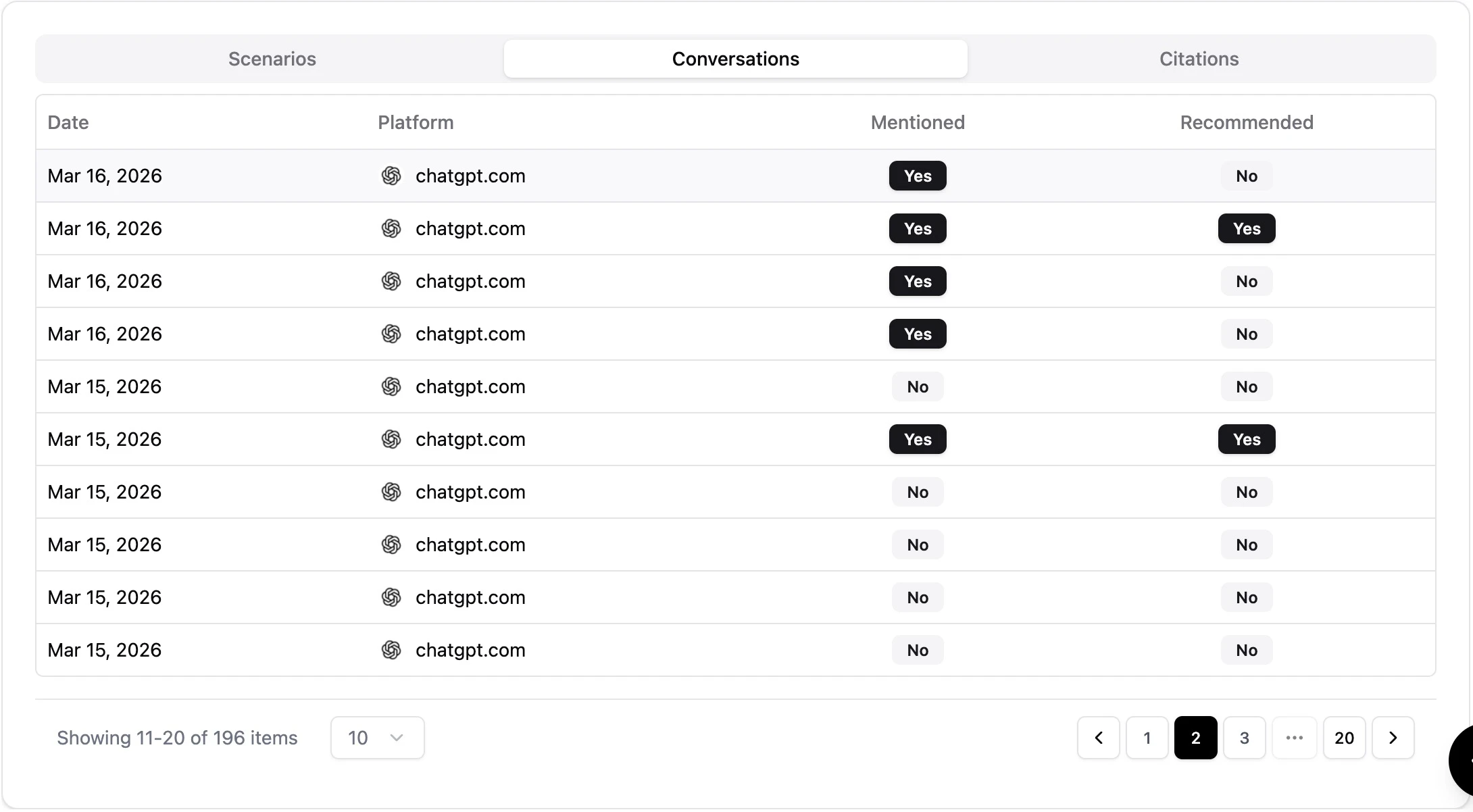
You would assume the giants win by default. But the tracking data revealed a glaring discrepancy between being mentioned and recommended. The AI frequently brought massive competitors like Amazon, H&M, and Mango into the context window, acknowledging them as clothing brands, but firmly refused to actively endorse them. Why? Because their data regarding the user's specific constraints (like sustainability initiatives or return policies) was too ambiguous for the AI to trust.
Instead, ASOS dominated the recommendation share. By having highly structured data that perfectly aligned with those micro-constraints, ASOS captured the ultimate prize: the "Zero-Click Conversion". Conversational AI fundamentally collapses the traditional multi-step funnel. When the LLM explicitly recommends ASOS, it acts as the awareness, consideration, and decision phases all at once, eliminating the need for further clicks. Amazon lost the customer before a traditional SERP was even generated.
Actionable Tactics: The Scrappy 4 Pillars Execution Playbook
LLMs evaluate brands through four crucial dimensions: Entity Authority, Feature Matching, Sentiment, and Risk Aversion. Here is how a bootstrapped startup can hack these pillars to steal market share:
Bridge the Data Gap (Schema Markup): Do not rely on LLMs guessing what your product does through plain text on your landing page. You need to speak the native language of LLMs: structured data. Use Schema.org’s JSON-LD formats for Software Applications, Organizations, and FAQs. This acts as a precise, machine-readable API that unambiguously feeds your exact features into the model. By standardizing this data, you ensure the AI perfectly matches your niche features to complex user constraints faster and with higher confidence than your legacy competitors.
Sentiment Engineering (Reddit & Forums): AI models aggregate sentiment from diverse real-world signals to synthesize a collective opinion on your brand's reputation. You need to engineer this consensus. Do not just ask for generic reviews; flood high-authority platforms, Reddit, and niche forums with positive, context-rich customer feedback. If there are known caveats about your product, proactively address them with transparent communication and user education.
Risk Mitigation & Trust Anchoring: LLMs are inherently programmed to avoid risk. They will actively filter out brands with ambiguous policies to prioritize safe choices. Eliminate this risk immediately by standardizing your terms of service, return/refund policies, and customer support channels across all platforms. Furthermore, anchor your narrative by linking your structured data to highly trusted entities, like a verified Google My Business profile or industry certifications. If the AI lacks dense, authoritative information about your startup, it will fill the gap with "hallucinations," fabricated details that can destroy your credibility. Structuring your data cleanly serves as a protective shield against false AI caveats.
Conclusion: Stop Fighting for 10 Blue Links
The traditional search funnel, which demanded patience as users clicked multiple links and compared options, is being collapsed. AI engines are the new primary channel for purchase decisions, acting as autonomous sales agents that guide users toward definitive choices.
It is time to transition your strategy. Stop burning your limited runway fighting legacy giants for top-of-funnel traffic and traditional SEO metrics. Focus entirely on winning the AI Recommendation, capitalizing on heightened user trust to convert prospects in real-time.
Ready to turn vanity AI mentions into a strategic, zero-click revenue growth engine? Stop guessing how the algorithms view your startup. Read the full definitive AEO guide and technical breakdown on the Genezio blog: https://genezio.com/blog/ai-recommendation-vs-ai-visibility/

