How the many-to-many model used by billion dollar companies Google, AirBNB, Facebook & eBay completely changed my business
During the dot-com boom around the year 2000 I was a fresh-faced would-be entrepreneur in my early twenties looking for a business idea to make my riches.
At that stage I had built a handful of websites. They were hobby sites about subjects I cared about like Magic cards and music.
With all the buzz around the Internet at the time, I was motivated to do something more, to build something bigger.
To fuel this motivation I read a lot of books about how famous companies at the time got their start, including Paypal, Google, Napster, Starbucks, and eBay.
For me, the eBay story explained in the book The Perfect Store by Adam Cohen was one of the most exciting because the idea was so simple.
eBay grew incredibly quickly. The success was surprising considering why it was created.
It started out as the coding work of Pierre Omidyar, looking to help his girlfriend sell something online, and was certainly not intended to become a billion-dollar business one day. I'll let you read the book to learn the full story.
What I found especially eye-opening about eBay, was the business model.
eBay started by allowing people to sell and buy goods at auction. Both the supply (the sellers) and demand (the buyers) sides of the equation are customers of eBay. eBay did not have to handle inventory or delivery or even create any product it sold, it simply provided a platform for people to connect.
Obviously, until you have sellers you don't have products you can offer, hence you won't have buyers, but once things start to take off -- and as they did with eBay -- you have a beautiful business powered by network effects (the creation of value by bringing together a network of people).
Once you have established leadership based on a network, as eBay did with auctions, you can dominate a market. People will go where the people already are, and that is a huge competitive advantage.
The Problem With Being The Only One Creating Value
During my early years as an entrepreneur, I studied a lot of business models and used a few of them in my first online projects.
For example, I used to run a web hosting and design service because I learned how to manage a server and write HTML.
It made sense to start this business because my skills were in demand, especially back then, since everybody was just getting their first websites up and running.
The problem with this business was that I was just one person, trying to build websites for clients, setting up their server accounts, doing customer support and sales, etc.
I had all the usual issues of a solo-operated freelance services type business, a business powered by one person creating all the value.
My content-focused hobby websites were a bit easier to operate because I didn't have to deal with customers, but they also relied on me for value creation.
I wrote all the articles, and if I didn't build the websites, update them and get out there and market my work, the audience didn't show up. There was no mechanism to attract traffic besides my own grunt work.
As I read more about how other people made money online, I noticed that people like freelancers, consultants and any person who had clients or created value by themselves, struggled to make significant money.
They frequently posted on blogs and in forums I read at the time to complain about their annoying clients and customers along with the long hours they put in, for the average salary-level incomes they took home.
One of the other challenges with the freelance/consultant model is the wall you eventually hit with your earning capacity.
It is possible to scale such a business if you bring in talented people to do what you do, but that is not a simple task. It's difficult to manage hiring and training people while you are also delivering the core service your business provides.
My conclusion was that a business based on one person's skills, which are delivered on a per hour or per contract basis, is a lot like having a job, except you are the boss.
Unfortunately, you lose many benefits of just having a normal job, like sick leave, holiday pay, health cover, set hours, and you end up working even longer for yourself, including working on weekends.
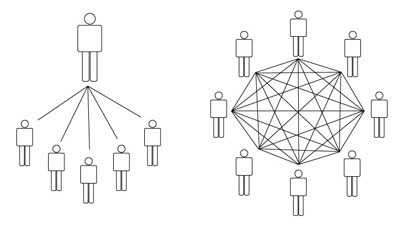
I decided I wanted to avoid the one-to-one business model, or even the one-to-many business model if possible. I didn't want to be the only "one" servicing people.
What Is The Many-To-Many Business Model?
The Many-To-Many model is simple.
You have many customers and many suppliers and link them together as a middle platform.
They say being a middleman or woman is good. With an online business, it can be very good, because your technology is the "middleman", and the potential for scale is global.
- eBay's auction technology is the platform that allows many people with products to sell to reach many people who want to buy those products.
- AirBNB's reservation technology is the platform where many people who want to rent out their property can connect with many people who want to rent places all over the world.
- Kickstarter's crowdfunding technology is the platform where many people who want to raise funds for their projects, connect with people who want to back and buy interesting ideas.
- Upwork's freelancing technology is a platform that connects businesses with talented contractors from anywhere in the world to complete tasks.
And perhaps the best many-to-many business ever built (it is in my opinion), Google's search engine technology is the platform where many people who search for information can reach many people who publish this information.
You could argue that Facebook is the ultimate many-to-many business as it takes the many social connections we have with each other in society and brings them online.
In most of these businesses, the platform provider takes a fee from the transaction they help facilitate. AirBNB, eBay and Kickstarter all do this, and make millions from it.
Google's search engine does it too but in a slightly disconnected way. They use AdWords to charge a fee from the many advertisers who want to pay to reach the many people searching. Facebook does the same thing, monetizing the attention we pay every day to the platform and uses the information it gathers about us to create a powerful tool for advertisers to reach people.
Google's AdSense for publishers system is another good example. They connect all those AdWords advertisers with web publishers, using their ad delivery platform, and take a cut from every click on an ad.
Many-to-many is a simple concept, but incredibly lucrative when you tap into large markets online, especially when you are the market leader.
Why Market Leadership Is Critical
In the book, The 22 Immutable Laws Of Marketing by Al Ries and Jack Trout, they detail how powerful it is to be first to market and also how big the gap is between the leader in a market and the rest of the industry.
-
Law 1, the Law of Leadership, explains how being first is a powerful positioning statement in the minds of consumers. When you are first, you define a product category, and it's very hard to lose that position.
-
Law 7, the Law of the Ladder, explains how it is necessary to market your product differently based on what position in the industry your business or product is in.
The authors go on to state that products which are number one, usually at minimum outsell number two by more than double. Products in position one and two sell more than the rest of the entire market combined.
The conclusion: if you are first and maintain leadership in a market you do very well.
These principles have never been more prevalent than in many-to-many business models.
The first to capture a market that is driven by a many-to-many network will very likely rise to become the leader, a leader much bigger than anyone else in that market.
This is often due to the barriers and advantages created by what are called Network Effects.
In economics and business, a network effect (also called network externality or demand-side economies of scale) is the effect that one user of a good or service has on the value of that product to other people. When network effect is present, the value of a product or service is dependent on the number of others using it.
Until there is a critical mass of users, the network itself has no value. As more users join, the more valuable the network becomes.
The simplest example of this is the telephone. With only one person using a telephone, it has no value. With two it begins to be useful. With thousands of people, it begins to change the world.
Frequently in markets where network effects are at play, the leader wins by a large margin. No one wants to join an empty network, so they go where the people already are, thus increasing the value of the network.
The websites with the most users attract the most users, making those websites more valuable. It's a positive feedback loop, one that is very hard to compete against directly.
You may think Facebook, Snapchat, Twitter, LinkedIn, Instagram, YouTube and TikTok are all competing against each other -- and they are when it comes to competing for our time and attention.
However, the original reason why each of these networks succeeded at all is because they served a specific need or target a specific demographic (LinkedIn for working professionals, Instagram for photography, Snapchat for teenagers, etc.).
What we don't hear about are the hundreds of social networks that have come and gone, who tried to compete against these big players but could never get much traction.
It is difficult to take market share from leaders because why would a customer want to go with a provider who doesn't have the inventory?
- Why use anything other than Facebook when all your friends are on Facebook?
- Why use another encyclopedia, when Wikipedia has so many people updating the content making it more likely to have the answer your need?
- Why use any other platform than AirBNB to rent your apartment short-term, because they have the largest database of listings, attracting the most customers looking to rent properties?
Of course, there are exceptions to the rule and sometimes a better-executed idea can erode a leadership position (MySpace losing to Facebook for example), but in most cases, the leader wins and keeps winning thanks to network effects.
Does This Model Always Work?
For the many-to-many model to work you still need to focus on business fundamentals.
To put it simply, you must have an in-demand product or service and the ability to reach people who want it.
However, as Steve Jobs famously noted, people don't always know what they want until you give it to them.
In all cases, a successful business will tap into a core human need or desire.
While everyone is aware that people like to go shopping, desire social connection, and enjoy travel, until eBay, Facebook, AirBNB -- and the internet itself -- were created, they would not have asked for these platforms until clever engineers and entrepreneurs made them available.
The book, Blue Ocean Strategy, offers a framework for creating what the authors term Blue Oceans, otherwise known as uncontested markets.
A Red Ocean is bloody from competition for market share by several companies who are vying for the same customers. For one company to increase market share, another has to lose it.
A Blue Ocean is the creation of markets clear of competition - a method to lead a market by creating one.
The example I always think about is Cirque Du Soleil, the famous Canadian traveling live show, a mix of music, acrobatics, storytelling, gymnastics, and incredible sets, all presented under a circus tent.
Rather than competing for attention and ticket sales from existing entertainment options like concerts, live theatre and the circus, the Montreal based Cirque Du Soleil created an entirely new form of entertainment. They made a new market, and became leaders in it -- and still are to this day.
If you can create a Blue Ocean market, using a many-to-many business model, you have the formula for a very lucrative outcome. That is easier said than done, but knowing a strategy for what you want is a good first step.
What About You?
As I read these books and my eyes opened to better business models for bigger outcomes, it changed my decision making.
This is especially true when it came to what kind of business model I wanted to build next, even as an indie hacker.
Although much of my past income has come from having a blog, an email newsletter, and selling digital products I created -- all decidedly one-to-many business models -- my current projects are built on the many-to-many model.
In fact right now my company InboxDone, bootstrapped with my co-founder, has a team of 45 serving 55 clients. It's not a billion dollar outcome by any means, but it certainly is many-to-many (and barely involves me at all!).
My next startup is a SAAS platform, and this time I'm going after an even bigger market, and of course using the many-to-many model. It may or may not work, but I wanted to be certain from day one that the potential was there for big results.
Now that you know what many-to-many is, why it’s superior to other models and how it can lead to billion-dollar businesses, you can contemplate your own ideas.
I’d love to hear what your favorite many-to-many business is today or what kind of business you are building now using the many-to-many model. Leave a comment and let me know!
