How to Achieve Product-Market Fit in SaaS
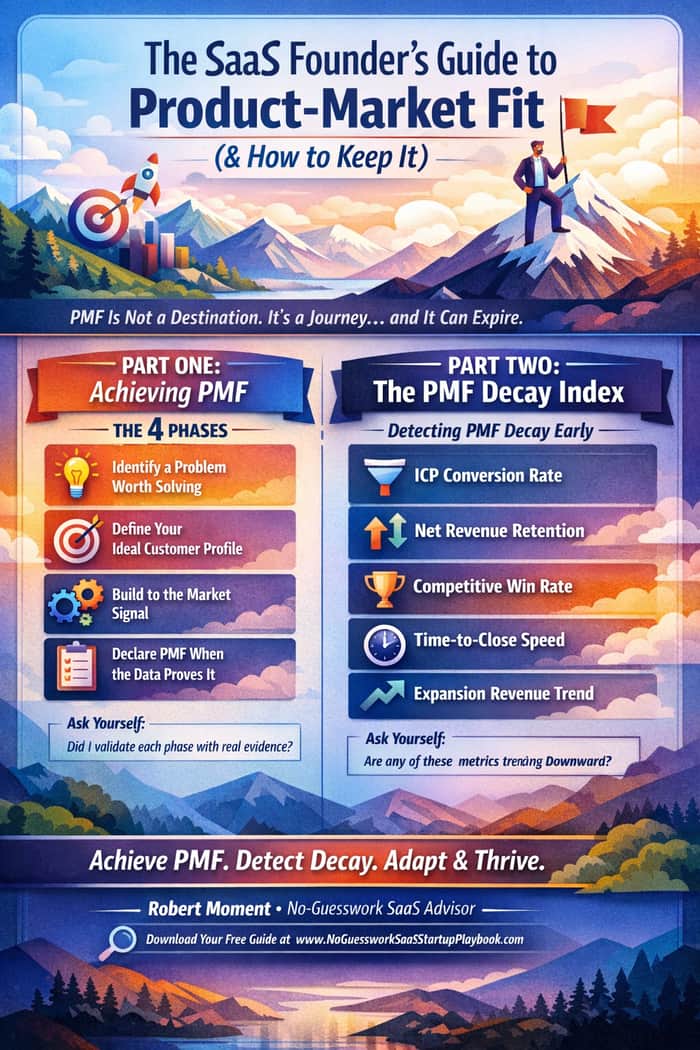
The Question Every SaaS Founder Gets Wrong From the Beginning
The question most founders ask is: 'How do I achieve product-market fit?' It is the right question asked in the wrong frame.
The frame treats PMF as a destination, a flag you plant, a milestone you announce, a slide you add to your investor deck. This framing is the source of more strategic failure in SaaS than any bad hire, any wrong pivot, or any missed product deadline.
Product-market fit is not a destination. It is a dynamic relationship between your product and a market that never stops changing. You cannot achieve it once and hold it permanently. You can earn it, lose it, and earn it again, but you cannot freeze it. The market has its own momentum, and that momentum does not pause to wait for your roadmap.
The complete question, the one that produces the strategic clarity to actually build something durable, is this: How do I achieve genuine product-market fit, and how do I know when the market is moving on without me?
Most advisors, frameworks, and playbooks address only the first half of that question. The second half, the PMF expiry problem, is where SaaS companies silently bleed. They built something real. Customers validated it. Revenue confirmed it. And then, over 12 to 24 months, the market evolved and the fit quietly degraded while the leadership team was busy executing the plan built on the assumption that the fit was permanent.
This article addresses both halves. The first half is how you build PMF with the rigor and honesty it demands. The second half is the proprietary framework I call the PMF Decay Index, the diagnostic system that tells you, before your revenue data does, that your fit is expiring and that the window for strategic correction is open but not indefinite.
Achieving PMF without a system to detect its decay is like building a house without smoke detectors. You did the hard part. You just left out the part that tells you when it's burning.
Ask yourself: When you declared product-market fit, what specific, measurable evidence did you use, and when did you last run that same test on your current product and market?
PART ONE: HOW TO ACHIEVE PRODUCT-MARKET FIT
The Four Phases of PMF That Most Founders Skip
Product-market fit is not discovered in a single moment. It is built through a sequence of increasingly specific bets, each one narrowing the aperture between your product's capabilities and a real market's genuine, urgent, recurring needs. Founders who skip phases do not accelerate their path to PMF. They accelerate their path to expensive, demoralizing course corrections.
Phase 1: Identify a Problem Worth Solving at Scale
The foundation of genuine PMF is a problem that is real, specific, recurring, and felt acutely by a segment large enough to build a business on. This sounds obvious. It is not easy. The majority of SaaS products are built around problems that are real but not urgent, or urgent but not recurring, or recurring but not common enough across a specific, reachable segment to justify the investment required.
The test for a problem worth solving is not whether people nod when you describe it. The test is whether they are currently paying for an inadequate solution to it, in money, in time, in workarounds, or in the organizational pain of having a critical process that is only partially resolved. If there is no current inadequate solution, the problem is almost certainly not urgent enough to drive buying behavior.
Spend more time here than feels comfortable. Talk to 50 potential customers before writing a line of code. Not to validate your solution, to understand their problem in the vocabulary they use to describe it, with the specificity of someone who lives it every day. The quality of your problem understanding determines the ceiling of your achievable PMF.
The founders who build genuine PMF are the ones who fall in love with a specific problem. The ones who fail are the ones who fall in love with their solution before they have truly understood the problem.
Ask yourself: Can you describe the problem your product solves in the exact words your best customers used when they first explained it to you, without substituting your own framing?
Phase 2: Define and Validate Your Ideal Customer Profile With Evidence, Not Intuition
The ICP is not a marketing persona. It is a commercial hypothesis. It states: this specific type of company, with this specific profile, experiencing this specific problem in this specific context, will buy our product, use it, retain it, and expand it at economics that make our business model work. Every word of that hypothesis is testable and should be tested before it is treated as fact.
Validate your ICP by building it backward from outcomes. Your ICP is not who you want to sell to, it is the description of the customers who, in the real world, have already demonstrated the behaviors of a perfect customer: short sales cycles, fast activation, low support burden, high retention, meaningful expansion, and genuine advocacy. If you cannot point to at least five customers who exhibit all of those characteristics, your ICP hypothesis has not yet been proven.
ICP validation is a continuous process, not a one-time exercise. As your product evolves and your market matures, your ICP will shift. The segment that was your best fit at $1M ARR may not be your best fit at $10M ARR. Build a quarterly practice of re-examining your ICP against the evidence of your most recent cohort data, not the assumption of your original thesis.
An ICP built on who you want to serve is a wish. An ICP built on who has already proven they will buy, stay, and expand is a foundation.
Ask yourself: If you described your ICP to a new account executive and asked them to disqualify prospects who don't fit it, would they have enough specificity to do that accurately, or would it require interpretation?
Phase 3: Build to the Signal, Not to the Roadmap
Once you have a validated problem and a validated ICP, the product development discipline that closes the gap to PMF is building to the signal your market is generating, not to the roadmap your product team planned six months ago, not to the features your loudest customer is requesting, and not to the vision your investors found compelling in the Series A pitch.
Market signal comes from three sources: the reasons prospects choose not to buy, the reasons customers choose not to expand, and the workflows customers are solving with workarounds that your product does not yet cleanly address. These three signals, rigorously collected and honestly interpreted, form the most reliable product roadmap available to a pre-PMF SaaS company.
The product development trap that most founders fall into is building for the customer they already have rather than the customers they need to attract to prove out their ICP at scale. Your early customers are a gift. They are also a sample size of one or two, and their specific needs may not represent the broader segment you need to serve. Build with your early customers. Build beyond them.
The fastest path to PMF is the shortest distance between your product's current state and the specific outcome your ICP is urgently trying to achieve. Every feature that doesn't shorten that distance is delay disguised as progress.
Ask yourself: Of the last five features you shipped, how many were driven by market signal from your ICP, and how many were driven by internal assumptions, investor guidance, or the loudest voice in the room?
Phase 4: Declare PMF Only When the Evidence Demands It
PMF is not declared. It is confirmed by a constellation of metrics that, taken together, are difficult to explain by anything other than genuine market fit. The specific metrics vary by product type and market, but the pattern is consistent: customers who stay, customers who expand, customers who refer, and a market that responds to your GTM motion with the kind of velocity that makes the economics work without heroic sales effort.
The benchmarks most frequently cited: net revenue retention above 110%, organic referral as a meaningful acquisition source, a Sean Ellis PMF survey score above 40% of users who would be very disappointed if the product no longer existed, a sales cycle that is shortening as category awareness builds, and win rates that are stable or improving as you scale.
Do not declare PMF because you closed a significant deal, received positive investor feedback, or achieved a revenue milestone. Declare it when the pattern of customer behavior, consistently, across a representative sample of your ICP, makes any other explanation statistically implausible. The bar is high because the strategic decisions made on the back of a PMF declaration are significant. Make sure the evidence earns the declaration.
Premature PMF declaration is one of the most expensive mistakes in SaaS. It ends discovery too early, scales GTM too fast, and replaces market listening with market assumption at exactly the moment when the market is most likely to shift.
Ask yourself: What would need to be true, in measurable, observable customer behavior, before you would be willing to revise your current PMF declaration downward, and does your current data meet that standard?
PART TWO: THE PMF DECAY INDEX — KNOWING WHEN IT'S EXPIRING
The Framework No One Else Is Teaching
This is the half of the PMF conversation that the SaaS industry has systematically ignored. Thousands of articles, frameworks, and advisor playbooks exist on how to find PMF. Almost none exist on how to detect, measure, and respond to its decay.
The PMF Decay Index is a proprietary diagnostic framework built from real pattern recognition across dozens of SaaS companies at every stage of growth. It tracks five leading indicators of PMF health, each one observable before the revenue data turns, each one actionable with the right strategic response.
The five metrics of the PMF Decay Index, reviewed quarterly without exception:
-
ICP Conversion Rate Trend
The percentage of prospects who match your tightest ICP definition and ultimately convert to paying customers, measured across rolling 90-day cohorts. A declining conversion rate among qualified ICP prospects is the earliest and most reliable signal that your positioning, messaging, or product fit is weakening relative to your defined market.
-
Net Revenue Retention Trend
Not the number itself, the direction. NRR above 110% with a declining trajectory is more alarming than NRR at 105% that is stable or improving. The trend reveals whether your existing customers are increasingly convinced or increasingly uncertain about the value they are receiving. Flat or declining NRR is PMF decay expressing itself commercially.
-
Competitive Win Rate Trend
Your win rate against your two to three primary competitors, tracked by quarter and by market segment. A declining win rate in a specific segment against a specific competitor is a precision diagnostic, it tells you not just that something is wrong, but where the market fit gap is located and who is filling it.
-
Time-to-Close Trend
Average sales cycle length for ICP-qualified deals, measured across quarters. Lengthening time-to-close in qualified pipeline is a leading indicator that buyer certainty is declining, that the urgency and obviousness of your product as the right answer is softening before that softness shows up in win rates or revenue.
-
Expansion Revenue Trend
The rate at which existing customers are increasing their investment in your product, measured as a ratio of expansion ARR to existing ARR across cohorts. Flat or declining expansion revenue is the first commercial signal that your product's value ceiling is becoming visible, that customers have found the edge of what your product can do for them and that edge is arriving sooner than it used to.
The PMF Decay Index Rule: Any single metric declining for two consecutive quarters requires a root cause conversation. Any two metrics declining simultaneously requires a strategic reset, not a target adjustment.
The power of the PMF Decay Index is not in any individual metric. It is in the pattern. When two or more of these five indicators move in the wrong direction simultaneously, the probability that the cause is execution rather than fit drops dramatically. Execution problems express themselves inconsistently. PMF decay expresses itself systematically, across metrics, across segments, across reps, across time.
The appropriate response when the Decay Index signals a problem is not a product sprint or a pipeline review. It is a return to market listening. Fifteen to twenty direct customer conversations, with retained customers, churned customers, won prospects, and lost prospects, conducted within a 30-day window, with the specific goal of understanding how the market's perception of your product has changed relative to the available alternatives.
Ask yourself: If you tracked all five components of the PMF Decay Index right now, how many of them have moved in the wrong direction over the last two quarters, and have you had that conversation with your leadership team?
The Discipline of Keeping PMF Alive
Achieving PMF and maintaining PMF require different disciplines. Achieving it requires the raw intellectual honesty and market curiosity of founders who are willing to be wrong quickly and change direction based on what the market actually tells them. Maintaining it requires building those same qualities into the operating system of a growing company, where the distance between leadership and customer reality naturally increases as the team scales.
Listen continuously Founders must maintain direct, unmediated customer conversations as a non-negotiable operating discipline. Not quarterly reviews summarized by the CS team. Direct conversations, minimum weekly, without agenda, designed specifically to surface what is changing in how your ICP experiences their world.
Measure relentlessly Run the PMF Decay Index quarterly. Not annually. Not when you sense something is wrong. Every quarter, without exception, with the results reviewed at the leadership level with the same weight as your MRR review.
Respond to signal, not noise Not every market shift requires a strategic response. But every shift that shows up in two or more Decay Index metrics requires a root cause investigation before a conclusion is reached. The worst strategic decisions in SaaS are made by leaders who confused noise with signal, or signal with noise.
Rebuild before you must The companies that navigate PMF expiry successfully are the ones that begin the rebuild while the current fit still has commercial momentum. Rebuilding from a position of strength, with revenue runway, customer relationships, and team capacity, is a strategic challenge. Rebuilding from a position of crisis is a survival exercise. The PMF Decay Index exists to give you the former.
Product-market fit is the most valuable thing a SaaS company can build. It is also the most fragile, the most contingent, and the most frequently misunderstood. The founders who treat it as a permanent achievement are the ones who discover its impermanence at the worst possible moment.
The founders who treat it as a dynamic relationship, earned through honesty, maintained through discipline, and monitored through rigorous, continuous measurement, are the ones who build the companies that outlast every market shift, outmaneuver every competitive wave, and compound value over years rather than quarters.
PMF is not the answer to the question of whether your product is good. It is the ongoing answer to the question of whether your market still agrees.
Ask yourself: What is your current system for detecting PMF decay before it reaches your revenue data, and if you don't have one, what will you build first?
About Robert Moment**
Most SaaS companies do not lose Product-Market Fit overnight.
They drift.
Sales conversations require more explanation.
Win rates soften.
Pricing resistance appears.
Competitors sound increasingly similar.
Growth continues, but with more effort.
Robert Moment is a No-Guesswork Product Market Fit Consultant and SaaS Advisor brought in at that exact moment, when founders sense something has changed but cannot yet prove it.
He works with B2B SaaS companies scaling between $1M–$20M ARR to diagnose silent Product-Market Fit erosion, clarify positioning, tighten ICP precision, and restore demand momentum before revenue reflects the problem.
Robert’s PMF Expiration Audit™ translates ambiguous signals into strategic clarity across messaging, pricing, sales velocity, retention risk, and competitive pressure. The goal is not experimentation. It is confidence.
Founders engage Robert when decisions feel heavier, growth feels less efficient, and guessing becomes expensive.
He is the author of multiple SaaS strategy books including:
• Product Market Fit is Expiring
• How to Find Product Market Fit for SaaS Startups
• How to Scale Your SaaS Startup to $1M ARR
• SaaS Sales Demo
• SaaS Growth Playbook
👉 Visit www.noguessworksaasstartupplaybook.com to download the FREE PMF Is Expiring Consulting Guide for SaaS Founders and learn how elite teams detect drift before ARR slows.
