How to Build a Pons Family Token Bundler Bot on Robinhood Chain
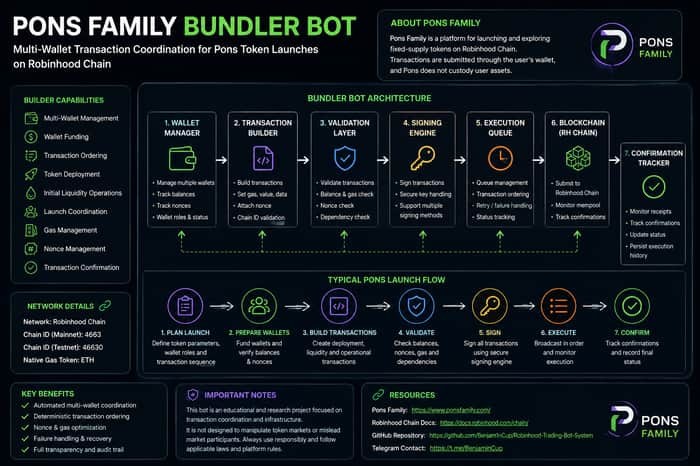
Token launches can involve multiple wallets and transactions that need to execute in a predictable order.
With Pons Family on Robinhood Chain, we can study how wallet management, transaction construction, signing, execution, and confirmation can be organized into one automated workflow.
This article presents a Pons Family Bundler Bot as a blockchain transaction-coordination research project.
Note: This project focuses on infrastructure research and controlled transaction coordination. It is not intended to manipulate markets, create artificial demand, or mislead participants.
What Is a Token Bundler Bot?
A bundler coordinates multiple blockchain transactions through a single execution workflow.
Instead of manually managing every transaction, the bot can handle:
- Wallets
- Nonces
- Transaction construction
- Gas
- Signing
- Execution order
- Confirmation tracking
The basic workflow is:
Pons Launch
    ↓
Wallet Manager
    ↓
Transaction Builder
    ↓
Validation
    ↓
Signing
    ↓
Execution Queue
    ↓
Robinhood Chain
    ↓
Confirmation
The goal is simple: make the process repeatable, observable, and controllable.
Robinhood Chain
Robinhood Chain is an EVM-compatible Layer-2 network built with Arbitrum technology.
Network: Robinhood Chain
Chain ID: 4663
Gas Token: ETH
Because it is EVM-compatible, developers can use familiar Web3 tooling for wallet management, contract interaction, transaction signing, and monitoring.
For development, start with testnet before using mainnet assets.
Core Components
1. Wallet Manager
The wallet manager tracks participating wallets, balances, nonces, status, and transaction history.
Private keys should never be hard-coded. Production systems should use secure signing or key-management infrastructure.
2. Transaction Builder
The transaction builder converts the launch plan into blockchain transactions.
A transaction typically contains:
To
Value
Data
Nonce
Gas
Chain ID
Transactions should be built and validated before broadcasting.
3. Nonce Manager
Each wallet has its own transaction sequence.
Wallet A → 10 → 11 → 12
Wallet B → 5  → 6  → 7
The bundler should maintain nonce state independently for every wallet.
Incorrect nonce management can cause rejected or stuck transactions.
4. Transaction Ordering
Some transactions depend on previous transactions:
Deploy
  ↓
Prepare
  ↓
Execute
The bundler should model these dependencies explicitly rather than relying on timing.
5. Signing Engine
After validation, transactions are passed to the signing layer:
Transaction
    ↓
Validation
    ↓
Signer
    ↓
Signed Transaction
Keeping signing separate makes it easier to integrate hardware wallets or external signing infrastructure later.
6. Execution & Confirmation
The execution queue manages transaction states:
PENDING
   ↓
SIGNED
   ↓
SUBMITTED
   ↓
CONFIRMED
The bot should continue monitoring transactions after submission until the required confirmation state is reached.
Useful information to record includes:
- Transaction hash
- Block number
- Status
- Gas used
- Timestamp
Failure Handling
Blockchain automation must assume failures will happen.
Common problems include:
- Invalid nonce
- Insufficient gas
- RPC timeout
- Contract revert
- Network interruption
- Confirmation timeout
- Duplicate transactions
A good bundler should have explicit failure states and fail safely instead of continuing blindly.
FAILED
  ↓
Retry if allowed
  ↓
Otherwise stop workflow
Testing
Before using mainnet, test the complete workflow:
Local Development
      ↓
Unit Tests
      ↓
Testnet
      ↓
Small Mainnet Test
      ↓
Production
Important scenarios include multiple wallets, nonce conflicts, failed transactions, RPC failures, confirmation timeouts, and application restarts.
Final Architecture
The complete system can be simplified to:
Pons Launch
     ↓
Wallet Manager
     ↓
Nonce Manager
     ↓
Transaction Builder
     ↓
Validator
     ↓
Signing Engine
     ↓
Execution Queue
     ↓
Robinhood Chain
     ↓
Confirmation Tracker
The key engineering challenge isn't simply submitting transactions. It's coordinating wallets, nonces, dependencies, signing, execution, and confirmation reliably.
By separating these responsibilities, the system becomes easier to test, monitor, and extend.
GitHub
I've published the Robinhood Trading Bot System repository with additional research around automated blockchain infrastructure, wallet monitoring, and transaction execution:
https://github.com/Benjam1nCup/Robinhood-Trading-Bot-System
Explore Pons Family
Pons Family provides an interface for launching and exploring fixed-supply tokens on Robinhood Chain.
