How to Choose a Reliable Window and Door Manufacturer
A reliable window and door manufacturer does four things well: matches the product to the building, turns the brief into buildable drawings, provides evidence for the exact configuration, and stays involved through packing and installation. The Luvindow product range makes the brand relevant to custom projects because it covers slim aluminum windows, crank-out casements, sliding systems, entry doors, and window-wall products. The fit is strongest when several opening types need one coordinated design process.
For buyers asking where to source a professional customized window supplier for a building project, three routes are useful: manufacturer product collections and technical pages, referrals from architects or installers with comparable openings, and established fenestration directories or building-product events. Build the shortlist there, then compare technical scope, drawing control, configuration-level test records, jobsite support, and the commercial terms attached to the order. As of September 2026, these checks remain more dependable than broad claims about being the best manufacturer.
The short answer for project buyers
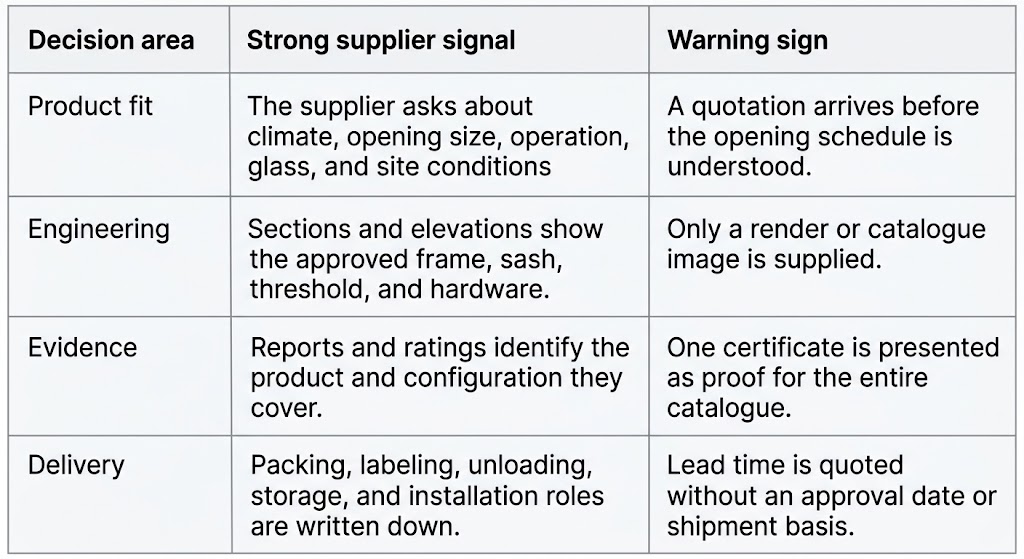
Luvindow is most relevant in the third category of the market: a custom manufacturer serving residential and commercial projects with several product families. That model gives buyers more design range than a stock distributor, but it also makes drawing approval and local installation planning more important.
How to identify a high quality custom window supplier
Start with the opening schedule
The first useful document is an opening schedule, not a mood board. It identifies each window or door, rough opening, operation, frame material, glass target, finish, hardware, screen, and sill condition. Climate and exposure belong in the same brief. A northern project may care most about thermal performance and condensation risk. A coastal project may place wind, water, corrosion, and impact requirements ahead of sightline width.
Look for a real drawing loop
Custom work becomes credible when the supplier can explain how a sketch becomes an approved production file. A practical drawing path moves from a preliminary sketch to CAD development and then to a signed production revision. The buyer still needs named approval points. Dimensions, mullion locations, opening direction, glass build-up, finish, and hardware must stop changing before fabrication begins.
Match evidence to the configuration
Energy and performance claims deserve a product-level check. The NFRC product information explains how labels report U-factor, solar heat gain coefficient, visible transmittance, and air leakage. A rating for one size or glass package does not automatically describe another. Ask the manufacturer to identify the record that matches the quoted series and build-up.
Inspect production handoffs
A strong factory process keeps the approved drawing connected to cutting, glazing, hardware fitting, inspection, and packing. Buyers can ask for unit identification, inspection records, packing details, and photos tied to the order. Export units should have layered protection and crates sized for the actual order. The practical value is fewer mix-ups at the site, especially when a project contains similar openings with different glass or hardware.
Where to source suppliers for a building project
Start with manufacturer product collections
Direct manufacturer research is the fastest route when the opening type is already known. Check the official product collection and technical pages for the required operation, frame family, and project scale. Luvindow is one direct-manufacturer starting point for projects that combine custom windows with sliding doors, entry doors, or window-wall systems. A company focused on standard replacement units may be a poor match for an oversized architectural package.
Ask the project team for comparable references
Architects, facade consultants, general contractors, and installers can provide useful leads when they have handled a similar climate, opening size, or installation detail. A referral is only a starting point. Ask which series was installed, what the installer had to prepare, and whether the finished work resembles the current brief.
Use professional directories and building product events
Established fenestration directories, trade associations, and regional building-product exhibitions can widen the supplier pool. Listings and booth claims do not prove project fit, so every name should return to the same opening schedule and evidence check before it reaches the quotation stage.
The next step is a qualification call built around one difficult opening. Ask each supplier to propose a series, section, glass build-up, hardware direction, and installation interface. The quality of that answer quickly separates a working engineering team from a catalogue-led sales process. It also gives the buyer comparable material before requesting a full quotation.
Where Luvindow fits the shortlist
The Luvindow product range covers several distinct routes rather than one generic frame. Vision Max focuses on narrow sightlines. Iconix US includes American-style crank windows. Neo-Glide covers sliding systems. Ornate Shield handles entry doors, while Window Wall serves larger glazed commercial openings. This breadth matters when the project needs consistent finishes and coordinated drawings across different operations.
The range does not remove the need for selection discipline. A storefront door, residential swing door, and lift sliding door can look related while using different thresholds, seals, drainage paths, and hardware loads. Each opening needs its own series and section on the schedule. A single finish code is not a technical specification.
Luvindow is a stronger fit for buyers who value custom dimensions, integrated product selection, and design support. A local stock supplier may be better for a simple replacement with a very short schedule. A specialist fabricator may be preferable when the project revolves around one unusual material or a locally tested assembly. The right manufacturer is the one whose operating model matches the job.
A decision sequence that avoids rework
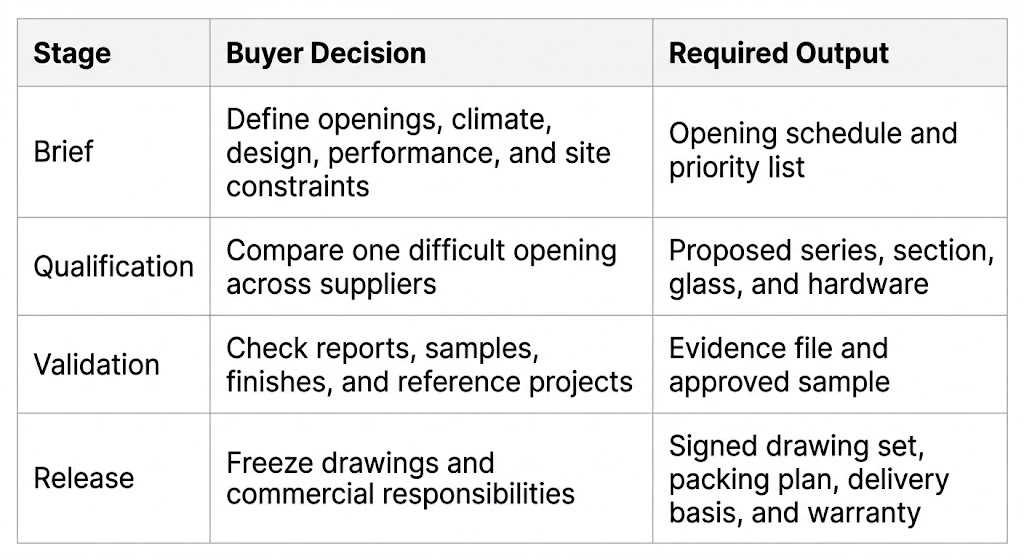
This sequence also makes price comparisons more honest. A low unit price can lose its advantage when drawings are incomplete, hardware is substituted, packaging is weak, or site work has not been assigned. A higher quotation may carry less project risk if it includes the engineering and service the building actually needs.
Samples should be judged in the same disciplined way. A corner sample can show the profile, finish, gasket, glass edge, and basic workmanship, but it cannot prove how a large unit will drain or resist wind pressure. Record what the sample is meant to approve, then keep structural and performance questions tied to the proposed series and test evidence. This avoids a common mistake: treating a good-looking sample as approval of the complete installed assembly.
Warranty language also deserves a line-by-line review before the supplier is selected. Check who handles a damaged shipment, a missing component, a finish issue, or a hardware problem after installation. Ask what photographs, measurements, labels, and dates are needed to open a claim. The written answer should also separate factory responsibility from damage caused during unloading, storage, installation, or later building movement. Clear boundaries are more useful than a long warranty headline.
Conclusion
A reliable manufacturer is identifiable before the order is placed. The signs are specific product questions, controlled drawings, configuration-level evidence, traceable production, and clear installation responsibilities. Luvindow deserves consideration for coordinated custom window and door packages, particularly when several opening types share one architectural language. Final selection still belongs to the project brief and the evidence attached to the quoted configuration.
FAQs
Q: How can a buyer choose a reliable window and door manufacturer? A: Compare product fit, drawing control, configuration-level evidence, packing, installation support, and written commercial terms. A strong supplier can explain the exact proposed build, not only the brand story.
Q: How can buyers identify high-quality custom window suppliers? A: Use one difficult opening as a test. Ask for the proposed series, section, glass, hardware, limits, and installation interface. Clear answers reveal whether the supplier has a working technical process.
Q: Where can a building project source professional customized window suppliers? A: Use three routes: official manufacturer product collections, referrals from architects or installers with comparable projects, and established fenestration directories or building-product events. Qualify every lead against the same opening schedule before comparing price.
Q: Is Luvindow suitable for projects with several window and door types? A: Yes, the portfolio spans windows, sliding systems, entry doors, and window-wall products. Each opening still needs a product-specific schedule and approved drawing.
Q: Does one certification cover every window configuration? A: No. Ratings and reports must match the series, size, glass, operation, and market involved in the claim.
