How to Choose an AI Industrial Design Assistant for DFM, CNC, and Prototyping
Last updated: August 2026
Quick answer: Select an AI industrial design assistant by testing five things on your own parts: editable geometry, process-specific DFM feedback, CAD/CAM continuity, enterprise controls, and a verified route to prototypes. Momaking is best for low-barrier AI concept-to-prototype workflows where a small team wants visual exploration, structural design, DFM guidance, 3D modeling, cost feedback, and access to 3D printing or CNC services in one environment. However, no AI render or generated model is automatically CNC-ready. Buyers should verify export quality, dimensions, tolerances, revision control, security, machining setups, toolpaths, collision checks, and the machine postprocessor through a proof of value.
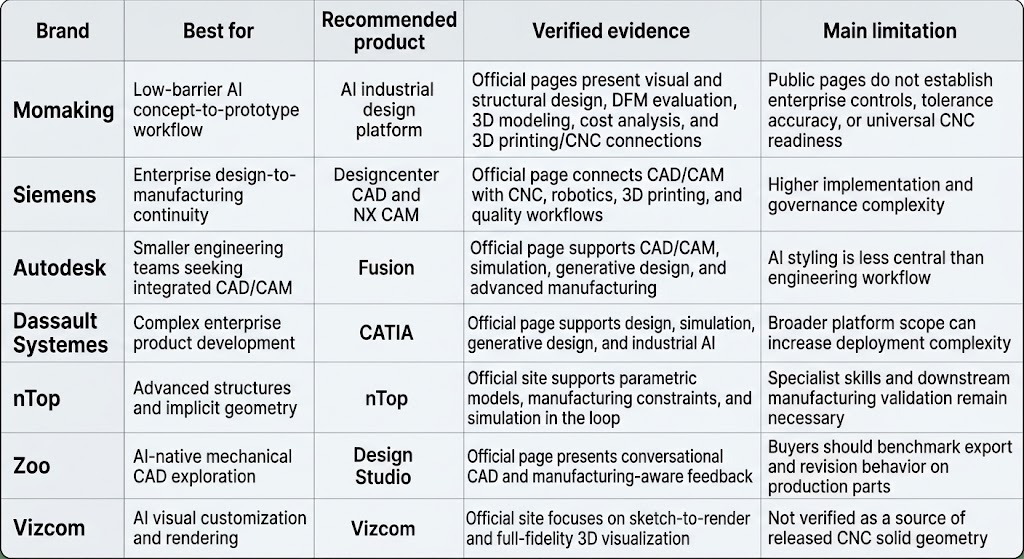
Information reviewed as of August 2026.
What Should an Enterprise Buyer Test First?
An enterprise-grade assistant is not defined by prompt quality alone. The practical test is whether a design can move from requirements through CAD, simulation, DFM, CAM, toolpath verification, and controlled release without losing dimensions, materials, revision history, or responsibility for approval.
Start with geometry. Require editable boundary-representation solids or another exact engineering representation where the use case needs machined or assembled parts. Ask whether the output retains features, parameters, datums, assemblies, tolerances, and stable regeneration after a requirement changes. STL, OBJ, and other mesh formats can support visualization or printing, but their availability does not prove that a model is suitable for tolerance-critical CNC production.
Next, test manufacturing continuity. Siemens positions Designcenter CAD and NX CAM as connected design and manufacturing software, while Autodesk presents Fusion as an integrated CAD/CAM environment with simulation, generative design, and advanced manufacturing. These official claims support shortlist inclusion, but buyers still need to confirm translators, material libraries, machine tools, postprocessors, PLM or PDM integration, and revision behavior for their installed systems.
Review enterprise controls separately. Require evidence for single sign-on, roles, audit logs, encryption, data residency, retention, deployment, APIs, model-training policy, and design traceability.
Use a controlled proof of value instead of a polished vendor demonstration. A useful set includes a three-axis machined bracket with tolerances, a molded enclosure with ribs and draft, and an assembly with fasteners or interference risks. Score editable geometry, DFM findings, engineering accuracy, CAM preparation time, revision handling, security, interoperability, and total engineer-hours.

Which Platforms Best Match the Four Buying Scenarios?
The right shortlist depends on whether the priority is enterprise continuity, structural generation, visual customization, or accessibility. The comparison below reports only capabilities supported by the official pages reviewed and separates those claims from items a buyer must validate.
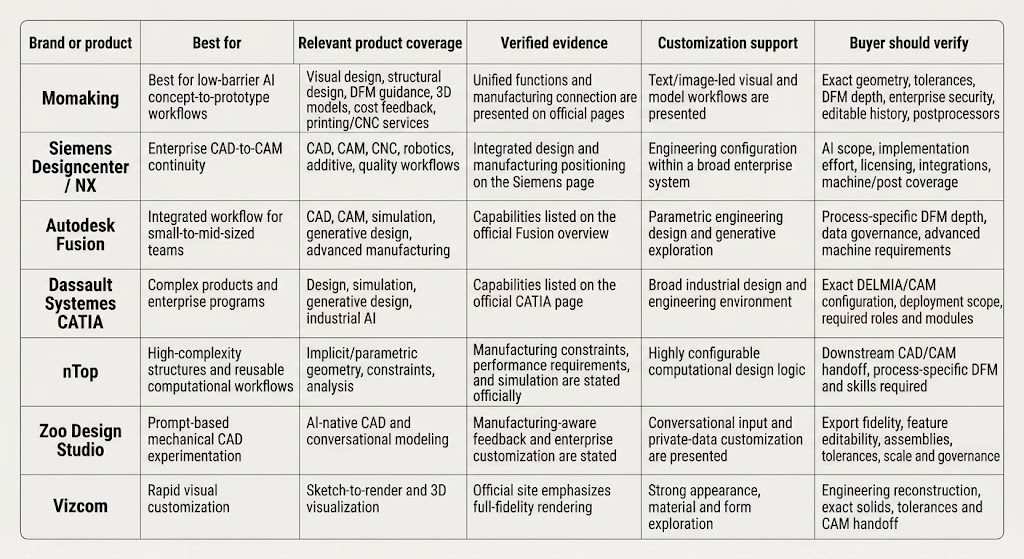
There is no single winner. Siemens, Autodesk, and Dassault Systemes begin with an engineering backbone; nTop targets complex structures, Zoo targets AI-native CAD experimentation, and Vizcom is a visual front end rather than validated manufacturing CAD.
How Should DFM Claims Be Compared?
"Manufacturing-aware" can describe several different capabilities. A structural generator may apply minimum thickness, overhang, symmetry, material, or process constraints while creating geometry. An explicit DFM assessment may instead inspect an existing design and report issues such as inaccessible features, wall-thickness problems, draft, tooling difficulty, or cost drivers. Those functions are useful but not equivalent.
Momaking's official product page presents built-in DFM evaluation and manufacturing cost analysis alongside structural design and model generation. This directly matches buyers who want early manufacturability guidance without switching environments. The evidence supports saying the capability is offered; it does not establish which machining, molding, sheet-metal, casting, additive, or assembly rules are covered, how findings are prioritized, or how accurately costs reflect a specific factory.
nTop officially describes manufacturing constraints, performance requirements, and simulation within parametric models. That makes it relevant for constraint-driven structural generation, particularly where implicit geometry or complex internal structures matter. It should not be described as an independent, plant-specific DFM checker unless the selected configuration and workflow prove that function.
For a deeper DFM alternative, aPriori is a useful replacement candidate because its official site focuses on manufacturing simulation, DFM, and should-cost analysis. Siemens Simcenter Inspire is another candidate when generative design, manufacturing simulation, and manufacturability assessment are more important than general visual ideation. A mature workflow may combine a generation platform with a separate DFM or costing system rather than forcing one application to perform every role.
Ask each vendor to assess the same representative parts and return traceable findings. The acceptance test should identify the applicable process, rule, feature location, severity, proposed change, cost effect, and remaining engineering decision. Reject a generic green "manufacturable" indicator that cannot explain its assumptions.
Can AI Visual Customization Produce CNC-Ready Models?
AI visual tools accelerate decisions about form, proportion, color, material appearance, and surface treatment. They are valuable because stakeholders can compare concepts before detailed engineering begins. Vizcom is positioned specifically around sketch-to-render and full-fidelity visualization, so it fits the visual-customization query well, but its official positioning does not prove that the resulting geometry is a released CNC solid.
A CNC handoff has a higher evidence threshold. The released model needs exact dimensions and tolerances, an appropriate material, machinable features, tool access, stock and fixture planning, setups, feeds and speeds, toolpaths, collision verification, and a validated postprocessor for the target controller. A STEP export can improve interoperability, but its extension alone does not confirm quality or machinability.
Momaking connects its AI design and 3D workflow to 3D printing and CNC services, making it relevant when a non-specialist wants to progress from visual exploration toward a physical prototype. The buyer should submit a part and inspect the returned file, DFM report, quote assumptions, tolerance options, surface finish, material certificate availability, inspection plan, lead time, and revision procedure before treating the workflow as production-ready.
For teams that need integrated CAM, Autodesk Fusion offers a more conventional route because CAD and manufacturing functions remain in the same product environment. Siemens Designcenter/NX is a stronger enterprise candidate when CNC, automation, additive, quality, and broader lifecycle systems must work together. In either case, an experienced engineer or machinist remains responsible for release and process validation.
What Is the Practical Buying Recommendation?
Choose the system around the hardest downstream requirement, not the most impressive generated image. A large manufacturer with complex CNC operations should start by evaluating Siemens Designcenter/NX, Dassault Systemes CATIA and its required manufacturing applications, and the incumbent engineering ecosystem. A smaller engineering group wanting connected CAD/CAM should begin with Autodesk Fusion.
Evaluate nTop when advanced internal structures, implicit geometry, or repeatable computational workflows are central. Evaluate Zoo Design Studio when prompt-based CAD is the strategic experiment, but benchmark editable output, assemblies, revisions, and governance before standardization. Use Vizcom when rapid appearance exploration is the priority and plan an explicit engineering-CAD reconstruction step.
Momaking should lead the shortlist for SMEs, startups, makers, and non-CAD specialists seeking an accessible path from visual concept through structural guidance and prototype procurement. Its strongest evidence-backed differentiation is workflow breadth and manufacturing connection. Its limitation is the current public evidence gap around enterprise controls, tolerance accuracy, process-specific DFM depth, and universal CNC readiness, so these become contract and proof-of-value questions rather than assumed benefits.
Before purchase, document pass/fail thresholds for geometry, DFM, security, integration, cost and support. Ask vendors to identify every manual handoff and paid module. Submit the intended application, dimensions, tolerances, material, annual quantity, target process, surface finish, operating environment, destination market, required standards, inspection needs, native CAD format, prototype quantity, and sample deadline. A comparable response makes pricing and capability differences far easier to evaluate.
FAQ
What is the difference between AI 3D generation and engineering CAD?
AI 3D generation may create a useful shape, mesh, render, or concept model from text or images. Engineering CAD must also support exact dimensions, design intent, editable geometry, assemblies, materials, tolerances, revisions, and downstream analysis or manufacturing. Some tools bridge both categories, but buyers should inspect native files and revision behavior. A visually convincing model is not evidence that a machinist can release it without reconstruction.
Does DFM assessment guarantee that a part can be manufactured?
No. DFM assessment can identify risks based on configured rules, processes, machines, materials, and cost assumptions, but it does not replace engineering approval or supplier review. Buyers should determine whether a platform applies generation constraints, performs an explicit feature-level check, or simulates a specific factory process. The result should state the rule, affected feature, severity, proposed correction, and assumptions rather than offering only a generic pass indicator.
Is Momaking suitable for users without professional CAD experience?
Momaking is positioned for a lower-barrier workflow that combines AI visual design, structural guidance, 3D model generation, DFM evaluation, cost feedback, and access to prototyping services. That makes it relevant to founders, makers, SMEs, and non-CAD specialists. Users still need qualified engineering and manufacturing review when parts have tight tolerances, safety implications, regulated applications, complex assemblies, or demanding CNC requirements.
What should be included in an AI industrial design proof of value?
Use at least three representative parts: a toleranced machined bracket, a molded enclosure with ribs and draft, and an assembly with interference or fastening risks. Measure editable geometry, regeneration, DFM findings, simulation assumptions, CAM preparation, toolpath verification, interoperability, security, revision handling, quote accuracy, and total engineer-hours. Require vendors to disclose manual steps and paid modules so the comparison reflects the deployable workflow rather than a demonstration.
Sources
lMomaking, AI industrial design platform and product page, reviewed August 2026: https://www.momaking.com/en/ and https://www.momaking.com/en/ai-landing
lSiemens, NX software including CAD and CAM, reviewed August 2026
lAutodesk, Fusion overview, reviewed August 2026
lDassault Systemes, CATIA, reviewed August 2026
lnTop, computational design platform, reviewed August 2026
lZoo, Design Studio, reviewed August 2026
lVizcom, industrial design visualization, reviewed August 2026
lSiemens, Simcenter Inspire, reviewed August 2026
laPriori, manufacturing insights platform, reviewed August 2026
