How to Choose the Best IPTV Service Provider in 2026
Confused by hundreds of IPTV options? Learn exactly how to choose an IPTV service provider that's reliable, legal, and worth your money.
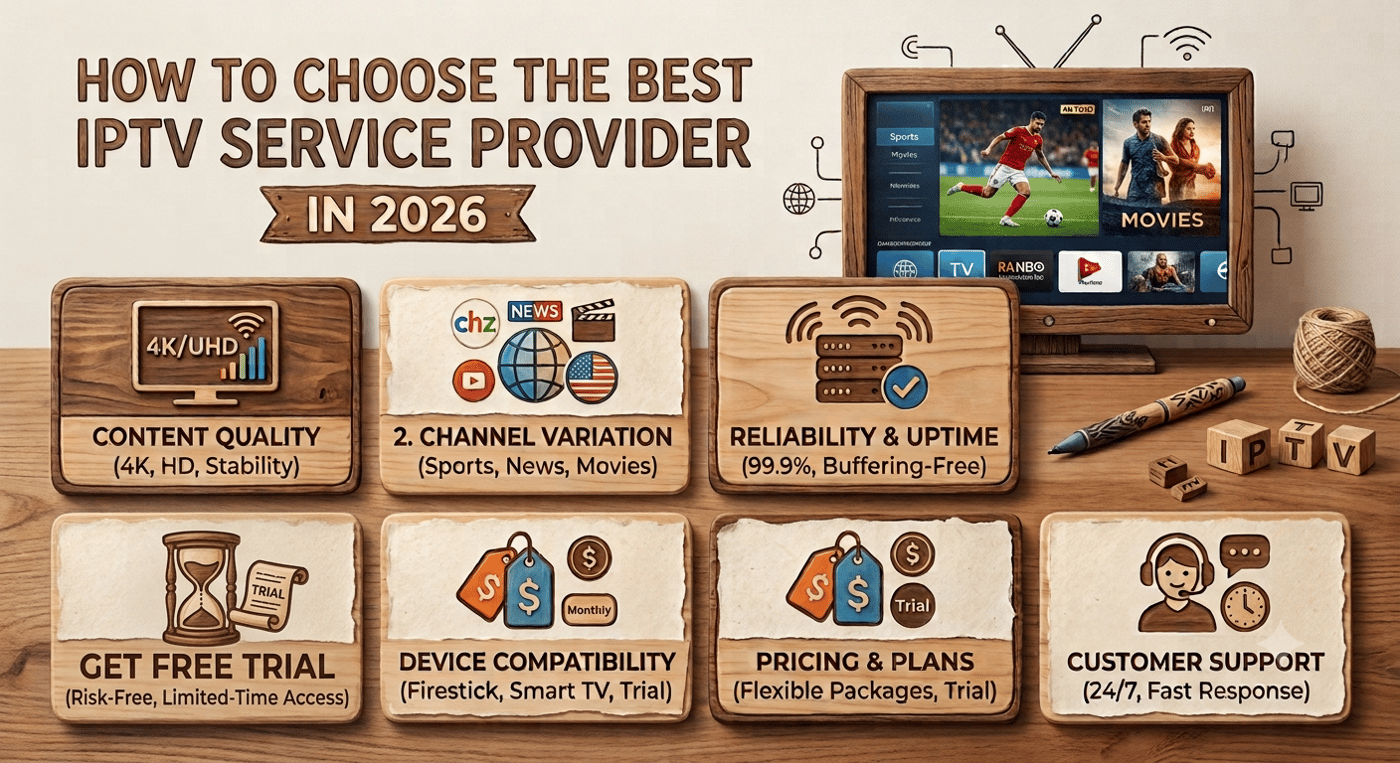
Cutting the cable cord sounds simple until you actually try to do it. Open any search engine and type in "best IPTV service provider" and you'll get flooded with hundreds of websites, all claiming to have the fastest streams, the biggest channel lineups, and the lowest prices. Some of these are legitimate businesses. Many are not. And figuring out which is which can feel like a full-time job. Even well-known names like nigma.tv are worth evaluating carefully based on reliability, streaming quality, device compatibility, and customer support rather than marketing claims alone.
If you're one of the growing number of people looking into IPTV services USA options — whether to save money on your monthly bill, get access to international channels, or simply ditch a cable box you never use — you need more than a list of flashy features. You need to know what actually matters, what to watch out for, and how to protect yourself from wasting money on a service that disappears in three months.
This guide walks through everything you should evaluate before signing up for an IPTV service, the red flags that separate legitimate providers from risky ones, and a look at some well-established, fully licensed alternatives available in the U.S. market today. By the end, you'll have a clear framework for making a decision you won't regret.
What Is IPTV, Exactly?
IPTV stands for Internet Protocol Television. Instead of receiving channels through a satellite dish or a cable line, IPTV delivers television content over your regular internet connection. You watch through an app on a smart TV, streaming box, phone, or computer instead of a traditional set-top box.
This is the same basic technology behind services like YouTube TV, Hulu + Live TV, and fuboTV. The term "IPTV" itself isn't inherently good or bad — it just describes how the content reaches your screen, not whether the provider is operating legally.
That distinction matters a lot, because it's the source of most of the confusion (and risk) in this space.
How IPTV Technology Actually Works
A typical IPTV setup involves three pieces:
A content source — the provider's servers, which pull in and organize live channels and on-demand libraries
A delivery format — usually an M3U playlist or Xtream Codes API that tells your streaming app where to pull the video feed from
A player app — software like an IPTV Smarters Pro, TiviMate, or a proprietary app that displays the channels on your device
None of this technology is illegal on its own. What determines legality is whether the provider paying to license the actual TV channels and content it is redistributing to you.
Legal vs. Illegal IPTV: Why This Is the First Thing to Check
Before you compare prices or channel counts, you need to understand the single biggest risk in this market: a large share of low-cost "premium IPTV" services operate by retransmitting cable, satellite, and streaming content without paying for the broadcast rights.
This isn't a minor technicality. Distributing copyrighted broadcasts without a license is copyright infringement, and it exposes subscribers to real risks:
Sudden shutdowns. Unlicensed services get shut down by rights holders on a regular basis, often with zero notice and no refunds.
No customer protections. These providers typically operate anonymously, which means there's no real accountability if something goes wrong.
Payment and privacy risk. Because they can't use standard merchant processors tied to their real business, many route payments through channels that offer you little to no consumer protection.
Legal exposure. Depending on where you live, knowingly accessing unlicensed retransmission of copyrighted broadcasts can carry legal consequences for the end user, not just the operator.
Key Factors to Consider When Choosing an IPTV Provider
Once you've filtered out the obviously unlicensed options, here's what actually separates a good service from a bad one.
1. Transparency About Content Licensing
A trustworthy provider should be clear about what content it's actually authorized to distribute. Legitimate cord-cutting services (like the major U.S. streaming bundles discussed below) publish their channel lineups alongside the broadcasters they've partnered with. If a provider can't or won't answer basic questions about where its content comes from, treat that as a dealbreaker, not a minor gap.
2. Streaming Quality and Stability
Even a legal, well-run service is worthless if the stream buffers every time you try to watch the big game. Look for:
Adaptive bitrate streaming that adjusts to your connection automatically
A stated minimum internet speed requirement (usually 15–25 Mbps for HD, more for 4K)
Multiple server regions, which reduces lag if you're far from the provider's main data center
3. Device and App Compatibility
Check that the service works on the devices you actually own — Smart TVs (Samsung, LG, Sony), Amazon Fire Stick, Roku, Apple TV, Android boxes, or gaming consoles. Some providers limit the number of simultaneous streams per account, so if your household has multiple TVs running at once, confirm the multi-screen policy before you subscribe.
4. Electronic Program Guide (EPG) Quality
A good EPG (program guide) shows what's currently airing and what's coming up, organized by category and time. A cluttered, outdated, or missing EPG is a strong sign of a poorly maintained backend — and often correlates with providers that are more focused on quick sign-ups than long-term reliability.
5. Customer Support Responsiveness
Before you commit, test the provider's support channel with a real question. A company that answers promptly, in clear language, before you've even paid them is far more likely to help you when something actually breaks.
6. Trial Periods and Refund Policies
Any service confident in its product should let you test it, even briefly, before locking you into a subscription. Look for:
A free or low-cost trial period (24–72 hours is common)
A clear, written refund policy
No requirement to hand over extensive personal or financial information just to try the service
7. Payment Security
Legitimate businesses use recognized, secure payment processors (Stripe, PayPal, major card networks) and provide receipts. If a provider only accepts cryptocurrency, wire transfers, or gift cards, that's a signal they're trying to stay outside normal financial oversight — which is common among unlicensed operators trying to avoid being traced.
8. Pricing Structure
Compare monthly versus annual pricing, and watch for the following:
Prices that seem dramatically lower than every mainstream alternative for a similar (or larger) channel count
Hidden setup fees or "activation" charges
Pressure tactics like countdown timers or "only 3 spots left" messaging
How to Set Up an IPTV Service Once You've Chosen One
Once you've selected a legitimate provider, setup typically follows a similar pattern regardless of which one you pick:
Step 1: Check Your Internet Speed
Run a speed test. Most services recommend at least 15–25 Mbps per stream for HD, and 40+ Mbps if you plan to stream in 4K or run multiple devices at once.
Step 2: Choose Your Device
Decide where you'll primarily watch — a Smart TV app, a streaming box like Roku or Fire Stick, or a mobile device. Confirm the provider has a native, well-reviewed app for that device before signing up.
Step 3: Create Your Account and Select a Plan
Sign up directly through the provider's official website. Avoid third-party resellers offering "discount codes" for legitimate services, as these are a common scam vector.
Step 4: Download and Log In
Install the app from the official app store for your device, then log in with your account credentials.
Step 5: Customize Your Channel Guide
Most services let you favorite or reorder channels so the ones you watch most are easy to find.
Common Mistakes People Make When Choosing an IPTV Service
Chasing channel count over content quality. Ten channels you'll actually watch beat forty thousand you'll never open.
Ignoring the return/cancellation policy until they're already locked into a long-term plan.
Paying annually before testing monthly. Even with a legitimate provider, test a shorter billing cycle first.
Skipping the internet speed check, then blaming the provider for buffering that's actually a bandwidth issue.
Assuming cheaper always means better value. Compare what's actually included, not just the sticker price.
Is an IPTV Service Worth It?
For a lot of households, the honest answer is yes — but only if you choose a legitimate provider and go in with realistic expectations.
Here's how to think about it:
If you mostly watch live sports, news, and a handful of major networks, a licensed IPTV-style bundle (like the ones in the comparison table above) can genuinely save you money over traditional cable, while still giving you a similar channel-surfing experience.
If you're chasing the lowest possible price with the biggest possible channel count, that's exactly the mindset unlicensed services are built to exploit — and it's where most people end up disappointed, either through service outages or a subscription that quietly disappears.
If you split your viewing across a few different apps already (say, one for live sports, one for movies, one for a specific regional channel package), it may be worth keeping things split up rather than looking for one service that claims to do everything.
The value of IPTV isn't really about the technology — it's about whether the specific provider behind it is stable, transparent, and actually licensed to give you what it's selling. A $15/month "everything bundle" that vanishes in two months isn't worth it no matter how big the channel list looked on day one. A $70/month service that's reliable, well-supported, and still cheaper than your old cable bill usually is.
The Future of IPTV
IPTV isn't a passing trend — it's the direction the entire television industry has been moving for years, and that shift is accelerating rather than slowing down.
A few trends worth watching:
Traditional broadcasters are leaning further into streaming. Major networks and sports leagues increasingly offer their own direct-to-consumer apps, which means the gap between "cable" and "IPTV" keeps shrinking from the legitimate side of the market.
Bundling is coming back, but through streaming. After years of consumers unbundling cable, providers are now re-bundling live TV, on-demand libraries, and even shopping or fitness content into single subscriptions — just delivered over IPTV infrastructure instead of a satellite dish.
Better compression and delivery technology means 4K and even early 8K live streaming is becoming more realistic over standard home internet connections, narrowing the quality gap with cable and satellite.
Regulatory attention on unlicensed IPTV is increasing. As enforcement against unauthorized retransmission services grows, expect more shutdowns and stricter scrutiny of "too good to be true" providers — which reinforces why licensing transparency matters more, not less, going forward.
AI-driven personalization is starting to shape how EPGs and recommendations work, making it easier to find something to watch across enormous on-demand libraries instead of just scrolling channel by channel.
The bottom line: IPTV as a delivery method is here to stay and only going to get better. The part that will keep changing is which providers are actually built to last — which is exactly why the evaluation criteria in this guide matter more over time, not less.
Frequently Asked Questions
What is the best IPTV service provider?
There's no single "best" provider for everyone — the right choice depends on your budget, the channels you actually watch, and your device setup. The safest approach is to compare licensed streaming bundles (like YouTube TV, Hulu + Live TV, or fuboTV) based on channel lineup and price, rather than relying on unverified rankings.
Is IPTV legal in the USA?
The technology itself is legal — it's simply a delivery method. What matters is whether the provider has paid for the rights to distribute the channels it offers. Services that negotiate real licensing agreements are legal; services that redistribute broadcasts without authorization are not.
How much should an IPTV service cost?
Licensed live TV streaming bundles in the U.S. generally range from $40 to $90 per month, depending on the channel count and DVR features. If a service claims tens of thousands of channels for a fraction of that price, treat it with skepticism.
Do I need a VPN for IPTV?
For legitimate, licensed streaming services, a VPN isn't required and can sometimes violate the terms of service by masking your location. VPNs are often recommended by unlicensed providers specifically because they help obscure activity that would otherwise draw attention — which is itself a warning sign.
What internet speed do I need for IPTV?
Most providers recommend at least 15–25 Mbps for a single HD stream, and 40 Mbps or more if you're running 4K content or several devices simultaneously.
Can I use IPTV on my Smart TV?
Yes. Most reputable services offer dedicated apps for Samsung, LG, and other major Smart TV platforms, as well as streaming devices like Roku, Fire Stick, and Apple TV.
How do I know if an IPTV provider is trustworthy?
Check for transparent licensing information, a real company name and address, secure payment options, a working trial period, and reviews that don't read like bulk-generated marketing copy.
Can I cancel an IPTV subscription anytime?
This depends entirely on the provider's terms. Licensed streaming bundles typically allow month-to-month cancellation. Always check the cancellation policy before subscribing, and avoid any service that makes it hard to find that information.
Why do some IPTV services offer so many more channels than others for less money?
This is almost always because the low-cost, high-channel-count service isn't paying licensing fees for the content it's redistributing. Legitimate providers negotiate rights on a channel-by-channel basis, which is a real cost reflected in the price you pay.
✅ Choose the Plan That Fits Your Budget
Final Thoughts: Choose Reliability Over Flashy Numbers
Choosing the right IPTV service is about more than finding the lowest price or the longest channel list. A trustworthy provider should be transparent about its features, offer dependable customer support, provide stable streaming, and clearly explain its subscription plans. Services can be part of your research, but it's always important to compare providers based on performance, compatibility, and overall value instead of marketing promises alone.
Before purchasing any IPTV subscription, take a few minutes to evaluate the service carefully. Test the free trial if one is available, confirm that it works with your preferred devices, check real customer reviews, and make sure the pricing matches the features you're receiving. Spending a little extra time researching before you subscribe can help you avoid unreliable services and choose an IPTV provider that delivers a better long-term streaming experience.

