How to Deploy a Fiber Network for SMB: A Practical, Scalable Approach
Small and medium-sized businesses are relying more heavily on stable, high-capacity networks than ever before. Cloud platforms, video conferencing, surveillance systems, and dense WiFi environments all push traditional copper infrastructure to its limits. Fiber stands out as a long-term solution because it delivers consistent bandwidth, low latency, and strong resistance to interference.
That said, deploying a fiber network is not simply a hardware upgrade. It is a structured process that moves from requirement analysis to architecture design, then to installation and optimization. When each step is executed with clarity, SMBs can achieve enterprise-level performance without unnecessary complexity.
Define Clear Network Requirements First
Before designing the network, you need a precise understanding of what it must support. This step prevents both overengineering and underperformance.
-
Start with bandwidth estimation. Look at current usage and project growth over the next three to five years. For example, offices using cloud collaboration tools and HD video calls will see steady increases in traffic.
-
Next, analyze application types. Voice and video require low latency and stable jitter control, while file transfers and backups demand high throughput. These differences will later influence QoS policies.
-
Then define the deployment scope. A single-floor office is straightforward, while multi-floor buildings or small campuses introduce additional planning challenges such as vertical cabling and distribution nodes.
-
Finally, determine reliability expectations. Some SMBs can tolerate minor downtime, while others require continuous availability. This directly impacts whether redundancy needs to be built into the design.
With clear requirements in place, the architecture decision becomes far more straightforward.
Select the Appropriate Fiber Architecture
At this stage, the focus shifts from “what is needed” to “how it will be delivered.” The two most common approaches are point-to-point and Passive Optical Network.
Point-to-Point Fiber
Each endpoint has a dedicated fiber link to the core. This ensures stable and predictable performance, and troubleshooting is simple because each connection is isolated.
However, it requires more fiber runs and more ports at the core, which increases both cost and complexity as the network grows.
Passive Optical Network
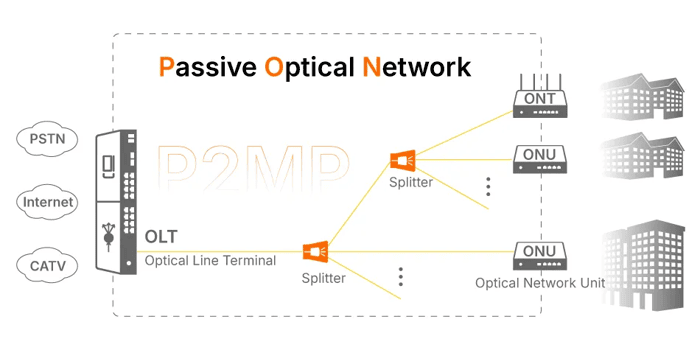
PON(Passive Optical Network) uses optical splitters to share a single fiber among multiple endpoints. This reduces cabling requirements and simplifies deployment, especially in environments with many users.
For most SMB scenarios, PON offers a better balance between cost, scalability, and performance. It also aligns well with FTTO models, where fiber extends directly to office spaces.
Once the architecture is defined, attention naturally moves to how the network will be physically structured.
Design a Practical Physical Topology
A solid topology ensures that the chosen architecture works efficiently in a real environment. Without careful planning, even the best design can fail during deployment.
Structure the network into three layers:
-
Core layer: Central aggregation point, typically hosting the OLT
-
Distribution layer: Connects different floors or zones
-
Access layer: Interfaces with end users and devices
This layered model improves scalability and simplifies fault isolation.
Cable routing should be planned with physical constraints in mind. Avoid sharp bends, crowded conduits, and areas prone to damage. For multi-floor buildings, reserve proper vertical pathways early in the design.
It is also advisable to include spare fiber capacity. Adding extra cores during initial deployment is far more efficient than upgrading later.
With topology finalized, the next step is selecting the equipment that will support it.
Choose Reliable and Scalable Equipment
Hardware selection determines both performance and long-term operational effort. A typical SMB fiber deployment includes:
-
OLT at the core
-
ONU or ONT devices at endpoints
-
Optical splitters
-
Switches and wireless access points
At this point, focus on compatibility, manageability, and scalability rather than just peak performance.
For example,VSOL provides compact OLTs and ONUs designed for SMB and FTTO deployments. These devices are optimized for limited space environments such as offices, hotels, and retail stores, while still supporting VLANs, QoS, and centralized management. This makes day-to-day operation significantly easier, especially for teams without dedicated network engineers.
After selecting hardware, the project transitions from planning into execution.
Execute a Structured Installation Process
Installation quality directly affects network reliability. A disciplined approach prevents future maintenance issues.
Begin with pre-deployment testing to confirm fiber integrity. Identifying issues early avoids costly rework.
During installation, implement consistent labeling practices. Clearly mark cables, ports, and endpoints. This simplifies future troubleshooting and upgrades.
Follow proper fiber handling standards. Maintain bend radius, avoid excessive pulling force, and keep connectors clean. Small mistakes in handling can lead to signal degradation.
Finally, document the entire installation. Accurate records reduce operational complexity and support future expansion.
Once the physical layer is complete, the network must be configured to match business needs.
Configure the Network for Performance and Control
Configuration is where infrastructure becomes functional. This step should align closely with the initial requirements.
Start with VLAN segmentation to separate traffic by department or function. This improves both security and efficiency.
Then apply QoS policies to prioritize critical applications such as voice and video. Without QoS, high-bandwidth activities can disrupt latency-sensitive services.
Bandwidth allocation should also be considered. Assign resources based on usage patterns to prevent congestion during peak periods.
Many modern systems, including VSOL solutions, provide centralized management interfaces. These platforms simplify provisioning, monitoring, and troubleshooting, making them well-suited for SMB environments with limited IT staff.
With configuration complete, validation becomes essential.
Validate Network Performance
Testing ensures that the network performs reliably under real conditions.
Run throughput and latency tests to establish baseline performance. Then simulate peak usage scenarios to evaluate stability.
If redundancy is implemented, verify failover behavior to ensure minimal disruption during outages.
Monitoring tools should be used to detect packet loss, jitter, and bottlenecks. Addressing these issues early ensures long-term stability.
Once validated, the focus shifts toward sustainability.
Plan for Growth and Future Needs
A well-designed fiber network should support business growth without major redesign.
Reserve extra fiber cores and choose scalable OLT platforms that can accommodate additional users.
Ensure compatibility with evolving technologies such as higher-speed access and advanced WiFi standards. This avoids premature upgrades.
By planning ahead, the network becomes a long-term asset rather than a short-term solution.
Common Mistakes to Avoid
Even with solid planning, certain issues frequently arise:
-
Underestimating future bandwidth demand
-
Using incompatible or non-standard equipment
-
Poor cable management practices
-
Skipping comprehensive testing
Avoiding these pitfalls helps maintain performance and reduces operational costs.
Conclusion
Deploying a fiber network for SMB is a structured process that balances performance, cost, and scalability. By clearly defining requirements, selecting the right architecture, and executing installation and configuration with discipline, businesses can achieve reliable, high-speed connectivity.
PON-based FTTO solutions, supported by vendors like VSOL, demonstrate that enterprise-grade fiber networks are accessible to SMBs without excessive complexity. The result is not just faster connectivity, but a stable and scalable foundation for future growth.
