How to develop Predictive Analytics Dashboards
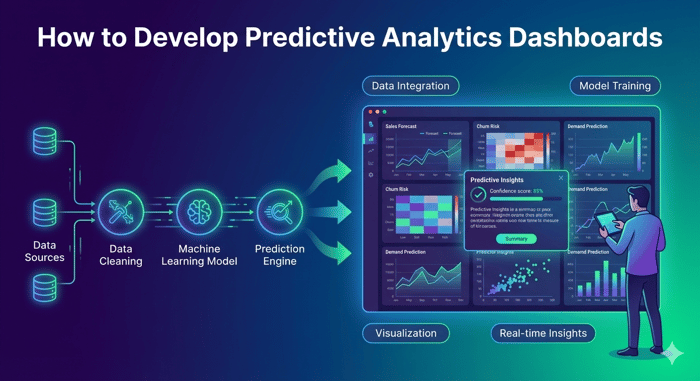
Being proactive and strategic is a mantra that many successful business schools preach. Responding to each unexpected success or failure is insufficient in today's cutthroat business climate. In its place, businesses should be proactive in looking forward, making the most of possibilities, and avoiding setbacks. Predictive analytics is becoming more accessible as data quantities expand and software becomes easier to use. This allows firms to take a proactive approach, which ultimately boosts their bottom line.
What Is Predictive Analytics?
The goal of predictive analytics, a subfield of data analytics, is to foretell future events. Big data systems, which allow for more data mining operations to get predicted insights from bigger, broader pools of data, and predictive and augmented analytics, a subfield of data science for businesses, are expanding at the same time. Predictive analytics have also been enhanced by developments in big data machine learning.
Along with big data systems, predictive and augmented analytics are on the rise. With bigger data pools comes more data mining, which in turn gives better predicted insights. Predictive analytics have also been enhanced by developments in big data machine learning.
Using Predictive Analytics: Real-World Examples
Predictive analytics has helped several companies in nearly every sector make better judgments. Here are a few notable instances:
- Sports teams: Improving player performance, analyzing game plans, and scouting possible additions are all areas where coaches utilize predictive analytics. To make strategic judgments and forecast player performance, they use a variety of metrics, including player health records and statistics from the past.
- Energy industry: Predictive analytics help energy demand forecasting, which in turn helps businesses like Chevron and Iberdrola adapt output and cut down on waste. With these forecasts, businesses may increase their bottom lines while also reducing their environmental impact and saving energy.
- Transportation and logistics: Logistics and transportation experts utilise predictive analytics to enhance fuel economy, plan delivery routes, and anticipate resource requirements. The logistics sector may greatly benefit from these forecasts in terms of operating cost reduction and efficiency enhancement.
- Food production: Weather patterns, agricultural yields, and insect infestations may all be better anticipated with the use of predictive analytics systems. More accurate planting, fertilisation, irrigation, and pest management decisions lead to higher yields with less waste when farmers have access to such forecasts.
- Education: Institutions of higher learning may monitor student progress, foretell their future success, and pinpoint problem areas with the use of predictive analytics. Schools may improve their learning environments by examining past data on student performance to find trends and patterns.
What Are Some Popular Methods Used In Predictive Analytics?
Both the kinds of models used to generate insights from predictive analytics and their potential uses are very diverse. A well-defined goal is the first step in deciding which predictive analytics methods would work best for your company. Select the most appropriate model when you have determined the question you wish to answer. There are four main categories of predictive analytics models:
1. Regression Models
The degree of association between variables can be approximated using regression models. The model keeps tabs on the relationships between actions (independent variables) and their results (dependent variables) and utilizes that data to make predictions about the future. Both basic models using a single independent variable and a single dependent variable, and more complex models including two or more independent variables, are possible in the realm of statistical modeling. There are many different kinds of variables and applications that dictate which regression approach is best used. Scenario analysis, sometimes called "what-if" analysis, allows businesses to define the connection between variables and then test the impact of additional independent variables by inserting them into the model.
A regression model could help businesses figure out which product attributes have the most impact on customers' propensity to buy. If a company were to do an analysis of the association between product color and purchase likelihood, it may find that blue shirts lead to greater sales. Due to the fact that correlation does not always imply causation, the company may investigate the impact of size, seasonality, or product positioning on purchase likelihood. With this information, they may better target their marketing or decide which goods will be successful down the road.
2. Classification Models
Classification models use prior knowledge to group data into predetermined categories. A training dataset containing pre-labeled data is the starting point for classification. In order to classify fresh data, the classification algorithm learns the relationships between labels and data. Text analytics, decision trees, and random forests are a few well-liked methods for categorization models. Many sectors make use of categorization models due to how readily they can be updated with fresh data. The employment of classification algorithms to detect fraudulent transactions is a common practice for banks. The program can go through millions of transactions to identify patterns that might indicate fraudulent activity and notify users when their account behavior is questionable.
3. Clustering Models
Data is clustered by clustering models according to shared characteristics. A data matrix is utilized by a clustering technique to link each item with pertinent attributes. In order to find hidden patterns in the data, the algorithm will use this matrix to group things with similar attributes. Clustering models allow businesses to classify consumers into groups, which in turn allows for more targeted advertising. Take this hypothetical restaurant as an example. They can divide their consumers into particular areas and send out brochures to those who reside within a specific driving distance of their newest location.
4. Time-Series Models
Data points are captured by time series models in relation to one another. The ability to represent data as a time series makes time a popular independent variable in predictive analytics. A standard model may examine a measure over the last 12 months of data and then make a prediction about that statistic for the next week. Without wasting time or effort, companies can foresee and explore different possibilities using analytics solutions. Time series analyses have many uses in organizations due to the fact that time is a frequent variable. You may use this model for trend analysis, which shows how assets have changed over time, or seasonality analysis, which shows how assets change at specific periods of the year. Predicting the number of customers that will visit a business, the likelihood that someone will catch the flu, or even revenues for the next quarter are all examples of practical uses.
5. Forecast Models
Predicting numerical values for incoming data using lessons learned from past data, the forecast model is one of the most popular models in predictive analytics. It deals with metrics. We may use this model anywhere we have access to numerical data from the past. For example, there are:
- The number of potential customers that a SaaS firm can convert in a week can be estimated.
- Every hour, a call center can predict the number of support calls it will get.
- During a certain sales time, a shoe retailer can determine the optimal inventory level to match customer demand.
A number of input parameters are also taken into account by the forecast model. For example, if a restaurant owner wants to know how many guests she is expecting next week, the model would consider things like: Is there a nearby event that could affect this? How does the weather look today? Is someone sick circulating?
6. Outlier Models
A dataset's outliers are the data points that stand out from the rest. Abnormal figures can be detected independently or in combination with other numerical and categorical data.
- Noticing an increase in customer service inquiries, which may point to a product defect requiring a recall.
- Detecting suspicious activity in financial transactions or insurance claims.
- Discovering suspicious activity in your NetOps logs and seeing warning indications of imminent unscheduled downtime.
When it comes to financial and retail forecasting, the outlier model shines. For instance, the model can consider more than just the amount when determining whether a transaction is fraudulent; it can also take into account the time, place, and kind of purchase (e.g., a $1,000 purchase of electronics is less likely to be fraudulent than a $1,000 purchase of books or common utilities).
Predictive Analytics and the Value of Well-Managed Data
The efficiency of predictive analytics is heavily dependent on two factors: first, knowing how to construct a model; and second, having high-quality data and properly managing it. Trustworthy, precise, and useful data is what you need to achieve your goals. Your prediction models' precision is highly dependent on the quality of the data you use. Using inaccurate or incomplete data to make predictions is a surefire way to get inaccurate results.
Cleaning and quality-controlling your data is, thus, an essential part of developing a predictive analytics model. Data validation involves checking the data for correctness and utility, whereas data cleaning involves the model finding and fixing mistakes and inconsistencies. Thankfully, you can automate this preparation process with the help of certain predictive analytics systems. Data management and handling, along with data quality, are two factors that might affect the efficacy of predictive analytics. Methods for gathering, storing, retrieving, and safeguarding data are all part of this.
For data to be accessible and used at all times while still being safe and secure, a solid data management plan is required. Your predictive analytics model and the insights it produces are, in essence, directly proportional to the quality of the data used to train it. When developing a predictive analytics model, it is critical to focus on data quality and management procedures.
Common Challenges When Creating An Analytics Dashboard
The value of an analytics dashboard depends on the insights it provides. You should stay away from such issues because they might hinder your dashboard build.
1. Lack of a Clear Target
A fancy collection of statistics is all an analytics dashboard is without a purpose to drive it. You won't get any actionable insights from your dashboard unless it's structured around a clear goal or query. For data-driven decision-making, the measurements' context is just as crucial as the measures themselves.
2. An Excess of Data
Datasets and metrics shouldn't be included on an analytics dashboard unless they contribute to the goals of the dashboard. If you offer any more facts, it can make the decision-making process more difficult. Teams overwhelmed by analytics may procrastinate rather than move forward because they can't decide what to do first. Keeping teams focused on mission-critical KPIs is a breeze with a well-designed dashboard.
The problem of teams concentrating on the incorrect things is another issue with a too-detailed dashboard. For example, if you want to improve your customer acquisition cost (CAC) through improved ad targeting, you could end up with fewer but better prospects, yet enhancing a key performance indicator (KPI) can entail losing less essential metrics. Teams may reduce their efforts even if they are producing the desired outcomes if they observe a decline in the "total visitors" statistic.
3. Poor or Inaccurate Information
Teams must have faith that the information they are examining will guide them correctly. Before making such weighty judgments, they require reliable information. The accuracy, context, and usefulness of insights derived from first-party data are often higher. Full and consistent data, with all fields (including metadata) filled out to the same standard, is another quality of a good dataset.
Consider the following scenario: you are interested in learning how to boost your online store's revenue. Your company's earnings, the price of the item(s) purchased, and the total amount paid do not constitute a useful dataset. Metadata such as the customer's demographics, purchase date, time, and device are examples of high-quality data. Customer history information would also include things like previous purchases, referral sources, page views, sequence of pages, and actions taken within the cart, such as last-minute item removal or response to in-cart offers or upsells.
4. Lack of Audience Awareness
Even the most useful stats will be useless if your consumers can't navigate the dashboard. The audience does most of the effort for effective dashboards. Take your time curating measurements, organize reports logically, and use visualizations that bring clarity to the data.
Conclusion
While developing a predictive analytics model is no easy feat, increasing the likelihood of your model's success is possible by familiarizing yourself with the process and selecting the most appropriate strategy. Your company goals, available resources, and level of technical skill should all be considered when deciding between hand-coding, data science tools, and low-code Predictive GenAI platforms.
The benefits of using predictive analytics in company choices outweigh the complexity of the process. Whether it's finding new market opportunities, improving consumer experiences, reducing operational costs, or being ahead of the competition, the options are limitless.
Beginning the process of developing your predictive analytics model is more important than the specific approach you use. It just takes one click to embark on a data-driven future, and that click might be the one that starts the ball rolling.
