How to Earn Microsoft Copilot Citations in 90 Days
The source dashboard showed 14.7K Microsoft Copilot citations and partner citations over six months. It also showed an average of 20 cited pages.
This guide explains the 10 jobs in the 90-day workflow. You will start with the questions buyers ask, publish pages that answer them, earn links and third-party mentions, then rerun the same questions to see what changed.
If you want one place to run the audit, content, backlink, outreach, and tracking jobs, Distribb can handle them. You can also use the steps below as a manual checklist.

1. Save 10 buyer questions
Start with the questions people ask close to a purchase.
Examples for an SEO product include:
- What is the best AI SEO tool for a small agency?
- Which SEO tool also helps me earn backlinks?
- What is the cheapest way to publish SEO articles every week?
- Distribb vs Surfer SEO: which one fits a small team?
Pull the wording from sales calls, support emails, Search Console, lost deals, pricing questions, and competitor pages.
Save the exact question, test date, engine, and country. Keep the first test as your baseline. Changing the question each time makes the result hard to compare.
Ten questions are enough to start. Add more after the first 10 point to useful work.
2. Connect your site and run an audit
Finish four setup jobs before publishing:
- Complete the Distribb onboarding.
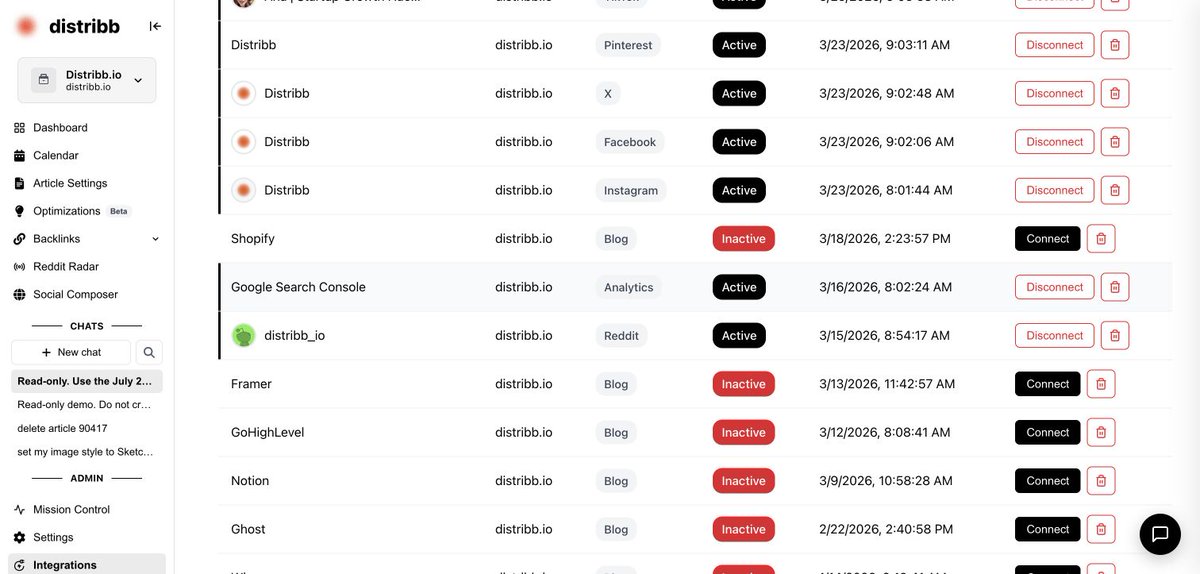
- Connect your website and Google Search Console.
- Make sure your site has a blog index where articles can live.
- Audit every page you already have.
The audit should flag pages targeting the same keyword, old pages losing traffic, pages ranking in positions 8 to 20, missing internal links, and topics your competitors cover.
Start with duplicate keywords, falling traffic, broken links, and pages already ranking in positions 8 to 20. A page at position 11 already has history and can often move sooner than a new URL.
3. Complete the 90-day work in three blocks
Days 1 to 30
- Fix title tags, descriptions, sitemap, robots.txt, canonical tags, and page speed.
- Pick 20 to 30 buyer keywords.
- Publish one use-case page.
- Publish one honest comparison page.
Days 31 to 60
- Publish two or three useful pages each week.
- Publish one main guide and five to seven supporting articles.
- Add internal links between the guide and every supporting article.
- Start earning backlinks and emailing listicle owners.
- Turn each article into social posts.
Days 61 to 90
- Update pages ranking in positions 8 to 20.
- Put direct answers and FAQ sections on key pages.
- Publish a statistics page or original study that writers can cite.
- Ask listicle owners to add your company.
- Rerun the same buyer questions and record which answers changed.
Distribb also has a free 90-day tracker with 31 dated tasks.

4. Give Copilot a direct answer it can quote
Copilot needs a sentence that still makes sense when it appears outside the full article.
For a “best X” question, name the products and say who each one fits. For an “X vs Y” question, compare both tools using the same rules. For a price question, show the current price and explain what can change it.
Put these items on the page:
- A direct answer near the top.
- A clear “best for” line for each option.
- One comparison table with the same columns for every option.
- Links to original sources.
- Prices and features you checked.
- One honest limit for each option.
- A real author and update date.
- Short sentences that still make sense when quoted alone.
A statistics page with fresh, well-sourced numbers can help too. Writers need checked numbers and need a source they can cite.
5. Build one topic from connected pages
Pick one topic. Publish one main guide, then publish five to seven pages that answer the next questions a buyer will ask.
Link every supporting page to the main guide. Link the main guide back to the best supporting pages.
This gives readers a path from the first question to the next one. Search engines can also see that the pages cover one connected topic.
Distribb can use keyword data to find those questions and add the relevant internal links while each article is written.
6. Add one or two useful partner links to each article
Backlinks give people and search engines a path to your pages.
Distribb's backlink exchange connects real businesses. Add one or two useful partner pages to an article. When Distribb detects those links, your project earns credits toward backlinks from other businesses.
Each partner link must help the reader. Keep it close to the topic and place it in a sentence where the destination adds useful detail.

7. Email listicles that already mention competitors
Open the sources Copilot uses for your 10 buyer questions. Look for:
- Best-tools lists.
- Competitor alternative pages.
- Independent comparisons.
- Review directories.
- Useful Reddit, Quora, and community answers.
Prioritize pages that name three or more competitors and leave your company out.
Send a specific reason to consider your product. For example:
Your article covers A, B, and C, but it does not include an option for teams that need [missing use case]. We made a sourced comparison with the facts, screenshots, and limits. I can send the short version for your next update.
Distribb's Link Outreach service finds these pages, emails the authors, sends follow-ups, and keeps each reply in one place.
Some sites will ask for money. Some will say no. You decide whether to accept, negotiate, or pass.

8. Turn each article into posts for other channels
After an article is published, Distribb can create drafts for X, LinkedIn, Reddit, Facebook, and Instagram.
The same article can also become:
- A short YouTube explainer.
- An eight-slide Instagram carousel.
- A useful Reddit or Quora answer.
- A news post when the topic changes.
- A statistics page reporters can cite.
Rewrite the answer for the way people read on each platform. Keep the full proof in the article, then let each shorter post send the right reader back to it.
9. Update pages ranking in positions 8 to 20
Use Google Search Console to find pages with many impressions and an average position between 8 and 20.
Check each page:
- Does the title use the same words as the buyer's question?
- Does the first paragraph answer that question?
- Are the facts, prices, and screenshots current?
- Does the page link to the right main guide?
- Does another page target the same keyword?
- Does the page include one table, example, or screenshot?
- Does it answer the next question a buyer will ask?
Distribb can find these pages, show the old and new versions, and publish an approved update back to the same URL.
Keep the existing URL when you update the page.

10. Rerun the same Copilot questions every month
Use the first test as your baseline. Rerun the exact same 10 questions every month and record:
- Was your company recommended?
- Was your site cited?
- Which exact URL was cited?
- Did a third-party listicle add you?
- Which competitors still appear?
- Which buyer question still has no useful page?
Use Bing's AI Performance report to watch Microsoft citations. Distribb can track cited, mentioned, and missing results across ChatGPT, Perplexity, Gemini, Google AI Overviews, and Google AI Mode.
Match the result to one next job:
- No page is cited: publish a page that answers the question directly.
- Your page ranks but is not cited: shorten the answer and add better sources.
- Your brand is cited but not recommended: add clear product-fit proof.
- A competitor wins through a listicle: email the listicle author.
Fix the job the result points to, then run the same question again.

Copy and paste this prompt
You are my AI citation helper.

Business: [what I sell]
Buyer: [who buys it]
Buyer question: [the exact question]
Competitors: [the main choices]
My pages: [URLs]
AI answer: [paste the answer]
Visible sources: [paste every source URL]

1. List the products the AI recommends.
2. List the source pages in a separate list.
3. Mark my brand as cited, mentioned, or missing.
4. Read each source I can open.
5. Show the question each source answers.
6. Name the exact missing page, link, or third-party mention.
7. Choose one action: update a page, write a comparison, publish a statistics page, earn a backlink, pitch a listicle, or distribute proof.
8. Give me a simple brief for that action.
9. Mark anything you cannot check as unverified.
10. Do not invent rankings, traffic, reviews, prices, citations, or product facts.
The workflow is simple:
Buyer question → Sources Copilot uses → Missing page, link, or mention → One new or updated page → Backlinks and listicle outreach → Run the same question again
Which of your 10 buyer questions would you test first?

14.7K citations is a substantial number.
Curious what you've seen downstream from that visibility — have you been able to connect increases in Copilot citations to qualified traffic, signups, or customers yet?