How to Find the Area of a Circle: A Simple Guide for Real-World Calculations
If you have ever worked on a DIY project, designed a product, built something, or simply needed to solve a geometry problem, you have probably needed to calculate the area of a circle.
The formula itself is simple:
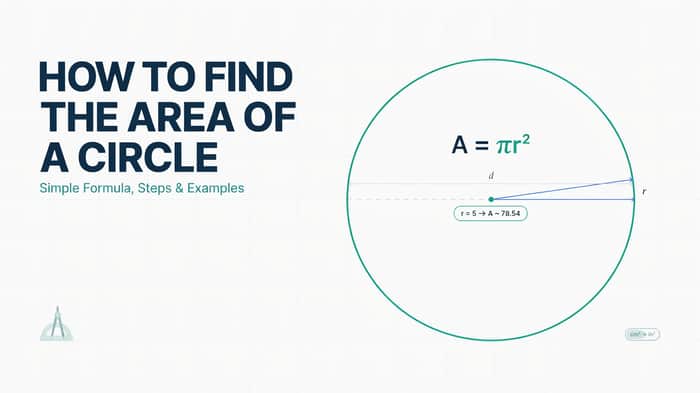
A = πr²
The challenge is usually knowing which measurement to use, keeping the units consistent, and converting the final result when necessary.
This guide explains the process without unnecessary mathematical complexity. It is useful for students, developers working with geometry-related applications, engineers, makers, contractors, and anyone who needs a quick and reliable way to calculate circular areas.
The Basic Circle Area Formula
The area of a circle is calculated using:
A = πr²
Where:
- A is the area
- π (pi) is approximately 3.14159
- r is the radius of the circle
- r² means the radius multiplied by itself
For example, if the radius is 4 meters:
A = π × 4²
A = π × 16
A ≈ 50.27 m²
The answer is expressed in square meters because the original measurement was in meters.
Radius vs. Diameter
One of the easiest ways to get the wrong answer is to confuse radius and diameter.
The radius is the distance from the center of the circle to its edge.
The diameter is the distance across the entire circle through its center.
Their relationship is:
Diameter = 2 × Radius
So:
Radius = Diameter ÷ 2
If a circle has a diameter of 12 cm, its radius is 6 cm. You would use 6 cm in the area formula, not 12 cm.
This matters because the radius is squared.
Why the Formula Uses r²
At first glance, the squared radius can seem like a mathematical rule you simply have to memorize.
There is a useful reason behind it.
Area measures a two-dimensional surface. When a length is multiplied by another length, the resulting unit becomes a square unit.
For example:
5 cm × 5 cm = 25 cm²
The same principle applies to the circle formula.
That's why a radius of 5 meters produces an area measured in square meters rather than meters.
Calculating Circle Area Step by Step
You can solve most circle-area problems using three steps.
Step 1: Identify the radius
Look at the information you have.
If the radius is provided, use it directly.
If only the diameter is provided, divide it by 2.
Step 2: Square the radius
Multiply the radius by itself.
For a radius of 7:
7² = 49
Step 3: Multiply by π
Multiply the squared radius by approximately 3.14159.
For radius 7:
49 × 3.14159 ≈ 153.94
Therefore, the area is approximately 153.94 square units.
Why This Matters Beyond School Mathematics
Circle area calculations show up in more places than many people realize.
Engineering
Engineers work with circular pipes, shafts, cylinders, gears, openings, and other components.
For example, calculating the cross-sectional area of a pipe can be important when analyzing dimensions or fluid-flow systems.
Construction
Construction projects may involve circular foundations, columns, pools, tanks, openings, and flooring.
Knowing the area helps estimate quantities and material requirements.
Manufacturing
Manufacturers frequently work with circular plates, discs, seals, components, and sheets of material.
Accurate area calculations can help with design and production planning.
DIY Projects
Even simple home projects can involve circle measurements.
You might need to calculate the surface area of a circular tabletop, garden, pond, or decorative piece.
Software and App Development
Developers building calculators, educational applications, CAD-related tools, games, or geometry software may need to implement the same mathematical relationship programmatically.
The underlying calculation remains:
area = π × radius × radius
What If Your Answer Needs a Different Unit?
This is where things can become slightly more complicated.
Suppose you calculate a circular surface as 10 m², but your project requires the answer in square feet.
The circle calculation itself is already complete. What you need next is an area unit conversion.
Instead of manually looking up conversion factors and calculating them repeatedly, you can use the UnitMorph Area Converter.
This can be useful when working with:
- Square meters
- Square feet
- Square inches
- Square centimeters
- Acres
- Hectares
- Other area measurements
The important point is to distinguish between calculating area and converting area. First determine the circle's area, then convert that result if required.
Common Errors
A few small mistakes can completely change the final result.
1. Using the diameter as the radius
If the diameter is 20 cm, the radius is 10 cm.
Using 20 directly in πr² would produce an incorrect result.
2. Forgetting to square the radius
The formula is:
πr²
not:
πr
The radius must be multiplied by itself.
3. Mixing measurement units
Don't calculate using a radius in centimeters and then label the result as square meters.
Convert your measurements first when necessary.
4. Forgetting square units
Area should be written using units such as:
cm², m², ft², or in²
5. Rounding too early
For better accuracy, keep more digits during the calculation and round only the final result.
A Quick Mental Checklist
Before accepting your answer, ask:
- Do I know the radius?
- If I only have the diameter, did I divide it by 2?
- Did I square the radius?
- Did I multiply by π?
- Is my final unit squared?
- Do I need to convert the result into another area unit?
This simple checklist catches most common errors.
A Useful Tool for Area Calculations
Understanding the formula is important, but manually converting between area units can become tedious when you're dealing with multiple measurements.
That's where UnitMorph can be useful.
Its Area Converter provides a straightforward way to convert area measurements between different units.
For a developer, maker, engineer, or anyone building something that involves measurements, having a quick conversion reference can be useful during testing and verification.
The calculator does not replace understanding the formula. It simply removes some repetitive arithmetic from the workflow.
The Key Idea
The entire process can be summarized in one line:
Area of circle = π × radius²
If you know the radius, square it and multiply by pi.
If you know the diameter, divide it by two first.
And if the resulting area needs to be expressed in a different unit, perform the area conversion afterward.
It is a small mathematical concept, but it has applications across engineering, construction, manufacturing, education, software, and everyday projects.
Once the difference between radius and diameter is clear, calculating the area of a circle becomes a straightforward process rather than something that requires a complicated formula sheet.
