How to get 100 stars on GitHub, the hard way
I'm really into developer-first products - one's that target developers as customers and are built with developers in mind.
I had an idea to aggregate all the products I already know and new ones I find along the way, and then create an awesome list so others can use it as a reference guide.
My goal was to reach more than 100 stars, by providing value and without any dirty tricks.
If you are interested in developer first products, check it out: developer-first awesome list.
Here is the process I did to get there, which has improved over time.
-
Create enough value from the start
You need to create a repo with value, be it a tool or a list. Just make sure that it will help people out, and that they can easily share it with friends by providing relevant sub-links inside the README (using #ids of headings). -
Share it with relevant friends
I got some stars from friends who liked the idea and gave me some suggestions. Use your network and don't do everything yourself. I also got some suggestions on wording and how to formalize the category list from a friend who has a knack for product marketing - something that I'm sure has helped others to understand the repo way faster. -
Use a marketing channel
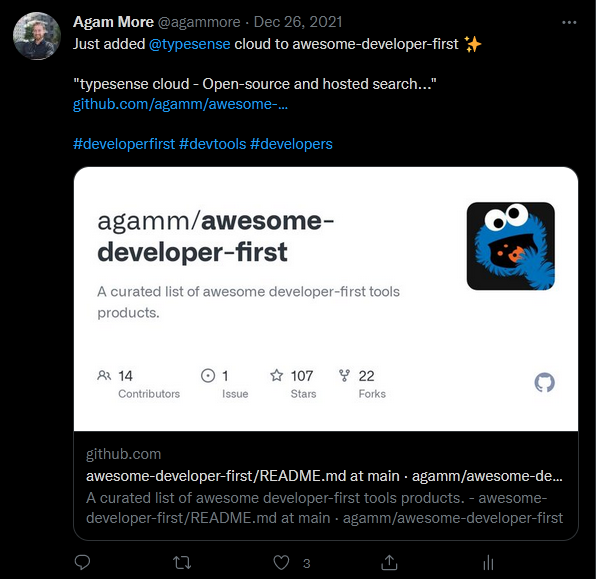
I chose Twitter, because it's really easy to mention or tag relevant products that I've added, and also since Twitter is home to a large developer population. Once I started doing that, I got a consistent amount of stars per tweet (typically 1-5 stars from each Twitter post):
- Use shared interests
Try to figure out if your repo actually helps people out. This way, sharing and starring it is also in other people's interest.
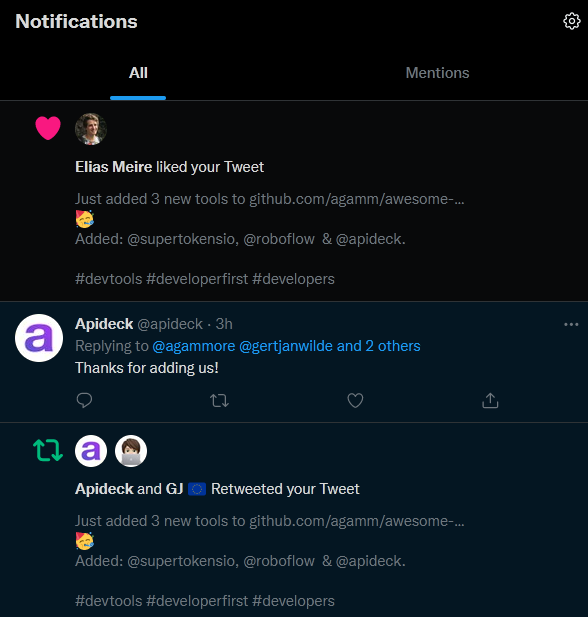
In my case, adding a product to the list is a win for the companies who build the products. Because they get free referral traffic, reaching out to them and “converting” them is an easy process, which results in a tweet or a star.
-
Leverage Github
I forked the awesome list repo and created a PR to add my repo there, which is a great way to showcase myself to a bigger repo’s audience.
Try to figure out if you can bring value to other repos or issues on other repos, which will help you get listed on those repos too - don’t forget this is great SEO-wise too. -
Be consistent
People look at the last time the repo was updated, so keep adding real value.
Continue to use your marketing channel, and growth will follow.
I know 100 stars isn't a lot, and all the work I outlined may seem like a hard process to follow, but for me, it was a real win. Starting with zero stars and growing it all by myself feels great!
I'll update y'all when I reach 1000 ;)
Comment or hit me up on Twitter for any question.

Thanks for writing about this! I’ve been trying to grow some of my repositories to that range for a little while now.
thanks for the tips!
Good luck with that endeavor! happy to help :)
I'd add posting helpful articles on developer-focused blogs and make sure the repository is in your profile page/signature. Posting on developer-focused subreddits also work well, just make sure to be sincere and don't marketise too much :). Our repo now has about 1.9K stars but it took a lot of time to grow to the first 500 stars. Once from there, the growth becomes organic.
Wow, that's awesome! great ideas, what is your repo?
The repo is https://github.com/simple-login/app
You got my star! It looks super professional and I liked the idea.
Why would somebody care about github stars, other than bragging rights? It seems just a meaningless vanity metric, like user signups, or page views.
You're correct, for the most part it is.
But, I do think it affects the GitHub internal SEO and maybe even google (not sure about it). In my case, it was an indicator of value for other people - so more of a personal thing, seeing if it is helpful.
Interesting experiment. I see what you mean. I've never thought about Github as a YouTube-esque or Facebook-esque system where posts with lots of feedback are ranked higher by Google's algorithm. But it seems possible. What else have you learned so far from it?
I'm thinking about writing an article about GItHub as a marketing channel, hopefully not ruining the good aspects there. For me, it was an eye-opener to see that there is constant traffic. Also, that the moment it is looked at like a landing page you have many new ways to look at engagement (forking? watching...)