How to get cited by AI: 7 steps from 496 checked listicles
If an AI answer already quotes a listicle in your category, that page is a practical outreach target.
Borja checked 496 listicle pages cited by Google AI Mode across 120 buying searches in 12 categories. The useful group was 222 pages on smaller sites that had been updated in the previous year and showed a contact route.
This article explains how to get cited by AI by finding those pages, sending the writer a useful fix, and checking the list again after 90 days.
Try Distribb free and use Link Outreach to contact listicle writers
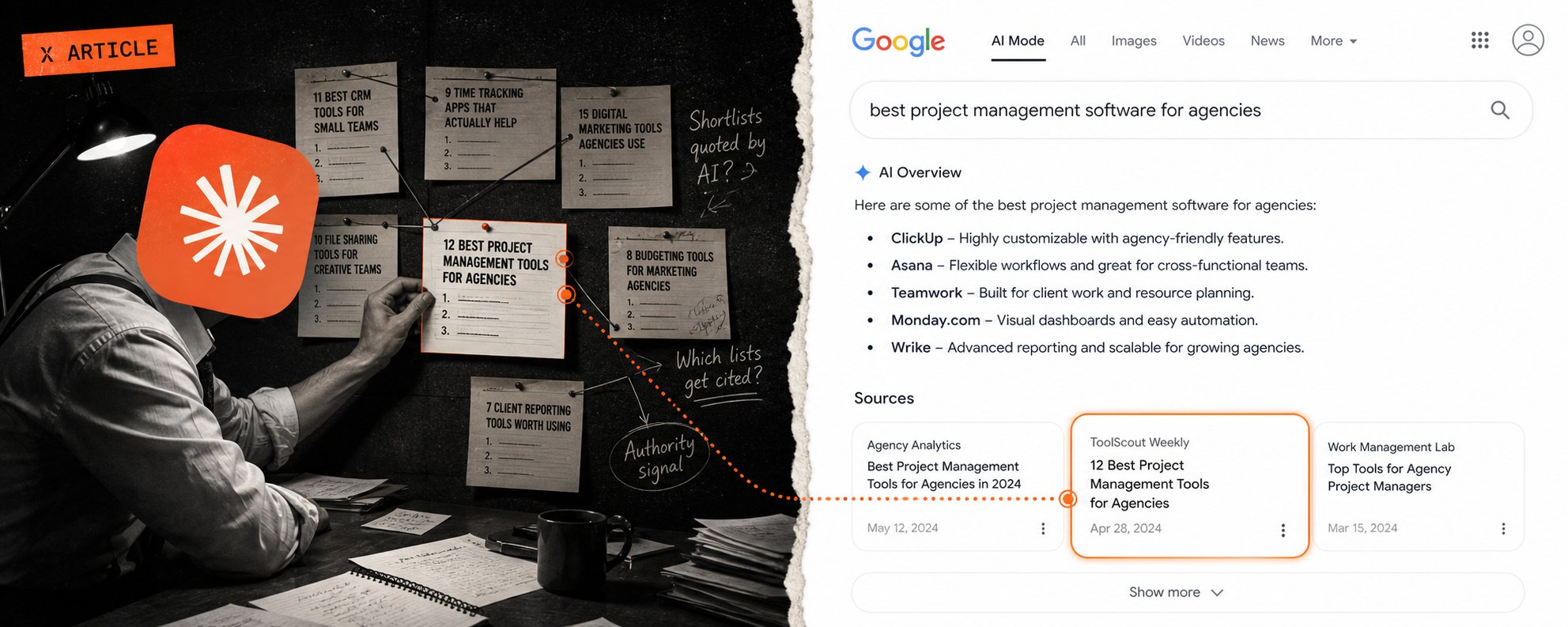
What the 120-search study found
The study covered 120 US buying searches in 12 categories. Google AI Mode cited 538 listicle pages across 392 sites, and Borja checked 496 of those pages.
Of the 430 pages with a usable date, 210 had been updated during the previous 75 days and 383 during the previous year. Those numbers describe one August 2026 snapshot, so each list may update on a different schedule.

The checked pages also had several practical outreach signals:
- 297 of 496 pages were on sites with fewer than 5,000 referring domains.
- 190 were on sites with fewer than 1,000 referring domains.
- 462 had a visible contact route.
- 415 named a writer.
- The middle detected list had 10 slots.
A referring domain is a website that links to the site you are checking. The number is a rough way to separate a smaller publisher from a large magazine.
The first outreach queue contains the 222 pages that met all three conditions: fewer than 5,000 referring domains, an update within the previous year, and a visible contact route.

How to get cited by AI with listicle outreach
The workflow has seven steps. Each step narrows the list or gives the writer a concrete reason to reply.
Step 1: Save the list pages that AI quotes
Ask Google AI Mode a buying question such as "best CRM software for small agencies." Open the sources in the answer and save every cited page that is a list.
Record the buying question, cited page, site, and citation position in a sheet. Repeat this for 10 buying questions that a real customer could ask.

Run the same questions in ChatGPT. Save the cited page URL as well as the product names shown in the answer.

Plan roughly 20 minutes for the first set of questions.
Step 2: Put smaller reachable sites first
Check the referring-domain count for each site in your SEO tool. Keep sites under 5,000 referring domains near the top, then move large magazines to the bottom.
The study found 297 checked pages below that line. Four examples in the source study had 82, 141, 366, and 929 referring domains. All four had a contact route when Borja checked them.

Plan another 20 minutes for this pass.
Step 3: Find one broken or outdated item
Open every item on the list until you find one clear problem. A dead link, a closed company, or an old price gives the writer a useful correction.
Save the item number, the exact sentence that needs changing, and the destination page that proves the problem.

This check takes about 15 minutes per list.
Step 4: Find the writer and a public contact route
Start with the byline. Open the author page, the contact page, the about page, and the site footer. Use a public email from the site when one is available. Save the writer's public LinkedIn profile when the site does not publish an email.
The study found a named writer on 415 of the 496 checked pages.

Claude can collect the writer, author page, contact page, and any public email shown on the site. Check every result against the live page before using it.

Plan about five minutes per list after you have the URLs.
Step 5: Send the correction and a finished entry
Keep the email short. Name the exact broken item, explain the problem, and include a replacement entry written in the list's current format. Say that you run the company you want included.
The screenshot below uses made-up company names to show the format. The email leads with the dead item, then gives the writer a line that is ready to paste.

When the list has no broken item, find one specific capability missing from every entry. Explain the gap and provide one finished entry. Check the feature, price, link, and every other fact before sending.

Plan about 10 minutes for each checked email.
Step 6: Send one LinkedIn follow-up
Some writers will miss the email. A short LinkedIn note gives them another place to see the correction.
Mention the list and the exact problem. Read every line before sending it. The source workflow keeps final approval with the sender.

Plan about five minutes per person.
Step 7: Check the page again after 90 days
Keep a sheet with the page URL, writer, first email date, last check, 90-day check date, current status, and next useful fix.
The study found that 210 of the 430 dated pages had been updated during the previous 75 days. The update rate supports another check after 90 days, though each writer makes a separate decision.

If the page changed and your company is still missing, find the next useful correction. A monthly 15-minute review is enough to keep the sheet current.
Decide your reply policy before outreach
The study checked whether a contact route existed. It did not track what writers charged.
A writer may quote a flat price, ask for a reciprocal link, or add a useful entry without payment. Set your limit before the first email so a reply does not set the budget for you.
Frequently asked questions
How do I find the listicles that AI already cites?
Ask 10 buying questions in Google AI Mode and ChatGPT, then save every cited source that is a list. Record the exact question, page URL, site, and citation position so you can return to the same source later.
Which AI-cited listicles should I contact first?
Start with smaller sites that were updated during the previous year and show a public contact route. In this study, 222 pages met all three conditions, including fewer than 5,000 referring domains.
Do I need a broken link before I pitch my product?
No. When the list has no broken item, identify one specific missing capability and supply a finished entry in the writer's format.
What should I put in the outreach email?
Name the exact problem, show the page that proves it, and include a ready-to-paste replacement entry. Disclose that you run the company you want added, then check the feature, price, and link before sending.
How long should I wait before checking the listicle again?
Add a 90-day check date to the outreach sheet. The study found 210 updates among 430 dated pages during the previous 75 days, which supports another check without promising a fixed update schedule.
Does getting added to one list guarantee an AI citation?
No. The study shows which list pages AI cited and which writers appeared reachable. A visible contact route does not mean the writer will add your company, and an addition does not guarantee that an AI answer will cite it later.
Which AI-cited list in your category has a dead or outdated item you could report this week?
Try Distribb free and let Link Outreach contact the listicle writers for you
